


Filter by
Lubricant Type
Trade Name
For Use On
DFARS Specialty Metals
Export Control Classification Number (ECCN)

RoHS
Dry-Film Lubricants
 |
Aerosol Can |
These lubricants go on wet for easy application. Once dry, they form a nonstick film that won't attract dust. Use them for general purpose lubricating in most applications.
Boron Nitride Additive—Lubricants with boron nitride resist corrosion from salt water and won’t wash off.
Ceramic Additive—Lubricants with ceramic are often used in extreme-temperature applications, such as welding, metal processing, and glassmaking.
Moisture-Resistant Grease
 |
 |
Aerosol Can |
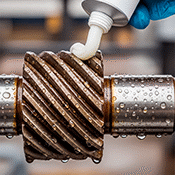
Keep metal parts lubricated in damp environments. Often used in paper manufacturing or water management facilities, this grease stays put even when it gets wet.
Thickener—Added for a more solid consistency, thickener also increases the heat and moisture resistance of grease. Choose grease with a thickener that’s best for your application. Lithium is a general purpose thickener. Calcium sulfonate and aluminum resist oxidation, which keeps the grease from hardening when it’s exposed to air for long periods. Calcium sulfonate resists higher heat than aluminum. Silica withstands the widest range of temperatures.
NLGI Consistency Grade—The higher the grade, the thicker the grease. Lower grades are best for cold temperatures and lubrication systems where grease needs to flow. Grade 0 is about the consistency of mustard. Grade 1 feels similar to tomato paste. Grade 2 is about as thick as peanut butter.
Base Oil—The foundation of a grease. Mineral oil is more economical, but synthetic oil lasts longer and performs better at extreme temperatures.
Additive—Boost the performance of the grease. Boron nitride creates a dry film that won’t wash out, even in salt water. Molybdenum disulfide holds up to extreme pressure and heavy wear. PTFE reduces friction to help parts slide easily. Zinc alloy neutralizes acid. It’s a safe replacement for lead.
Melting Temperature—When grease melts, it runs out of equipment and leaves it dry. Once melted, it won’t regain its original consistency. Choose a grease with a melting temperature that’s higher than your maximum operating temperature.
Penetrating Lubricants
DuPont
 |  |
Aerosol Can |
DuPont® Silicone Lubricant—DuPont® Silicone Lubricant repels moisture and is nonstaining.
Silicone Rubber Additive—Lubricants with silicone rubber are clear, have excellent moisture resistance, and can be used on most rubber and plastic.
Boron Nitride Additive—Lubricants with boron nitride last long and cure to a semi-dry film that resists corrosion from salt water and won’t wash off.
Penetrating Lubricants for Chain
|
For use with roller chain and other moving metal parts, these thin lubricants cut through dirt, grease, and rust, withstand heavy loads, and resist wear.
Molybdenum Disulfide Additive— Lubricants with molybdenum disulfide withstand high loads and have excellent wear resistance.
Boron Nitride Additive—Lubricants with boron nitride penetrate into roller chain links and pins while wet—below 120° F it acts as a dry lubricant that won’t attract dust or dirt; above 120° F it acts as a wet lubricant.
