We will reply to your message within an hour.
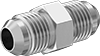
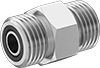
Use these fittings in extreme-pressure conditions up to 15,000 psi.
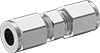
These fittings are made to tighter tolerances than other stainless steel pipe fittings. They are also known as instrumentation fittings.
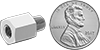
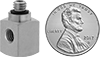
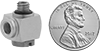
When space is at a premium choose these compact fittings.
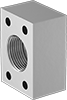
Also known as Code 61 SAE hydraulic flanges.
Also known as Code 61 SAE hydraulic flanges, these let you create an access point in a high-pressure hydraulic line.
These fittings are strong enough to handle extreme pressures, yet small enough to fit into cramped spaces.
The strongest steel fittings we offer, these can withstand extreme-pressure applications.
Their small size makes these miniature fittings a good choice for cramped, confined spaces.
When space in your pipe line is limited, choose these miniature fittings that are one inch or less in length.
Less than an inch in length, these miniature fittings work well in low-pressure pipe lines that are tight on space.
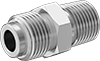
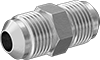
Also known as JIC (Joint Industrial Council) fittings, these provide a tight metal-to-metal seal on stainless steel tubing that is flared to 37°.
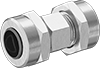
Individually bagged to prevent contamination, these fittings are suitable for applications that require a high level of cleanliness.
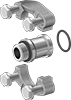
The flat face of the fitting connects to a tube adapter so you can slide the tubing and fitting sideways to disconnect in cramped spaces. They are also known zero-clearance fittings.
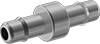
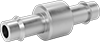
A single sleeve (ferrule) bites into tubing as you tighten the nut, creating a strong seal. The nut and sleeve are included.
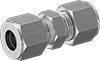
Use these fittings at pressures up to 9,700 psi. Also known as instrumentation fittings, they are made to tight tolerances for use in high-precision applications. They are compatible with Swagelok®, Let-Lok, and Parker A-Lok fittings.
Polished to at least a 15 Ra finish on the inside, these fittings have an ultra-smooth interior surface that helps prevent contamination. They are also known as ultra-high-purity fittings.
Also known as JIC (Joint Industrial Council) fittings, these provide a tight metal-to-metal seal on steel tubing that is flared to 37°.
Also known as JIS (Japanese Industrial Standard) fittings.
A tube adapter sits flush against the flat face of the fitting so you can slide the steel tubing and fitting sideways to disconnect in cramped spaces. Also known as zero-clearance fittings.
A single sleeve (ferrule) bites into tubing as you tighten the nut, creating a strong seal.
No sleeve is required to assemble these fittings, which makes for a faster, more convenient installation compared to 37° flared fittings. They are also known as refrigeration and SAE fittings.
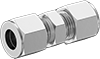
A nut with two sleeves (ferrules) gives these fittings extra gripping power. The sleeves bite into tubing as you tighten the nut, creating a strong seal.
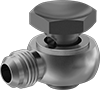
The external hex bolt on these fittings allows for easy installation in cramped spaces. They are also known as banjo-style fittings and JIC (Joint Industrial Council) fittings. They provide a tight seal on tubing that is flared to 37°.
Ball bearings allow these fittings to rotate 360°, even after they are tightened. They have a special seal that reduces friction to allow for continuous rotation.
Made of brass, these fittings have good corrosion resistance.
A 316 stainless steel body gives these fittings the best corrosion resistance of all our metal push-to-connect tube fittings.
Made of nickel-plated brass, these fittings have better corrosion resistance than unplated brass fittings.
These fittings won’t absorb moisture, so they’re good for water and high-humidity air applications.
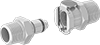
With no latch, these couplings have a compact design to fit in small spaces. They can handle pressures up to 700 psi.
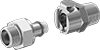
Use these luer lock couplings to quickly connect low-pressure air and water lines. Made of stainless steel, they’re more durable than plastic couplings.
Quickly connect low-pressure air lines with these luer lock couplings. Made of brass, they are stronger and more durable than plastic tube couplings.
Not only are these chrome-plated brass couplings corrosion resistant, they’re also durable enough to handle pressures up to 250 psi and can be used with vacuum.
Lighter in weight than their metal counterparts, these quick-disconnect couplings are made of acetal plastic. They are moisture resistant, so they won’t absorb water and lose strength, even in high-humidity environments.
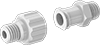
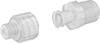
Made of plastic, these couplings are lighter in weight than metal luer lock couplings. They're a popular choice in labs because of their versatility—they fit any other luer lock plug, socket, syringe, or needle.
Monitor flow with these clear fittings.
These fittings include a nut with a built-in sleeve (ferrule), so there’s no need to remove the nut for assembly.
Color-code fittings for easy identification. These aluminum fittings have good corrosion resistance, but are lighter in weight than brass.
The nickel plating on these fittings provides better corrosion resistance than unplated brass fittings.
Made of stainless steel, these fittings have better corrosion resistance than brass fittings.
Aluminum fittings have good corrosion resistance, but are lighter in weight than brass.
Barbs grip onto tubing.
Made of brass, these fittings resist corrosion from water and are more durable than plastic and aluminum fittings.
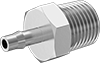
Fittings have a barb that grips onto tubing. Use in applications up to 120 psi.
A staple in labs, these couplings are highly versatile, fitting any luer lock plug, socket, syringe, or needle. They’re PVDF, so they resist most acids, alcohols, and organic solvents.
Fittings are 316 stainless steel, which has excellent chemical resistance and is more durable than plastic.
Also known as instant fittings, these chemical-resistant plastic fittings connect to tubing with a push. An internal gripping ring holds the tubing tight.
Made of FDA listed materials, these fittings have a single barb that creates a smooth clamping surface for extra-tight connections.
Fittings are threaded on both ends so you can connect them directly to a threaded hose or to pumps, cylinders, and other equipment in your hydraulic system.
Made of stainless steel, these hose fittings are more durable than plastic barbed hose fittings and have excellent corrosion and chemical resistance. Slide the barbed end into hose and secure with a clamp.
Also known as live swivels, these fittings swivel continuously 360° before and after installation. This not only makes installation easier, but also eliminates the twisting and kinking that can cause hose failure. Fittings are threaded on both ends so you can connect them directly to a threaded hose or to pumps, cylinders, and other equipment in your hydraulic system.
Crimp these fittings onto hydraulic hose for a permanent, leak-tight connection. Since they crimp on, they handle higher pressure than screw-on fittings.
With just a vise and a wrench, make or repair hose assemblies in the field.
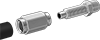
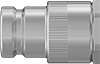
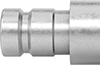
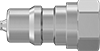
Use these couplings at pressures up to 10,000 psi. Also known as flush-face couplings, the plugs and sockets have a flat face, which allows them to mate close together, reducing fluid loss when connecting and disconnecting the line. They are compatible with High-Pressure Minimal-Spill-shape plugs and sockets.
Add quick connection points for mechanical gauges and other diagnostic equipment to your line. These couplings are also known as test ports and diagnostic couplings.
Use these couplings at pressures up to 5,000 psi. They consist of a plug and socket that connect and disconnect quickly. Use them if you need frequent access to a line. They are compatible with International Standard ISO B-shape plugs and sockets.
Use these couplings at pressures up to 7,200 psi. Also known as flush-face couplings, the plugs and sockets have a flat face, which allows them to mate close together, reducing fluid loss when connecting and disconnecting the line. They are compatible with International Standard ISO Minimal-Spill-shape plugs and sockets.
Reduce the risk of spills near electronics when connecting and disconnecting liquid cooling lines. Also known as double shut-off couplings, these couplings have a shut-off valve on both sides that stops the flow of coolant if they’re separated.
Metal hose fittings have better durability than plastic barbed hose fittings.
Made of polypropylene, these fittings are lighter in weight than metal barbed hose fittings.