We will reply to your message within an hour.
These brass fittings have the strength to handle high-pressure applications.
The plating on these brass fittings creates a shiny finish and provides extra protection in corrosive environments. Fittings have the strength to handle high-pressure applications.
When space in your pipe line is limited, choose these miniature fittings that are one inch or less in length.
Use these corrosion-resistant fittings in a low-pressure pipe line.
These fittings are strong enough to handle extreme pressures, yet small enough to fit into cramped spaces.
Use these fittings for low-pressure applications in noncorrosive environments.
These fittings can stand up to high-pressure applications. Use them in noncorrosive environments.
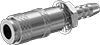
A built-in shut-off valve stops airflow when the fittings are disconnected from tubing.
Made of brass, these fittings have good corrosion resistance.
A 316 stainless steel body gives these fittings the best corrosion resistance of all our metal push-to-connect tube fittings.
Made of nickel-plated brass, these fittings have better corrosion resistance than unplated brass fittings.
These fittings won’t absorb moisture, so they’re good for water and high-humidity air applications.
Designed for use in welding applications, these fittings are flame retardant.
Connect high-pressure brake lines with fittings that won’t crack in frigid temperatures. Often used on commercial trucks and trailers, these fittings meet Department of Transportation FMVSS 571 safety standards.
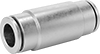
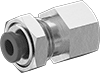
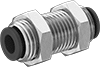
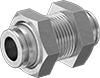
An all-metal body and built-in tube support or dual seals allow these fittings to handle the highest pressure ratings of all our push-to-connect tube fittings.
Withstanding up to 300° F, these fittings have the highest temperature rating of all our brass push-to-connect tube fittings for air and water.
Aluminum fittings have good corrosion resistance, but are lighter in weight than brass.
Made of brass, these fittings resist corrosion from water and are more durable than plastic and aluminum fittings.
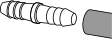
Minimize leaks in your line—these fittings have a single barb that creates a smooth clamping surface for extra-tight connections.
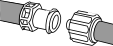
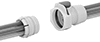
You don't need a clamp to secure these fittings to tubing. They have a nut on the barbed end that tightens to hold the tubing in place.
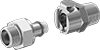
Lighter in weight than their metal counterparts, these quick-disconnect couplings are made of acetal plastic. They are moisture resistant, so they won’t absorb water and lose strength, even in high-humidity environments.
Made of brass, these couplings are more durable than plastic couplings.
Not only are these chrome-plated brass couplings corrosion resistant, they’re also durable enough to handle pressures up to 250 psi and can be used with vacuum.
Don’t get your lines crossed—use one of these couplings to quickly connect or disconnect multiple tubes at once.
With no latch, these couplings have a compact design to fit in small spaces. They can handle pressures up to 700 psi.
Prevent mixing the wrong high-pressure lines—these couplings are designed to only connect with a plug or socket of the same color.
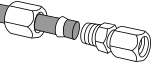
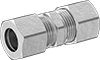
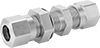
A single sleeve (ferrule) compresses the tubing as you tighten the nut on these fittings, creating a strong seal. They are brass for good corrosion resistance.
Safe for use in your air brake line, these fittings meet Department of Transportation FMVSS 571 standards. They’ve been tested for thermal cycling, vibration, and burst pressure, so put them to work right away.
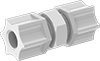
Lighter in weight than their metal counterparts, these compression fittings are polypropylene.
Made of plastic, these couplings are lighter in weight than metal luer lock couplings. They're a popular choice in labs because of their versatility—they fit any other luer lock plug, socket, syringe, or needle.
A built-in shut-off valve stops the flow when you separate these couplings, so air or water won’t leak from your line. Made of nylon, these couplings are lightweight and have good impact and abrasion resistance.
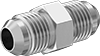
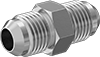
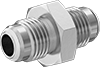
Also known as JIC (Joint Industrial Council) fittings, these provide a tight metal-to-metal seal on stainless steel tubing that is flared to 37°.
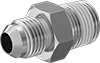
The male pipe threads on these fittings have a sealant applied for extra protection against leaks.
The threads on the tube end of these fittings are Class 3A or 3B and adhere to tighter tolerances than other 37° flared fittings.
A PTFE seal on the tube end of these fittings allows for an extra-strong connection in high-vibration applications.
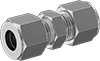
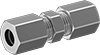
Use these fittings at pressures up to 9,700 psi. Also known as instrumentation fittings, they are made to tight tolerances for use in high-precision applications. They are compatible with Swagelok®, Let-Lok, and Parker A-Lok fittings.
For applications that require an extra level of cleanliness, these fittings are individually bagged to prevent contamination.
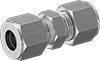
A single sleeve (ferrule) bites into tubing as you tighten the nut, creating a strong seal. The nut and sleeve are included.
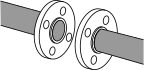
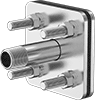
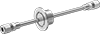
Transfer liquids and gases into high-vacuum chambers with these assembled fittings, also known as feedthroughs. Their quick-clamp (ISO-KF) connections are easier to install and remove than bolt-on flanges.
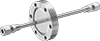
Bolt these fittings onto your ultra-high-vacuum chamber to transfer liquids and gases inside. Also known as feedthroughs, they come assembled with a flanged (CF) fitting, metal tubing, and two Yor-Lok tube fittings.
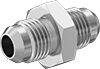
Also known as JIC (Joint Industrial Council) fittings, these provide a tight metal-to-metal seal on steel tubing that is flared to 37°.
These fittings have two sleeves for extra gripping power. They bite into steel tubing as you tighten the nut to form a strong seal.
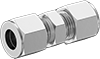
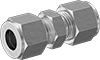
A single sleeve (ferrule) bites into tubing as you tighten the nut, creating a strong seal.
A nut with two sleeves (ferrules) gives these fittings extra gripping power. The sleeves bite into tubing as you tighten the nut, creating a strong seal.
Also known as instrumentation fittings, these are made to tighter tolerances than standard compression fittings. They are compatible with Parker CPI fittings.