We will reply to your message within an hour.
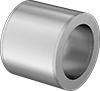
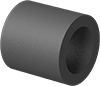
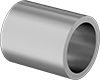
Also known as Oilite® bearings.
Increased iron content makes these bearings stronger and more resistant to shock loads than standard oil-embedded bearings; however they operate at lower speeds.
For applications with frequent starts and stops, the oil in these bearings contains particles of slippery PTFE that lubricate the bearing during startup.
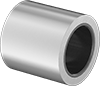
With a flexible layer of rubber sandwiched between an oil-embedded bronze bearing and rigid metal shell, these bearings reduce wear and machinery noise.
Use where high loads and speeds are not required.
A metal shell adds strength.
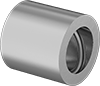
Graphite provides a layer of dry lubrication that can operate in high-temperature environments.
Made of FDA-listed materials or FDA compliant, these bearings are for use in food applications. They also withstand caustic and washdown environments.
Use these bearings in applications with frequent starts and stops because they operate with very little friction.
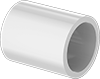
These bearings stand up to a wider range of chemicals than other dry-running sleeve bearings.
Reinforced with polyester fabric, these plastic bearings have load and speed capabilities comparable to metal bearings.
Good for underwater applications, these bearings won’t swell or warp when wet.
These bronze bearings are strong, wear resistant, and excellent at handling shock loads.
A figure-8-shaped groove provides a flow path for lubricant, distributing it evenly along the bearing’s surface.
Grooves on the inside of the bearing provide a flow path for lubricant, distributing it evenly along the bearing’s surface.
The oil in these bearings is suitable for incidental contact with food.
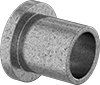
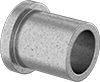
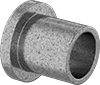
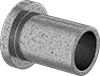
Support heavy loads that are often found in bottling and filling lines in food plants—these bearings contain extra iron and FDA-compliant oil. They’re flanged, so they handle loads both parallel and perpendicular to the shaft.
These bearings come with a traceable lot number and material test report. They are also known as Oilite® bearings.
A slit running along the length of these bearings allows you to quickly slip them into a housing—no tools required.
Made of FDA listed materials for use in food applications, these bearings also withstand caustic and washdown environments.
An aluminum shell adds strength.
Graphite provides a layer of dry lubrication that operates in high-temperature environments.
The addition of iron and aluminum gives these aluminum-bronze bearings high strength and excellent corrosion resistance—making them suitable for use in marine and mining applications.
Furnished with a traceable lot number and material test report, these bronze bearings are strong, wear resistant, and excellent at handling shock loads.
Handle heavy loads that frequently start and stop along shafts—these bearings contain extra iron and slippery PTFE lubricant. They’re thrust bearings, which means they support loads parallel to the shaft.
Made of 863 iron-copper and embedded with NSF registered H1 oil, these bearings can tackle high-load applications in food plants, such as bottling and filling lines.
A metal backing adds strength.
Use these UHMW bearings in wet, corrosive environments.
Capable of handling temperatures from -400° to 750° F, these graphalloy bearings withstand the widest temperature range of any of our mounted bearings.
Startup friction causes these porous bronze bearings to release a thin layer of oil on the bearing’s surface.
With a flexible layer of neoprene sandwiched between an oil-embedded bronze bearing and rigid steel shell, these bearings reduce wear and machinery noise.
A strong steel housing allows these bearings to handle higher speeds than standard oil-embedded mounted sleeve bearings.
A reliable classic—these babbitt bearings are strong and corrosion resistant.
Capable of handling temperatures from -400° to 750° F, these graphalloy bearings have the widest temperature range of any of our mounted bearings.
With no moving parts, sleeve bearings are better for dirty environments than ball and roller bearings.
The screw connections on these bushings easily mate to compatible quick-disconnect sprockets and pulleys.
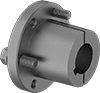
Mount these hubless bushings flush into your sprocket or pulley for a slim profile with no protruding screws.

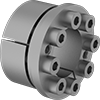
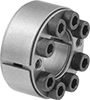
The tapered barrel on these bushings is split on both sides, allowing them to contract more tightly around the shaft than quick-disconnect and taper-lock bushings.
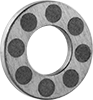
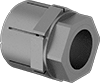
Also known as Trantorque bushings, these tighten with a twist of the collar nut—no screws needed.
A mounting flange prevents movement during tightening, so it's easy to center these bushings in your sprocket.
Insert these bushings into the bore of your sprocket for flush or recessed mounting.
A toothed slot lets these bushings contract for insertion into the bore of your sprocket or pulley and then expand for a snug fit.
Be prepared with shims in a variety of thicknesses. Also known as arbor spacers, these shims are notched to fit over keyed shafts.
Precisely shaped to fit snugly on keyed shafts, these shims align, level, and space components. Because of their tight fit, they also help components rotate in unison with the shaft.
These shims are shaped to fit over D-profile shafts. Use them to precisely align, level, and adjust spacing.
Be prepared with shims in a variety of thicknesses. These shims are shaped to fit over D-profile shafts. Use them to precisely align, level, and adjust spacing.
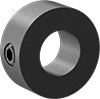
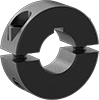
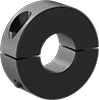
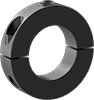
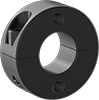
Keep these shaft collars in place by tightening their set screw into the shaft.
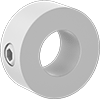
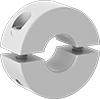
Made of chemical-resistant nylon, these collars are suitable for washdown applications.
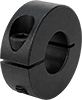
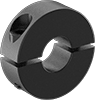
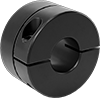
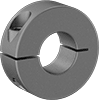
These metal collars are stronger than plastic shaft collars.
Suitable for use in washdown applications, these plastic collars also offer good chemical resistance.
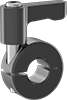
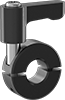
Installing and removing a collar is as easy as pushing down and lifting up a clamp lever.
Internal ball bearings allow you to slide a collar onto your shaft in one direction and then automatically lock the collar in place in the opposite direction.
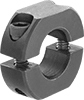
With larger clamping screws than those found on standard clamping collars, these provide a stronger grip on your shaft without using additional screws.
Wider than standard shaft collars with twice the number of clamping screws, these ensure a better grip for greater holding power.
Two knurled sides provide micrometer-like movement for precise width adjustments.
A threaded lever lets you tighten these collars with more torque than other quick-release styles, ensuring that they stay put on your shaft.
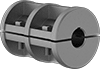
One side of these collars locks down like a standard one-piece shaft collar; the other has a flush face that's flat to 0.0005", which lets you mount the collars on a shaft next to precision bearings, sprockets, and gears.
An embedded sleeve squeezes the shaft as you tighten the clamping screws, allowing these collars to handle up to three times the thrust load of standard collars.
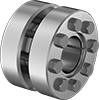
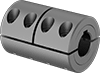
With larger screws than those found on standard clamping collars, these provide a stronger grip on your shaft without using additional screws.
Use a wrench to rotate your drive shaft without marring or gouging the shaft.
Make quick adjustments to these shaft collars with a lever on the side.
Although these collars fit inch-sized shafts, they have a metric OD and width for use with metric equipment.
Tighten the set screw to bite into an unhardened shaft for a secure hold.
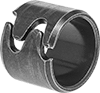
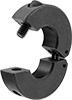
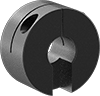
Offering the benefits of a two-piece collar in a one-piece design, these collars swing open for positioning then close anywhere on your shaft.
Three tapped counterbored holes and three through-holes provide mounting flexibility.
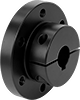
Two tapped holes on the face of these collars allow you to fasten them to gears, pulleys, and sprockets.
These collars have two different sides—one locks down like a standard clamping shaft collar; the other has a flush face that you can machine to add slots, holes, and grooves to match your special setups.
Install these collars anywhere on a shaft without removing components or having access to the ends of the shaft.
To install, slide these one-piece collars onto the end of your shaft.
Secure items to either side of these collars—each half has a flat end with a tapped hole
Slide these one-piece collars onto the end of your shaft to create an end-stop for linear components.
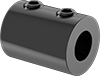
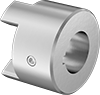
Set screws bite into your shaft to hold these couplings in place.
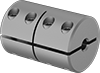
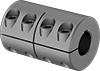
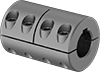
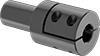
When one of your shafts is undersized from wear, oversized from coatings, or uncommonly sized, machine one end of these couplings to fit. They clamp around your shafts for a secure hold that won’t cause damage.
Designed to grip evenly around your shaft, clamping couplings provide more holding power than set screw couplings without marring the shaft.
These couplings have the gripping strength to handle higher torque than most other couplings.
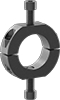
Install and remove these shaft couplings without disconnecting the shafts, motors, and other attached components—they’re made in two pieces so you don’t need to slide them onto shaft ends. They’re also useful when you have limited access to the ends of the shafts.
When your shafts are not close enough to use standard couplings, these have the length to bridge the gap.
Support the weight of a motor and transfer torque to another shaft at the same time with these couplings.
Access one shaft without disconnecting the other. These rigid couplings have a solid bottom that connects the shafts and two top pieces that clamp the shafts independently.
Each hub includes a set screw (unless noted), which bites into your shaft to hold the coupling in place.
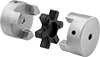
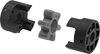
The thick split spider on these couplings takes on twice as much torque as standard split spiders, while a set screw holds the hubs in place on your shaft. Also known as jaw couplings, use them to connect motors to pumps, mixers, and other high-torque equipment.
Safely connect slightly misaligned shafts near food lines—the spider on these couplings contains metal, so it’ll trigger a metal detector if a piece frays off and contaminates your batch.
Each hub includes a set screw, which bites into your shaft to hold the coupling in place.
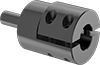
Increase the diameter of your shaft while also making it longer.
Reduce the diameter of your shaft while adding length.
One side is unfinished for milling custom pulleys, threaded hubs, sprockets, collars, knobs, sensor targets, or just about anything imaginable; the other side is a one-piece clamping coupling for mounting whatever you’ve created to your shaft.
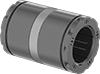
Because they usually do not require lubrication, linear sleeve bearings outperform linear ball bearings in dirty environments.
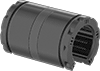
Ridges on the inside of these bearings wipe away dust and debris as the bearing travels on a shaft.
Made of FDA-listed materials for use in food applications, these bearings also have excellent chemical and corrosion resistance.
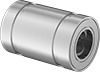
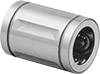
Use ball bearings in debris-free environments and when speed is a necessity. They operate with less friction than sleeve bearings, so you can run them at higher speeds.
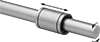
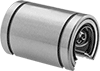
Engineered for simultaneous linear and rotary motion, these bearings are used with round end-supported shafts.
The choice for low-friction motion in high-temperature environments.
Designed to handle heavy loads, these bearings have higher load capacities than comparable standard linear ball bearings.
Ball bearings create less friction than sleeve bearings, so they require less force to operate.
Designed to handle heavy loads, these bearings have higher load capacities than comparable standard linear ball bearings for support rail shafts.
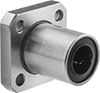
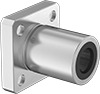
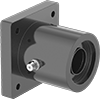
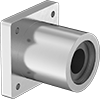
The flanged housing makes these bearings a good solution for vertical linear motion applications.
The shell, housing, and balls of these bearings are stainless steel for excellent corrosion resistance.
A ceramic coating makes high speeds as well as rapid acceleration and deceleration possible.
The Frelon liner on these bearings allows them to stand up to a wider range of chemicals than other flange-mounted linear sleeve bearings.
Virtually maintenance free, these bearings have slippery, chemical-resistant liners that don't require added lubrication.
Choose ball bearings for debris-free environments and when speed is a necessity. They operate with less friction than sleeve bearings, so you can run them at higher speeds.
Designed to handle heavy loads, these bearings have the highest load capacities of any mounted linear ball bearings we offer.
Use the adjustment screw in the housing to tighten or loosen the snugness (also known as preload) of the bearing to your shaft.
Mount these bearings on a support rail shaft for applications requiring maximum rigidity.
Outdoor as well as mild chemical environments are no problem for these bearings. They have stainless steel balls for corrosion resistance.
Designed to handle heavy loads, these bearings have higher load capacities than comparable standard mounted linear ball bearings for support rail shafts.