We will reply to your message within an hour.
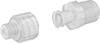
A staple in labs, these couplings are highly versatile, fitting any luer lock plug, socket, syringe, or needle. They’re PVDF, so they resist most acids, alcohols, and organic solvents.
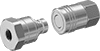
Quick-disconnect couplings consist of a plug and a socket that join with a latch so you can easily connect and disconnect your line.
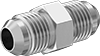
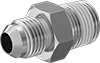
Also known as JIC (Joint Industrial Council) fittings, these provide a tight metal-to-metal seal on stainless steel tubing that is flared to 37°.
The male pipe threads on these fittings have a sealant applied for extra protection against leaks.
Individually bagged to prevent contamination, these fittings are suitable for applications that require a high level of cleanliness.
Connect to CPVC pipe for use in high-temperature plumbing and water supply applications.
Connect to CPVC pipe fittings for use in high-temperature plumbing and water supply applications up to 170° or 200° F.
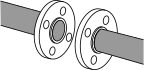
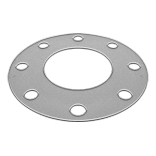
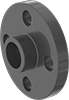
Bolt two same-size flanges together with a gasket to create an access point within a line. They are also known as Pressure Class 150 flanges. Use in high-temperature plumbing and water supply applications up to 200° F.
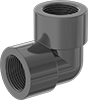
Made of polypropylene, these fittings won’t deteriorate when exposed to the damaging effects of ultraviolet light and are suitable to use outdoors. They have the chemical resistance to withstand acids, solvents, and other harsh substances.
This polypropylene pipe resists the damaging effects of ultraviolet light, so it’s suitable for outdoor use. It has the chemical resistance to withstand acids, solvents, and other harsh substances.
Use these polypropylene flanges in outdoor environments—they resist the damaging effects of ultraviolet light. They have the chemical resistance to stand up to acids, solvents, and other harsh substances. Bolt two same-size flanges together with a gasket to create an access point within a line. Flanges are also known as Pressure Class 150 flanges.
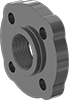
Also known as manifold flange fittings, these have a clamp-together design that lets you access your line for routine maintenance. Fittings resist acids, solvents, and other harsh chemicals. They won’t deteriorate when exposed to the damaging effects of ultraviolet light, so they’re suitable for outdoor use.
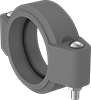
Use these clamps to connect easy-access CPVC pipe fittings and pipe.
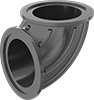
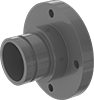
The grooved ends on these flanges connect to pipe with a clamp, so you can access your chemical process line for routine maintenance. Flanges have excellent chemical resistance to withstand a variety of salt solutions, acids, and other harsh substances. They are also known as Victaulic flanges.
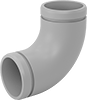
Also known as Victaulic fittings, these have grooved ends that connect to pipe with a clamp, so you can access your chemical process line for routine maintenance. Fittings have excellent chemical resistance to withstand a variety of salt solutions, acids, and other harsh substances.
Also known as Victaulic pipe, this pipe has grooved ends that connect to fittings and flanges with a clamp, so you can access your line for routine maintenance. It is CPVC, which has excellent chemical resistance to withstand a variety of salt solutions, acids, and other harsh substances.
The inside of these fittings won’t leach contaminants into your line or accumulate particles—they’re polished to an ultra-smooth 12 Ra finish, which also makes it easy to clean. Made of polypropylene, they resist organic solvents, acids, and alkalis better than CPVC fittings.
The inside of this pipe won’t leach contaminants into your line or accumulate particles—it’s polished to an ultra-smooth 12 Ra finish, which also makes it easy to clean. Made of polypropylene, it resists organic solvents, acids, and alkalis better than CPVC pipe.
The inside of these flanges won’t leach contaminants into your line or accumulate particles—they’re polished to an ultra-smooth 12 Ra finish, which also makes them easy to clean. Made of polypropylene, they resist organic solvents, acids, and alkalis better than CPVC pipe flanges.
Made of PVDF that’s finished to a 12 Ra smoothness, these fittings handle some of the harshest chemicals without leaching contaminants into your line. Comparable to Kynar, they handle most organic solvents that would dissolve CPVC, and chlorine or nitric acid that would weaken polypropylene.
Made of PVDF that’s finished to a 12 Ra smoothness, this pipe handles some of the harshest chemicals without leaching contaminants into your line.
Flanges have excellent corrosion resistance to handle a wide range of acids and other highly-corrosive chemicals. Use in metal surface treating applications, plating solution lines, and other chemical process applications. They are reinforced with fiberglass layers for better strength and durability than any of our other pipe flanges for chemicals. Bolt two same-size flanges together with a gasket to create an access point within a line.
With excellent corrosion resistance, this pipe can handle a wide range of acids and other highly-corrosive chemicals. Use in metal surface treating applications, plating solution lines, and other chemical process applications. Layers of fiberglass give this pipe better strength and durability than any of our other pipe for chemicals.
These fittings have excellent corrosion resistance to handle a wide range of acids and other highly-corrosive chemicals. They are commonly used in metal surface treating applications, plating solution lines, and other chemical process applications. Reinforced with layers of fiberglass, they have better strength and durability than any of our other pipe fittings for chemicals.
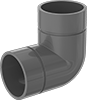
Made of polypropylene, these gravity-flow fittings withstand organic solvents, such as acetone, that would dissolve CPVC pipe. They also stand up to highly corrosive acids, such as hydrochloric acid, and alkalies.
Made of polypropylene, this gravity-flow pipe stands up to tough organic solvents, such as acetone, that would dissolve CPVC pipe. You can also use it for lines with highly corrosive acids, such as hydrochloric acid, and alkalies.
Made of PVDF, also known as Kynar, these fittings stand up to the harsh chemicals used to clean food processing lines. Unlike other plastic fittings, such as nylon and acetal fittings, they’ll resist degrading when exposed to strong alkali and highly acidic solutions.
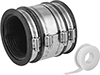
With an FEP sleeve and PTFE sealing tape, these connectors withstand chemicals better than rubber connectors. Use them for joining low-pressure chemical waste drainpipe and fittings or transitioning between different chemical piping.
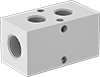
Distribute air or fluid to multiple locations from a single supply source with these manifolds. They are also known as headers.
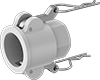
Couplings are plastic, which is lighter in weight than metal cam-and-groove hose couplings. They consist of a plug and a socket that connect and disconnect quickly. Use them if you need frequent access to a line. To connect, insert the plug into the socket and push the levers down.
To minimize fluid loss when connecting and disconnecting your line, these couplings have flat faces for a close fit and shut-off valves to stop the flow—they meet ISO 16028, which is an international standard for hose couplings.
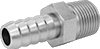
Each of these metal fittings is double bagged to prevent contamination in areas that require a high level of cleanliness.
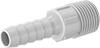
Made of plastic, these fittings are lighter in weight than metal barbed fittings, yet have the chemical and corrosion resistance to stand up to harsh substances. Slide the barbed end into plastic or rubber hose and secure with a clamp.
To stand up to the harsh chemicals used to clean food-processing lines, these fittings are made of PVDF, also known as Kynar.
Transfer harsh chemicals while reducing vibration that could damage pumps or other equipment.
No need for a gasket—this hose’s PTFE liner flares out as it passes through the flanges, so your line’s contents never touch the fittings.
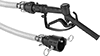
Dispense chemicals from a line that attaches and detaches from your drum or intermediate bulk container (IBC) in seconds. These nozzles and the included hose come with fittings that connect when you insert the plug into the socket and push the levers down.
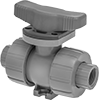
A threaded union on these valves makes them easy to install and remove without disrupting your line.
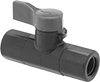
Insert tubing into the fittings on these valves—no heat, solder, or flux required. To withstand aggressive and corrosive solutions, they have a chemical-resistant fluoroelastomer seal and a plastic body.
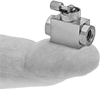
To withstand aggressive and corrosive solutions in miniature chemical-processing pipelines, these tiny valves have a chemical-resistant fluoroelastomer seal and a corrosion-resistant 303 stainless steel body.
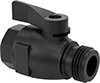
Control the flow of chemical solutions from any garden hose. With a fluoroelastomer seal and polypropylene body, these valves withstand strong chemicals, such as chlorinated water and phosphoric acid.
For chemical-processing applications in confined areas, these valves have a low-profile handle to fit in tight spots. A rubber seal and a plastic body stand up to aggressive, corrosive solutions.
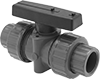
For fast installation and removal from pipelines, these valves have union fittings that disassemble into multiple pieces. All have a fluoroelastomer seal and a plastic body that can stand up to aggressive and corrosive solutions in chemical-processing applications.
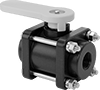
No need to remove these valves from your line to access their internal components—the three-piece bolted body comes apart. Ideal in chemical-processing applications, the seal and polypropylene body stand up to aggressive and corrosive solutions.
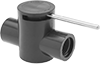
There’s no need to unbolt these valves for cleaning—remove the valve handle and slide the valve apart for inline access to internal components. Also known as elliptical valves, they have a fluoroelastomer seal and a polypropylene body to withstand aggressive and corrosive solutions in chemical-processing applications.
Streamline your installation and removal process. These valves give you the leak-tight permanent connection of a socket connect with the ease of fittings that come apart.
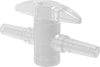
Made of PVDF to withstand corrosive solutions, these valves are ideal for use in chemical processing. Their luer lock fittings are quick to connect and disconnect for convenience.
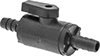
Barbs grip onto tubing, providing a secure hold. To withstand aggressive and corrosive solutions in chemical-processing applications, these valves have a plastic body and a chemical-resistant seal.
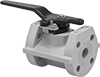
Bolt these valves to ANSI flanges—they meet ASME dimensional standards. They have a plastic body and a seal that withstand aggressive and corrosive solutions in chemical-processing applications.
These valves have socket-weld connections for bonding to unthreaded male plastic pipe.
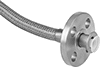
For use with threaded pipe, these valves have NPT connections.
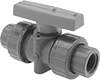
With a plastic body and a fluoroelastomer seal, these valves can stand up to aggressive and corrosive solutions in chemical-processing applications.
All valves have threaded NPT connections.
Also known as actuated ball valves, these provide higher flow rates than other air-driven valves.
Also known as piston valves, these have a compact, lightweight actuator that allows them to be installed in any mounting orientation. They’re often used in water-treatment applications.
Also known as diaphragm valves, these have a diaphragm that can handle dirty liquid, slurries, and abrasive media without damage.