McMaster-Carr logo
    Enter e-mail addresses in the fields below
    Message
    Cancel
    Comments
    E-mail address (if you would like a response)
    16 Products

    Fixturing for Parts Inspection

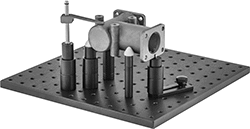
    Image of ProductInUse. Front orientation. Coordinate Measuring Machine Plates and Fixtures. Fixturing for Parts Inspection.
    From towers and brackets to standoffs and supports, these components are the building blocks for your custom fixturing setup. They elevate parts so you can access a variety of angles for measuring and inspecting while protecting your measuring device from hitting the inspection table. You’ll often see them used with coordinate measuring machines (CMMs). They’re not for use in machining applications.
    Angle Brackets
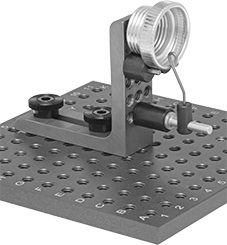
    Image of ProductInUse. Front orientation. Coordinate Measuring Machine Plates and Fixtures. Fixturing for Parts Inspection, Angle Brackets.
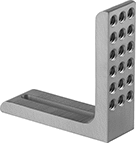
    Image of Product. Front orientation. Coordinate Measuring Machine Plates and Fixtures. Fixturing for Parts Inspection, Angle Brackets.
    Angle brackets create a 90° mounting point, so you can secure small workpieces with supports. Shorter than towers, they’re a good choice for parts that are about the size of your palm. The base bolts into your surface, so these brackets won’t budge.
    Slots,
    mm
    Lg.,
    mm
    Wd.,
    mm
    Ht.,
    mm
    Lg.
    Wd.
    Number
    of Holes
    Material
    Includes
    Each
    M8 Hole Thread Size
    762576447.212AluminumTwo M8 Bolts1409N69000000
     
    Standoffs
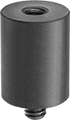
    Image of Product. Front orientation. Coordinate Measuring Machine Plates and Fixtures. Fixturing for Parts Inspection, Standoffs.
    Standoffs raise the height of towers and angle brackets or extend the reach of supports and clamps. Screw them into one another for added length.
    Dia.,
    mm
    Ht.,
    mm
    Thread
    Lg., mm
    Material
    Each
    M8 × 1.25 mm Threads
     
    Fixed Standoff Height
    13157.7Steel1409N53000000
    13257.5Steel1409N5600000
     
    Cone Supports
    Image of ProductInUse. Front orientation. Coordinate Measuring Machine Plates and Fixtures. Fixturing for Parts Inspection, Cone Supports.
    Image of Product. Front orientation. Coordinate Measuring Machine Plates and Fixtures. Fixturing for Parts Inspection, Cone Supports.
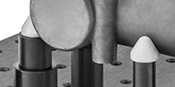
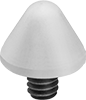
    Cone supports have a round pointed tip to minimize contact with your workpiece, so they’re often used to prop up delicate parts. They’re also useful for parts with irregular surfaces that slide off larger supports. Made of plastic, they’re nonmarring.
    Dia.,
    mm
    Ht.,
    mm
    Thread
    Lg., mm
    Material
    Each
    M8 × 1.25 mm Threads
    16137.7Nylon1409N7200000
     
    Positioners
    Image of ProductInUse. Front orientation. Coordinate Measuring Machine Plates and Fixtures. Fixturing for Parts Inspection, Positioners.
    Image of Product. Front orientation. Coordinate Measuring Machine Plates and Fixtures. Fixturing for Parts Inspection, Positioners.
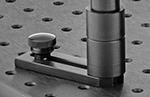
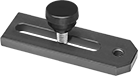
    Positioners secure components anywhere along the length of their slot, similar to drop-in nuts on T-slotted rails. This gives you the flexibility to install components between the threaded holes on plates, brackets, and towers.
    Slots,
    mm
    Lg.,
    mm
    Wd.,
    mm
    Thk.,
    mm
    Lg.
    Wd.
    Number
    of Holes
    Material
    Includes
    Each
    M8 Hole Thread Size
    652010308.51SteelTwo M8 Knurled Knobs1409N75000000
     
    Trays
    Image of Product. Bottom orientation. Coordinate Measuring Machine Plates and Fixtures. Fixturing for Parts Inspection, Trays.
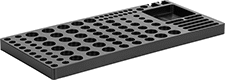
    Trays have slots to store and organize standoffs, supports, and other small components.
    Lg.,
    mm
    Wd.,
    mm
    Ht.,
    mm
    Material
    Each
    For M8 Thread
    43220325Acetal1409N660000000
     

    Fixture Plates

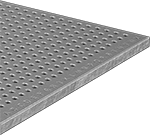
    Lay the foundation for your fixturing setup. These plates have a grid with evenly spaced threaded holes to install angle brackets and other fixturing components. They’re often used to help secure workpieces for measuring and inspecting. Just like a battleship gameboard, the edges are labeled with letters and numbers, making it easy to identify holes. While these lightweight plates aren’t for machining, you can use them for light fabrication jobs, such as laser marking. All can be attached to your table with clamps (not included), making them easy to remove and swap.
    Fixture Plates
    Image of Product. Front orientation. Coordinate Measuring Machine Plates and Fixtures. Fixture Plates.
    Anodized Aluminum—Anodized aluminum plates are often used with coordinate measuring machines (CMMs) and optical comparators. The coating protects them from scratches and wear, even when you’re working with heavy parts.
    Holes
    Lg.,
    mm
    Wd.,
    mm
    Thk.,
    mm
    Parallel Tolerance,
    mm
    No.
    of
    Ctr.-to-Ctr.,
    mm
    Material
    Each
    M8 Hole Thread Size
    300300130.63528915Anodized Aluminum6364N140000000
    450450130.63572915Anodized Aluminum6364N1600000000
     

    Clamps for Parts Inspection

    Image of ProductInUse. Front orientation. Coordinate Measuring Machine Plates and Fixtures. Clamps for Parts Inspection.
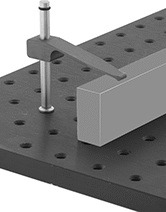
    With a light yet sturdy hold, these clamps help you keep workpieces in place hands-free for measuring and inspecting. Thread them right into your fixturing surface, whether it’s a plate, tower, or table. Because they apply less pressure than machining clamps, they won’t distort your parts, so you can take accurate measurements. While these clamps aren’t sturdy enough for use in machining, you can still use them for light fabrication work, such as laser engraving.
    Hold-Down Clamps
    Image of Product. Front orientation. Coordinate Measuring Machine Plates and Fixtures. Clamps for Parts Inspection, Tension Spring.

    Tension Spring

    Hold-down clamps secure parts from the top.
    Tension Spring—Tension spring clamps are the most common type of clamp. Slide the arm down the shaft until it touches the top of your workpiece. Since you apply pressure directly, using too much force might move your part.
    Reach Lg.,
    mm
    Ht.,
    mm
    Thread
    Lg., mm
    Material
    Each
    Tension Spring
     
    M8 × 1.25 mm Threads
    38756.2Aluminum1337N29000000
    58756.2Aluminum1337N3100000
     

    Modular Coordinate Measurement Machine Probes
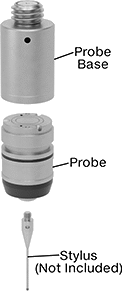
    Image of System. Probe Base and Probe Sold Separately. Front orientation. Contains Annotated. Coordinate Measurement Machine Probes. Modular Coordinate Measurement Machine Probes.

    Probe Base and

    Probe Sold

    Separately

    Swap out Renishaw probe styles to inspect different features on a part without having to recalibrate. These probes mount magnetically to a base that threads into your coordinate measuring machine (CMM), making mid-inspection changes quick. They’re also known as modules. It’s easy to tell different styles apart from their different end colors. To take 3D measurements, they record the coordinates of different points on your workpiece. Because this involves physically touching your workpiece, they’re more accurate than other automated measurement systems. They’re touch-trigger probes, the most common CMM probe type, which means they stop to record the coordinates of one point at a time. Use them to check distances, diameters, right angles, and the location of holes and grooves. However, they're not as good at checking complex features, flatness, or roundness.
    All probes require a stylus as well as a base (sold separately for some probes).
    Trigger force is the amount of force required for a probe to take a measurement and record it. Choose a probe with a force that is high enough to avoid false triggers from vibration but not so high it damages the workpiece and leads to inaccurate measurements.
    Probe and Base Kits
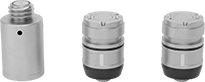
    Image of Product. Top orientation. Coordinate Measurement Machine Probes. Modular Coordinate Measurement Machine Probes, Probe and Base Kits.
    SF Series—SF series probes have a trigger force that works for most general purpose probing jobs where vibration is not an issue.
    TP20 Series—TP20 probe bases have a magnetic proximity switch to prevent a probe from accidentally triggering when you’re attaching it or detaching it. However, probes attached to these bases can’t be used to inspect magnetic parts.
    For Stylus
    Trigger
    Force, N
    No. of
    Pieces
    Includes
    Dia.,
    mm
    Thread
    Size
    O'all Lg.,
    mm
    For Axis Measuring
    Direction
    X- and
    Y-Axis
    Z-Axis
    End
    Color
    Features
    Manufacturer
    (Series)
    Each
    3Two 20 mm Lg. SF Probes
    One 19 mm Lg. TP20 Probe Base
    13M2
    10 to 50±X, ±Y, +Z0.080.75BlackMagnetic Proximity SwitchRenishaw (SF, TP20)6179N11000000000
     
    Coordinate Measurement Machine Probe Base Installation Tools
    Probe Bases
    Image of Product. Top orientation. Coordinate Measurement Machine Probes. Modular Coordinate Measurement Machine Probes, Probe Bases.
    Bases house the system that sends a signal to record a measurement. They thread onto probe heads with an M8 connection on your CMM.
    TP20 Series—TP20 probe bases have a magnetic proximity switch to prevent a probe from accidentally triggering when you’re attaching it or detaching it. However, probes attached to these bases can’t be used to inspect magnetic parts.
    TP20 NI Series—TP20 NI probe bases aren’t affected by magnetic fields, so they can be used to inspect magnetic parts. However, because they don’t have a magnetic proximity switch, you’ll need to program your CMM to stop taking measurements when you’re changing out probes.
    Dia.,
    mm
    Lg.,
    mm
    Enclosure
    Rating
    Features
    Manufacturer
    (Series)
    Each
    1319IP30
    Renishaw (TP20 NI)6179N13000000000
    1319IP30
    Magnetic Proximity SwitchRenishaw (TP20)6179N1200000000
     
    Coordinate Measurement Machine Probe Base Installation Tools

    Threaded Hole Location Gauges

    Image of Product. Back orientation. Threaded Hole Location Gauges.
    Find the true center of threaded holes to precisely align and measure parts. Once you thread these gauges into a hole, their cylinder sticks out as a reliable reference point. They’re often used with a coordinate measuring machine (CMM) to pinpoint the coordinates of the cylinder’s exact center. You can then use those coordinates to measure distances between points or reference them for error-free assembly. Even without a CMM, you can use these gauges with a micrometer to measure accurate center-to-center distances.
    Thread Size
    Thread
    Type
    Hardness
    Material
    Each
    M8 × 1 mmMetric
    Rockwell C60Tool Steel
    6648N210000000
    M8 × 1.25 mmMetric
    Rockwell C60Tool Steel
    6648N19000000
    back to top