We will reply to your message within an hour.
More
Designed to grip evenly around your shaft, these couplings provide more holding power than set screw couplings without marring the shaft.
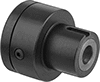
Each hub includes a set screw, which bites into your shaft to hold the coupling in place.
Each hub includes a set screw (unless noted), which bites into your shaft to hold the coupling in place.
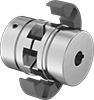
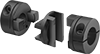
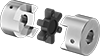
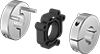
The thick split spider on these couplings takes on twice as much torque as standard split spiders, while a set screw holds the hubs in place on your shaft. Also known as jaw couplings, use them to connect motors to pumps, mixers, and other high-torque equipment.
Safely connect slightly misaligned shafts near food lines—the spider on these couplings contains metal, so it’ll trigger a metal detector if a piece frays off and contaminates your batch.
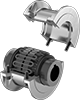
A strip of flexible spring steel wraps around the teeth of both hubs to absorb sharp, momentary load increases that can come from motor startups, emergency braking, or sudden impact with hard objects.
Also known as Schmidt couplings, these handle higher angular misalignment than other three-piece couplings. Good for applications with varying shaft misalignment, they're commonly used with conveyor rollers and roller feeds in printing and packaging machines.
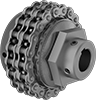
Use these gear-shaped couplings for high-speed and high-torque applications.
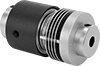
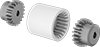
Made with lightweight nylon sleeves, these gear couplings require less energy to move than other high-torque flexible couplings. They compensate for parallel, angular, and axial misalignment.
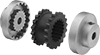
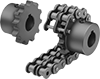
With a rugged roller-chain design, these couplings provide excellent torque and angular misalignment capacities.
With a rigid gear design, these steel couplings transmit more torque than other couplings of the same size.
Magnetic force transfers torque from one half of these couplings to the other; there’s no contact between the parts, so they won’t wear. Couplings compensate for angular and parallel misalignment.
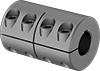
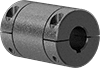
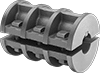
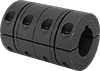
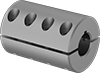
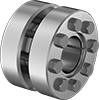
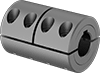
Designed to grip evenly around your shaft, clamping couplings provide more holding power than set screw couplings without marring the shaft.
When one of your shafts is undersized from wear, oversized from coatings, or uncommonly sized, machine one end of these couplings to fit. They clamp around your shafts for a secure hold that won’t cause damage.
These couplings have the gripping strength to handle higher torque than most other couplings.
When you need a strong hold and even grip on shafts that are oversized due to finishes, undersized from wear, or uncommonly sized, we’ll make a coupling for you that fits just right. These couplings clamp around your shafts to prevent marring them.
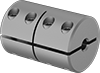
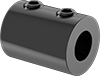
Set screws bite into your shaft to hold these couplings in place.
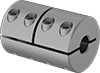
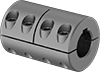
Install and remove these shaft couplings without disconnecting the shafts, motors, and other attached components—they’re made in two pieces so you don’t need to slide them onto shaft ends. They’re also useful when you have limited access to the ends of the shafts.
When your shafts are not close enough to use standard couplings, these have the length to bridge the gap.
For hard-to-access shafts that are oversized from coatings or undersized from wear, we’ll get you a coupling in the right size that clamps on as two pieces, so you don’t need to move your shafts or installed components.
Support the weight of a motor and transfer torque to another shaft at the same time with these couplings.
Access one shaft without disconnecting the other. These rigid couplings have a solid bottom that connects the shafts and two top pieces that clamp the shafts independently.
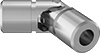
Connect and transfer torque between two shafts that are misaligned at an angle.
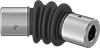
Ideal for wet environments, these U-Joints are stainless steel, so they have good corrosion resistance while also balancing strength. They have a heat- and water-resistant silicone cover (also known as a boot or bellows) to keep lubricant in and contaminants out.
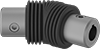
A cover (also known as a boot or bellows) seals out contaminants and seals in lubricant.
Often found in food, cosmetic, and pharmaceutical plants, these U-joints connect misaligned shafts in sanitary environments.
With a maximum torque of at least 11,600 in.-lbs., these U-joints handle more torque than any other U-joint in our offering.
Ideal for use in assemblies that change frequently, these U-joints have clamping screws that can be quickly loosened when you need to move them.
A spring automatically lengthens or shortens these U-joints to fit your application, making them a good choice for assemblies with frequent changes.
Increase the diameter of your shaft while also making it longer.
Reduce the diameter of your shaft while adding length.
Adapt your shaft to a threaded end without having to machine threads onto your shaft.
Protect your machinery if there is a jam, emergency stop, or other overload by cutting off torque between shafts when a maximum torque is reached.
Use friction to prevent torque overload, control tension, and brake.
Since they transfer torque in one direction and spin freely in the other, these clutches are useful in applications where you don’t want motion to reverse, such as in backstopping, indexing, and overrunning.
With rugged roller chains, these torque limiters handle more torque than other torque limiters. They have a disc that creates friction to prevent torque overload, control tension, and brake.
Use your air system to remotely make changes to the torque setting or cut off torque completely, even during operation.
Disengaged until they rotate fast enough to transmit torque, these clutches give the components on your driven side a smooth start by allowing the driving side to start without load.
Prevent corrosion from interfering with these torque limiters’ ability to protect your machinery if there’s a jam, emergency stop, or other overload.
With zero backlash (no play), there’s no motion lost when these torque limiters transfer torque, so machines move smoothly with accurate and repeatable motion. They protect your machinery if there is a jam, emergency stop, or other overload by cutting off torque when a maximum torque is reached.
One side is unfinished for milling custom pulleys, threaded hubs, sprockets, collars, knobs, sensor targets, or just about anything imaginable; the other side is a one-piece clamping coupling for mounting whatever you’ve created to your shaft.
Prevent damage from overloading. When overloaded, these limiters cause your sprocket or pulley to slip. Once the overload is removed, the limiters automatically reset.