

Filter by
Manufacturer


System of Measurement

Clarity




Container Type

Flexibility

Tensile Strength

Flexural Modulus
Maximum Temperature
U.S.–Mexico–Canada Agreement (USMCA) Qualifying
DFARS Specialty Metals
Export Control Classification Number (ECCN)
REACH
RoHS
Dremel 3D Printer Filaments
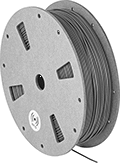 |
Build parts and prototypes from these filaments using Dremel fused filament fabrication (FFF) 3D printers. An RFID tag on the spool communicates with your printer, automatically adjusting it to the correct temperature and print speed for the filament material and notifying you when the filament is running out.
Maximum exposure temperature is the point at which a printed part will begin to deform. Above this temperature, your printed parts will start to lose structural integrity.
PLA
 |  |
Black | Blue |
 |  |
Green | Orange |
 |  |
Red | White |
 | |
Clear |
PLA filaments are the most commonly used in 3D printing. PLA is easy to use; it rarely clogs nozzles, doesn’t require a heated printer bed, and prints at a low temperature—meaning parts won’t warp while cooling. It produces string-free parts, so you can use it to print with a high level of detail. Less durable and more sensitive to heat than ECO-ABS, PLA is better for printing prototypes than end-use parts.
Tensile Strength—Tensile strength is the best measure of a filament's overall strength. Similar to the stress applied on a rope during a game of tug-of-war, it's the amount of pulling force a material can handle before breaking. A higher rating means a stronger filament. A tensile strength of 5,000 psi and above is considered good; 12,000 psi and above is excellent.
Eco-ABS
| |
Black | White |
ECO-ABS is less brittle and more impact resistant than PLA, so these filaments are good for printing parts that are frequently handled, dropped, or heated. They are, however, a little more high maintenance—parts may warp during cooling, so they require a heated printer bed.
Tensile Strength—Tensile strength is the best measure of a filament's overall strength. Similar to the stress applied on a rope during a game of tug-of-war, it's the amount of pulling force a material can handle before breaking. A higher rating means a stronger filament. A tensile strength of 5,000 psi and above is considered good; 12,000 psi and above is excellent.
Spool, mm | |||||||||||||
|---|---|---|---|---|---|---|---|---|---|---|---|---|---|
Mfr. Model No. | Dia., mm | Printing Temp. | For Printer Bed Temp. | Tensile Strength, psi | Max. Exposure Temp. | For Min. Nozzle Opening Dia., mm | Dia. | Dp. | Wt., g | Color | Each | ||
| ECO-BLA-01 | 1.75 | 190° to 240° C 374° to 464° F | 60° C 140° F | 8,410 | 63° C 145° F | 0.2 | 181 | 55 | 750 | Black | 3653N23 | 000000 | |
| ECO-WHI-01 | 1.75 | 190° to 240° C 374° to 464° F | 60° C 140° F | 8,410 | 63° C 145° F | 0.2 | 181 | 55 | 750 | White | 3653N24 | 00000 | |
Nylon%20--%3e%3csvg%20version='1.1'%20id='Layer_1'%20xmlns='http://www.w3.org/2000/svg'%20xmlns:xlink='http://www.w3.org/1999/xlink'%20x='0px'%20y='0px'%20viewBox='0%200%20400%20400'%20style='enable-background:new%200%200%20400%20400;'%20xml:space='preserve'%3e%3cstyle%20type='text/css'%3e%20.st0{fill:%231A70A0;}%20.st1{opacity:0.5;}%20%3c/style%3e%3cg%3e%3cg%3e%3cpath%20class='st0'%20d='M200,56.9c38.35,0,74.4,14.93,101.51,42.05c27.11,27.11,42.05,63.17,42.05,101.51s-14.93,74.4-42.05,101.51%20S238.35,344.02,200,344.02s-74.4-14.93-101.51-42.05c-27.11-27.11-42.05-63.17-42.05-101.51s14.93-74.4,42.05-101.51%20S161.65,56.9,200,56.9%20M200,12.9C96.41,12.9,12.44,96.88,12.44,200.46c0,103.59,83.97,187.56,187.56,187.56%20c103.59,0,187.56-83.97,187.56-187.56C387.56,96.88,303.59,12.9,200,12.9L200,12.9z'/%3e%3c/g%3e%3cg%3e%3cg%20class='st1'%3e%3cpath%20class='st0'%20d='M235.49,152.24h16.15l-27.46,111.87c-1.94,7.8-2.91,12.5-2.91,14.1c0,1.82,0.58,3.29,1.73,4.41%20c1.16,1.12,2.69,1.68,4.61,1.68c5.23,0,11.78-3.85,19.63-11.55l17.22,21.34c-16.95,17.33-34.87,26-53.78,26%20c-8.37,0-15.45-1.47-21.23-4.41c-5.79-2.94-10.44-7.25-13.95-12.92c-3.51-5.67-5.27-11.18-5.27-16.53c0-1.93,0.35-5.24,1.05-9.94%20c1-6.94,2.05-12.54,3.15-16.82l15.22-62.15h-32.69l7.65-30.97C190.89,163.58,214.53,158.88,235.49,152.24z%20M230.44,80.84%20c8.24,0,14.66,2.62,19.26,7.86c4.6,5.24,6.9,11.55,6.9,18.94c0,5.46-1.42,10.7-4.25,15.73c-2.83,5.03-6.88,9.07-12.12,12.12%20c-5.24,3.05-10.33,4.57-15.24,4.57c-4.6,0-9.17-1.23-13.72-3.69c-4.55-2.46-8.02-5.78-10.43-9.95%20c-2.41-4.17-3.61-8.67-3.61-13.48c0-5.35,1.52-10.64,4.57-15.89c3.05-5.24,7.03-9.25,11.96-12.04%20C218.68,82.23,224.24,80.84,230.44,80.84z'/%3e%3c/g%3e%3cg%3e%3cpath%20class='st0'%20d='M214.08,152.24h16.15l-27.46,111.87c-1.94,7.8-2.91,12.5-2.91,14.1c0,1.82,0.58,3.29,1.73,4.41%20c1.16,1.12,2.69,1.68,4.61,1.68c5.23,0,11.78-3.85,19.63-11.55l17.22,21.34c-16.95,17.33-34.87,26-53.78,26%20c-8.37,0-15.45-1.47-21.23-4.41c-5.79-2.94-10.44-7.25-13.95-12.92c-3.51-5.67-5.27-11.18-5.27-16.53c0-1.93,0.35-5.24,1.05-9.94%20c1-6.94,2.05-12.54,3.15-16.82l15.22-62.15h-32.69l7.65-30.97C169.48,163.58,193.11,158.88,214.08,152.24z%20M209.03,80.84%20c8.24,0,14.66,2.62,19.26,7.86c4.6,5.24,6.9,11.55,6.9,18.94c0,5.46-1.42,10.7-4.25,15.73c-2.83,5.03-6.88,9.07-12.12,12.12%20c-5.24,3.05-10.33,4.57-15.24,4.57c-4.6,0-9.17-1.23-13.72-3.69c-4.55-2.46-8.02-5.78-10.43-9.95%20c-2.41-4.17-3.61-8.67-3.61-13.48c0-5.35,1.52-10.64,4.57-15.89c3.05-5.24,7.03-9.25,11.96-12.04%20C197.26,82.23,202.83,80.84,209.03,80.84z'/%3e%3c/g%3e%3c/g%3e%3c/g%3e%3c/svg%3e)
|
Black |
Spool, mm | |||||||||||||
|---|---|---|---|---|---|---|---|---|---|---|---|---|---|
Mfr. Model No. | Dia., mm | Printing Temp. | For Printer Bed Temp. | Tensile Strength, psi | Max. Exposure Temp. | For Min. Nozzle Opening Dia., mm | Dia. | Dp. | Wt., g | Color | Each | ||
| DF45-NYP-B | 1.75 | 230° to 250° C 446° to 482° F | 80° C 176° F | 7,540 | 155° C 311° F | 0.4 | 180 | 55 | 500 | Black | 3653N12 | 000000 | |
PETG
|
Clear |
PETG is more moisture resistant than ECO-ABS, making it a great choice for printing parts for use in humid or wet environments. Generally, PETG’s other properties fall somewhere between those of PLA and ECO-ABS. It’s more flexible and durable than PLA, but less so than ECO-ABS. It’s harder to print than PLA because it requires a heated printer bed, but easier to print than ECO-ABS. PETG filaments should be kept in a sealed container with a desiccant.
Tensile Strength—Tensile strength is the best measure of a filament's overall strength. Similar to the stress applied on a rope during a game of tug-of-war, it's the amount of pulling force a material can handle before breaking. A higher rating means a stronger filament. A tensile strength of 5,000 psi and above is considered good; 12,000 psi and above is excellent.
Spool, mm | |||||||||||||
|---|---|---|---|---|---|---|---|---|---|---|---|---|---|
Mfr. Model No. | Dia., mm | Printing Temp. | For Printer Bed Temp. | Tensile Strength, psi | Max. Exposure Temp. | For Min. Nozzle Opening Dia., mm | Dia. | Dp. | Wt., g | Color | Each | ||
| PETG-TRA-01 | 1.75 | 240° to 260° C 464° to 500° F | 80° C 175° F | 7,250 | 84° C 183° F | 0.2 | 181 | 55 | 750 | Clear | 3653N25 | 000000 | |
