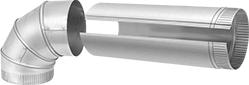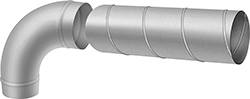
Deliver air for a range of HVAC applications, including exhaust and dust collection. Our basic duct, the round shape creates smoother, more efficient airflow than rectangular and oval duct. The male end is slightly smaller than the female, so sections join without clamps or tools.
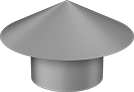
Rain Caps
Top off vertical duct and exhaust stacks to prevent corrosion and blockages that can disrupt airflow.
Galvanized Steel—Corrosion resistant and affordable, galvanized steel is the most commonly used ductwork material.
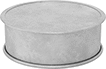
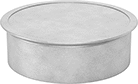
Cover unused duct openings to prevent air from leaking, dust from escaping, and debris from entering. End caps are often used to seal duct after changes to your system or equipment. To make modifications or expand your line, remove the cap.
Galvanized Steel—Corrosion resistant and affordable, galvanized steel is the most commonly used ductwork material.
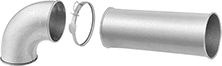
The fastest ductwork to disassemble for dust collection and other frequently cleaned systems. Join sections with quick-release clamps that open and close with a flip of the latch. Since you don’t need screws, welds, or tools, the installation time is half that of other duct types.
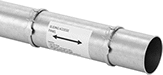
Duct with Access Panel
No need to cut a hole and install a door—just slide the built-in panel to get inside this duct for cleaning and inspection.
Galvanized Steel—Corrosion resistant and affordable, galvanized steel is the most commonly used ductwork material.
Cover unused duct openings to prevent air from leaking, dust from escaping, and debris from entering. End caps are often used to seal duct after changes to your system or equipment. To make modifications or expand your line, remove the cap.
Galvanized Steel—Corrosion resistant and affordable, galvanized steel is the most commonly used ductwork material.
Corrosion-Resistant 304 Stainless Steel—The most corrosion-resistant metal duct we sell. It won’t rust or degrade in systems that exhaust chemical fumes or vent heat from industrial ovens and dryers.
Reinforced with a continuous seam, this duct keeps its shape, even against suction from dust collection systems. On the inside, duct is smooth for efficient airflow. Because of its attractive look, spiral duct is often used for exposed heating and cooling systems.
End Caps
Cover unused duct openings to prevent air from leaking, dust from escaping, and debris from entering. End caps are often used to seal duct after changes to your system or equipment. To make modifications or expand your line, remove the cap.
Galvanized Steel—Corrosion resistant and affordable, galvanized steel is the most commonly used ductwork material.
Corrosion-Resistant 304 Stainless Steel—The most corrosion-resistant metal duct we sell. It won’t rust or degrade in systems that exhaust chemical fumes or vent heat from industrial ovens and dryers.
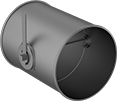
The simplest, most reliable way to regulate airflow in standard duct. Turn the lever to adjust the blade.
Blade Airflow Damper—The most economical choice, these dampers slide into the end of duct. Drill a hole for the damper's bolt and remove the handle. Place the damper inside duct, insert the bolt through the hole, and reattach the handle.
Galvanized Steel—Strong and corrosion resistant, galvanized steel is the most commonly used ductwork material.
Regulate airflow to sections of quick-disconnect duct. Often used in dust collection systems, these dampers attach with quick-release clamps. Turn the lever to adjust airflow.
Galvanized Steel—Strong and corrosion resistant, galvanized steel is the most commonly used ductwork material.
Corrosion-Resistant 304 Stainless Steel—The most corrosion-resistant metal duct we sell outperforms galvanized steel in harsh environments. It won’t rust or degrade in systems that exhaust chemical fumes or vent heat from industrial ovens and dryers.
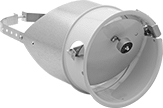
These dampers improve furnace performance by automatically opening and closing to maintain a consistent airflow despite changing environmental conditions.
Single-Acting Damper—Single-acting dampers open inward to prevent strong drafts from pulling too much heat into the chimney vent.
Double-Acting Damper—Double-acting dampers open both inward and outward to relieve pressure caused by obstructions and downdrafts.