


Filter by
System of Measurement
Thread Size


Body Style


Movement


Threading

Application
Eye Type

Shank Thread Size
Eye Shape


DFARS Specialty Metals
Export Control Classification Number (ECCN)
Specifications Met


Eyebolts—For Lifting
Steel
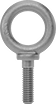 |
With Shoulder |
Thread | With Shoulder | |||||||||
|---|---|---|---|---|---|---|---|---|---|---|
Size | Lg., mm | Shank Lg., mm | Eye Dia., mm | Vert. Cap., lb. | Threading | Overall Lg., mm | Each | |||
Closed Eye | ||||||||||
| M14 × 2 mm | 28 | 28 | 33 | 3,500 | Fully Threaded | 104 | 3040T16 | 000000 | ||
Galvanized Steel
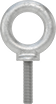 |
With Shoulder |
Thread | With Shoulder | |||||||||
|---|---|---|---|---|---|---|---|---|---|---|
Size | Lg., mm | Shank Lg., mm | Eye Dia., mm | Vert. Cap., lb. | Threading | Overall Lg., mm | Each | |||
Closed Eye | ||||||||||
| M14 × 2 mm | 45 | 45 | 35 | 3,500 | Fully Threaded | 121 | 4843T16 | 000000 | ||
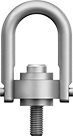
Hoist Rings—For Lifting
 |
 |
180° Pivot |
 |
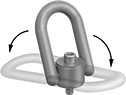
360° Swivel |
Designed for angular lifting, hoist rings resist stresses that would bend or break an eyebolt. They have a lifting ring that pivots 180° front to back and a base that swivels 360° to compensate for pitch, roll, and sway when lifting heavy or unbalanced loads. Install the base of the hoist ring flush to the mounting surface and tighten to the recommended torque that is stamped on the ring. Torque wrenches are sold separately.
Note: Capacities listed are for vertical lifting only. As the lift angle changes from vertical, the amount of weight the hoist ring can lift is significantly reduced. For example, when lifting a 1,000 lb. load at a 45° angle, you must choose a hoist ring with a capacity of at least 1,400 lbs. Do not use at an angle less than 30°.
Warning: Never use to lift people or items over people.
High Visibility—High-visibility hoist rings are fluorescent green, so they’re easy to distinguish from other hardware when attached to equipment being lifted.
Black-Oxide Steel—Black-oxide steel hoist rings have mild corrosion resistance.
Nickel-Plated Steel—Nickel-plated steel hoist rings are more corrosion resistant than black-oxide steel hoist rings.
CE Marked—Hoist rings that are CE marked meet European safety standards.
Each | |||||||||||||
|---|---|---|---|---|---|---|---|---|---|---|---|---|---|
Thread Size | Thread Lg., mm | Inside Wd., mm | Overall Ht., mm | Vert. Cap., lb. | Movement | Specs. Met | Certification | Mil. Spec. | 1-9 | 10-Up | |||
Forged Black-Oxide Steel | |||||||||||||
| M14 × 2 mm | 25 | 50 | 161 | 3,300 | 180° Pivot and 360° Swivel | ASME B30.26 | CE Marked, Mil. Spec. | MIL-STD-1365, MIL-STD-209 | 3005T145 | 0000000 | 000000 | ||
| M14 × 2 mm | 25 | 50 | 200 | 3,300 | 180° Pivot and 360° Swivel | ASME B30.26 | CE Marked, Mil. Spec. | MIL-STD-1365, MIL-STD-209 | 3005T195 | 000000 | 000000 | ||
| M14 × 2 mm | 32 | 50 | 168 | 3,300 | 180° Pivot and 360° Swivel | ASME B30.26 | CE Marked, Mil. Spec. | MIL-STD-1365, MIL-STD-209 | 3005T155 | 000000 | 00000 | ||
| M14 × 2 mm | 32 | 50 | 207 | 3,300 | 180° Pivot and 360° Swivel | ASME B30.26 | CE Marked, Mil. Spec. | MIL-STD-1365, MIL-STD-209 | 3005T205 | 000000 | 000000 | ||
Forged Fluorescent Green Powder-Coated Steel—High Visibility | |||||||||||||
| M14 × 2 mm | 25 | 50.8 | 160.2 | 3,300 | 180° Pivot and 360° Swivel | ASME B30.26 | CE Marked, Mil. Spec. | MIL-STD-1365, MIL-STD-209 | 4157N25 | 000000 | 000000 | ||
Forged Nickel-Plated Steel | |||||||||||||
| M14 × 2 mm | 25 | 50 | 161 | 3,300 | 180° Pivot and 360° Swivel | ASME B30.26 | CE Marked, Mil. Spec. | MIL-STD-1365, MIL-STD-209 | 3145T94 | 000000 | 000000 | ||
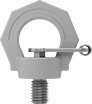
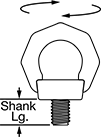
Rotating Eyebolts—For Lifting
Powder-Coated Steel
 |  |
Thread | With Shoulder | ||||||||||
|---|---|---|---|---|---|---|---|---|---|---|---|
Size | Lg., mm | Shank Lg., mm | Eye Dia., mm | Vert. Cap., lb. | Threading | Color | Overall Lg., mm | Each | |||
Closed Eye | |||||||||||
| M14 × 2 mm | 18 | 18 | 30 | 1,650 | Fully Threaded | Pink | 73 | 3059T121 | 0000000 | ||
Nonswiveling Hoist Rings—For Lifting
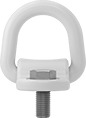 |
D-Shape |
|
180° Pivot |
The fixed base provides added stability and allows you to lift heavy loads with smaller thread sizes. Designed for angular lifting, hoist rings resist stresses that would bend or break an eyebolt. They have a lifting ring that pivots 180° front to back to compensate for roll and sway when lifting heavy or unbalanced loads. Install the base of the hoist ring flush to the mounting surface and tighten to the recommended torque that is stamped on the ring. Torque wrenches are sold separately.
Note: Capacities listed are for vertical lifting only. As the lift angle changes from vertical, the amount of weight the hoist ring can lift is significantly reduced. For example, when lifting a 1,000 lb. load at a 45° angle, you must choose a hoist ring with a capacity of at least 1,400 lbs. Do not use at an angle less than 30°.
Warning: Never use to lift people or items over people.
D-Shape—D-shape hoist rings have a wider end than triangle hoists, so it’s easier to attach webbing and large hooks.
No. of Mounting Holes | Thread Size | Thread Lg., mm | Inside Wd. | Overall Ht. | Vert. Cap., lb. | Movement | Fasteners Included | Certification | Each | |||
|---|---|---|---|---|---|---|---|---|---|---|---|---|
D-Shape | ||||||||||||
Forged Yellow Powder-Coated Steel | ||||||||||||
| 2 | M14 × 2 mm | 25 | 1 7/8" | 4 3/4" | 1,760 | 180° Pivot | Yes | CE Marked | 29505T31 | 000000 | ||
Nylon-Coated Eyebolts—For Lifting
Nylon-Coated Steel
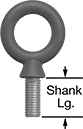 |
Closed Eye With Shoulder |
Closed Eye—Closed eyes are stronger than bent-closed eyes.
Thread | With Shoulder | ||||||||||
|---|---|---|---|---|---|---|---|---|---|---|---|
Size | Lg., mm | Shank Lg., mm | Eye Dia., mm | Vert. Cap., lb. | Threading | Temp. Range, ° F | Overall Lg., mm | Each | |||
Closed Eye | |||||||||||
| M14 × 2 mm | 28 | 28 | 35 | 3,500 | Fully Threaded | 30 to 275 | 103 | 7691T61 | 000000 | ||
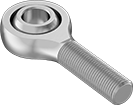
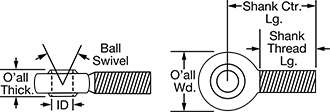
Ball Joint Rod Ends
 |  |
Shank | |||||||||||||
|---|---|---|---|---|---|---|---|---|---|---|---|---|---|
Thread Size | Ctr. Lg., mm | Thread Lg., mm | ID, mm | Max. Ball Swivel | Overall Wd., mm | Overall Thk., mm | Static Radial Load Cap., lb. | Material | Choose a Shank Thread Direction | Each | |||
Ball Joints | |||||||||||||
| M14 × 1.5 mm | 60 | 36 | 14 | 49° | 35 | 19 | 6,700 | Zinc-Plated Carbon Steel | Right Hand | 60645K113 | 000000 | ||
| M14 × 2 mm | 60 | 36 | 14 | 30° | 35 | 19 | 7,900 | Zinc-Plated Carbon Steel | Right Hand, Left Hand | 60645K983 | 00000 | ||
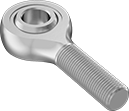
Lubrication-Free Ball Joint Rod Ends
 | |
Shank | |||||||||||||
|---|---|---|---|---|---|---|---|---|---|---|---|---|---|
Thread Size | Ctr. Lg., mm | Thread Lg., mm | ID, mm | Max. Ball Swivel | Overall Wd., mm | Overall Thk., mm | Static Radial Load Cap., lb. | Material | Choose a Shank Thread Direction | Each | |||
Ball Joints | |||||||||||||
| M14 × 1.5 mm | 60 | 36 | 14 | 21° | 35 | 19 | 16,100 | Zinc-Plated Alloy Steel | Right Hand, Left Hand | 2458K449 | 000000 | ||
| M14 × 2 mm | 60 | 36 | 14 | 21° | 35 | 19 | 16,100 | Zinc-Plated Alloy Steel | Right Hand, Left Hand | 2458K451 | 00000 | ||
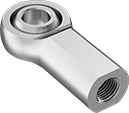
Internally Threaded Lubrication-Free Ball Joint Rod Ends
 | 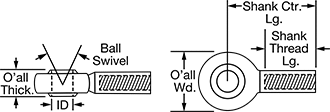 |
Ball Joint Rod End |
Shank | |||||||||||||
|---|---|---|---|---|---|---|---|---|---|---|---|---|---|
Thread Size | Ctr. Lg., mm | Thread Lg., mm | ID, mm | Max. Ball Swivel | Overall Wd., mm | Overall Thk., mm | Static Radial Load Cap., lb. | Material | Choose a Shank Thread Direction | Each | |||
Ball Joints | |||||||||||||
| M14 × 1.5 mm | 57 | 27 | 14 | 21° | 35 | 19 | 16,100 | Zinc-Plated Chrome-Moly Steel | Right Hand, Left Hand | 2458K91 | 000000 | ||
| M14 × 2 mm | 57 | 27 | 14 | 21° | 35 | 19 | 16,100 | Zinc-Plated Chrome-Moly Steel | Right Hand, Left Hand | 2458K89 | 00000 | ||
Partially Threaded Rod End Bolts
 |
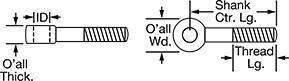 |
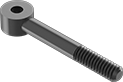
Create pivoting connections in applications that require high shear strength—the partially threaded shank of these rod end bolts withstands more side force than a fully threaded shank. Also known as swing bolts and eyebolts, they are used to create hinges, turnbuckles, and tie downs. Unlike ball joint rod ends, these rod end bolts are made from a single piece of metal, so they wear down more slowly and have a more controlled swing. However, because they do not have a moving ball joint, they do not compensate for angular misalignment. Made from steel, they are stronger and more wear resistant than stainless steel rod end bolts, but they are not as corrosion resistant.
Black-Oxide Carbon Steel—Rod end bolts with a black-oxide finish have a dark, matte coating that keeps the steel from rusting in dry environments.
DIN 444—Rod end bolts that meet DIN 444 adhere to international dimensional standards, ensuring they are compatible with other parts and tools.
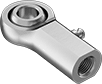
Internally Threaded Ball Joint Rod Ends with Grease Fitting
 | |
Shank | |||||||||||||
|---|---|---|---|---|---|---|---|---|---|---|---|---|---|
Thread Size | Ctr. Lg., mm | Thread Lg., mm | ID, mm | Max. Ball Swivel | Overall Wd., mm | Overall Thk., mm | Static Radial Load Cap., lb. | Material | Choose a Shank Thread Direction | Each | |||
Ball Joints with Grease Fitting | |||||||||||||
| M14 × 2 mm | 57 | 27 | 14 | 30° | 34.8 | 19 | 7,900 | Carbon Steel | Right Hand, Left Hand | 6536N5 | 000000 | ||
Corrosion-Resistant Ball Joint Rod Ends
 | |
Shank | |||||||||||||
|---|---|---|---|---|---|---|---|---|---|---|---|---|---|
Thread Size | Ctr. Lg., mm | Thread Lg., mm | ID, mm | Max. Ball Swivel | Overall Wd., mm | Overall Thk., mm | Static Radial Load Cap., lb. | Material | Choose a Shank Thread Direction | Each | |||
Ball Joints | |||||||||||||
| M14 × 2 mm | 60 | 36 | 14 | 30° | 35 | 19 | 5,300 | 303 Stainless Steel | Right Hand, Left Hand | 2988K16 | 000000 | ||
High-Load Ball Joint Rod Ends
 | |
These steel rod ends handle loads that are at least 25% higher than other comparably sized rod ends. PTFE allows smooth rotation and eliminates the need for lubrication.
Nylon/PTFE Insert—Rod ends with Nylon/PTFE insert have a durable, self-sealing insert that reduces wear.
Shank | |||||||||||||
|---|---|---|---|---|---|---|---|---|---|---|---|---|---|
Thread Size | Ctr. Lg., mm | Thread Lg., mm | ID, mm | Max. Ball Swivel | Overall Wd., mm | Overall Thk., mm | Static Radial Load Cap., lb. | Material | Choose a Shank Thread Direction | Each | |||
Ball Joints | |||||||||||||
Nylon/PTFE Insert | |||||||||||||
| M14 × 2 mm | 60 | 36 | 14 | 21° | 35 | 19 | 20,300 | Alloy Steel | Right Hand, Left Hand | 60745K97 | 000000 | ||
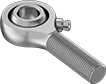
Ball Joint Rod Ends with Grease Fitting
 | |
Shank | |||||||||||||
|---|---|---|---|---|---|---|---|---|---|---|---|---|---|
Thread Size | Ctr. Lg., mm | Thread Lg., mm | ID, mm | Max. Ball Swivel | Overall Wd., mm | Overall Thk., mm | Static Radial Load Cap., lb. | Material | Choose a Shank Thread Direction | Each | |||
Ball Joints with Grease Fitting | |||||||||||||
| M14 × 2 mm | 60 | 36 | 14 | 30° | 34.8 | 19 | 7,900 | Carbon Steel | Right Hand, Left Hand | 4444T13 | 000000 | ||
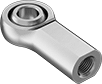
Internally Threaded High-Load Ball Joint Rod Ends
 | |
Shank | |||||||||||||
|---|---|---|---|---|---|---|---|---|---|---|---|---|---|
Thread Size | Ctr. Lg., mm | Thread Lg., mm | ID, mm | Max. Ball Swivel | Overall Wd., mm | Overall Thk., mm | Static Radial Load Cap., lb. | Material | Choose a Shank Thread Direction | Each | |||
Ball Joints | |||||||||||||
Nylon/PTFE Insert | |||||||||||||
| M14 × 2 mm | 57 | 27 | 14 | 21° | 35 | 19 | 20,300 | Chrome-Moly Steel | Right Hand, Left Hand | 4483T93 | 000000 | ||
Internally Threaded Corrosion-Resistant Ball Joint Rod Ends
 | |
Shank | |||||||||||||
|---|---|---|---|---|---|---|---|---|---|---|---|---|---|
Thread Size | Ctr. Lg., mm | Thread Lg., mm | ID, mm | Max. Ball Swivel | Overall Wd., mm | Overall Thk., mm | Static Radial Load Cap., lb. | Material | Choose a Shank Thread Direction | Each | |||
Ball Joints | |||||||||||||
| M14 × 2 mm | 57 | 27 | 14 | 30° | 35 | 19 | 5,300 | 303 Stainless Steel | Right Hand, Left Hand | 2988K36 | 000000 | ||
Long-Life Ball Joint Rod Ends
 | |
Seals keep out dirt and an oil-embedded polyester foam insert slowly releases lubricant for a long life. You can remove the insert to add more oil if it starts to run dry. These rod ends have an eyelet and a ball that swivels to support angular misalignment. Made of zinc-plated steel, they have moderate corrosion resistance.
Shank | |||||||||||||
|---|---|---|---|---|---|---|---|---|---|---|---|---|---|
Thread Size | Ctr. Lg., mm | Thread Lg., mm | ID, mm | Max. Ball Swivel | Overall Wd., mm | Overall Thk., mm | Static Radial Load Cap., lb. | Material | Choose a Shank Thread Direction | Each | |||
Ball Joints | |||||||||||||
| M14 × 1.5 mm | 60 | 36 | 14 | 21° | 34.8 | 21 | 6,700 | Zinc-Plated Carbon Steel | Right Hand, Left Hand | 5884N33 | 000000 | ||
| M14 × 2 mm | 60 | 36 | 14 | 30° | 34.8 | 21 | 7,900 | Zinc-Plated Carbon Steel | Right Hand, Left Hand | 5884N34 | 00000 | ||
