


About Glove Sizing
More
Latex Chemical-Resistant Gloves

Resistant to most acids, alcohols, and cleaning solutions, these gloves are often used for cleaning laboratories and general maintenance work. They stay flexible for tasks that require precision.
Smooth gloves are grippy enough to handle dry objects. They allow for more precise handling than textured gloves.
Gloves that meet EN 374 are rated to European standards for protection from chemicals. Gloves with a Type A or Type B rating resist chemical permeation for at least 30 minutes. A Type A rating means they are tested against twice as many chemicals as gloves with a Type B rating.
Gloves that meet EN 388 are rated to European standards for resistance to abrasions, cuts, tears, or punctures. This rating is similar to ANSI/ISEA 105.
Available Sizes | |
|---|---|
| Size | Glove Size  |
| S | 7 |
| M | 8 |
| L | 9 |
| XL | 10 |
Pkg. | |||||||||||
|---|---|---|---|---|---|---|---|---|---|---|---|
| Thick., mil. | Lg. | Texture | Cuff Style | Color | For Use With | Specifications Met | Number of Gloves Included | Choose a Size | 1-11 | 12-Up | |
Latex Rubber | |||||||||||
Gloves with Sleeve | |||||||||||
| 59 | 24" | Smooth | Open | Black | Hydrochloric Acid, Hydrogen Peroxide, Isopropyl Alcohol, Nitric Acid, Sodium Hydroxide, Sulfuric Acid | EN 374 Type A (AKLMPT), EN 388 (3121B) | 1 Pair | 5306T9 | 000000 | 000000 | |
PVC Chemical-Resistant Gloves
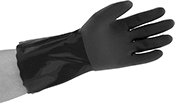
Protect your hands from common chemicals, such as sodium hydroxide and sulfuric acid. Often used for chemical washdowns, these gloves are good for tasks where durability is more important than dexterity. They hold up to repeated use, and they won’t absorb water even after soaking for long periods. However, they offer less chemical protection than our other chemical-resistant gloves. They shouldn’t be used with strong organic solvents.
Heat-protection gloves are lined with Kevlar, which helps them meet ANSI/ISEA 105 standards for heat resistance. Rated 3 on a scale of 5, they can withstand up to 390° F for at least 15 seconds before there’s a risk of second-degree burns. Gloves that meet ANSI/ISEA 105 or EN 388 standards are rated for various forms of protection, such as cuts, abrasions, or punctures.
Gloves that meet EN 374 Type A or B standards protect against chemical permeation for at least 30 minutes. Each letter in the rating represents a chemical that these gloves were tested against.
Available Sizes | |
|---|---|
| Size | Glove Size |
| M | 8 |
| L | 9 |
| XL | 10 |
Pair | ||||||||||||||
|---|---|---|---|---|---|---|---|---|---|---|---|---|---|---|
| Thick., mil | Lg. | Texture | Lining Material | Cuff Style | Color | Min. Temp. | Max. Temp., °F | For Use With | ANSI Conductive Heat Resistance Rating | Specifications Met | Choose a Size | 1-11 | 12-Up | |
PVC Plastic-Coated PVC Plastic | ||||||||||||||
| 59 | 12" | Textured | Kevlar Fabric | Open | Blue | Not Rated | 390° | Sodium Hydroxide | 3 | ANSI/ISEA 105, EN 374 Type B (AJK), EN 388 (4X42C) | 9937N18 | 000000 | 000000 | |