We will reply to your message within an hour.
More
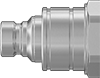
To minimize fluid loss when connecting and disconnecting your line, these couplings have flat faces for a close fit and shut-off valves to stop the flow—they meet ISO 16028, which is an international standard for hose couplings.
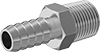
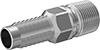
These metal hose fittings have better durability than plastic barbed hose fittings. They are 316 stainless steel for excellent corrosion and chemical resistance. Slide the barbed end into hose and secure with a clamp.
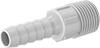
Made of plastic, these fittings are lighter in weight than metal barbed fittings, yet have the chemical and corrosion resistance to stand up to harsh substances. Slide the barbed end into plastic or rubber hose and secure with a clamp.
Low-profile barbs and a longer first barb allow for a smoother, easier installation than other barbed fittings. Slide the barbed end into hose and secure with a clamp.
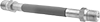
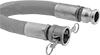
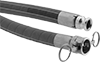
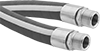
Cut the hose to your desired length and attach the fittings. You don't need any special equipment to install.
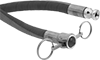
Use this conductive hose in a grounded system to eliminate static buildup. The material is blended with carbon black, which conducts static charges away from the hose walls.
Step on this hose and it springs back to its original shape.
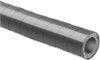
Expose this UHMW (ultra-high molecular weight) polyethylene hose to harsh physical conditions without worrying about it deteriorating or becoming brittle.
Yarn reinforcement gives this hose good strength under pressure.
Made of FEP (fluorinated ethylene propylene), this hose can stand up to chemicals at high temperatures.
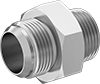
Also known as JIC (Joint Industrial Council) fittings, these connect to tubing that is flared to 37°. They can handle higher pressures than 45° flared fittings.
Also known as JIC (Joint Industrial Council) fittings, these provide a tight metal-to-metal seal on steel tubing that is flared to 37°.
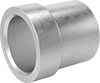
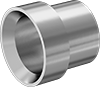
Use these sleeves with a nut and fitting to provide a tight metal-to-metal seal on steel tubing that is flared to 37°.
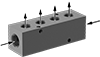
Distribute air or fluid to multiple locations from a single supply source with these manifolds. They are also known as headers.
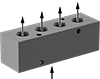
Unlike other manifolds, which have an inlet on either end, these have one inlet on the opposite side from the outlets. This design allows air or fluid to follow a straight path, improving flow through your system. Also known as headers.
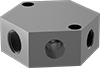
When you’re short on vertical space, these manifolds are a good fit—they have outlets on the side instead of on top, so they have a lower profile than rectangular manifolds. Use them to distribute air or fluid to five locations from a single supply source.
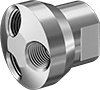
Mount these manifolds on the end of a hose line to distribute air, water, or hydraulic fluid to three locations from a single supply source.
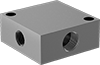
With outlets on the side instead of on top, these manifolds have a lower profile than rectangular manifolds and fit well in cramped spaces. Use them to distribute air or fluid to three locations from a single supply source.
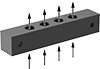
Use these junction blocks to organize and separate multiple lines in your system. They have threaded holes that allow air or fluid to flow straight through the block.