


Filter by
Actuator Style


Conduit Thread Type
Actuator Height
Switch Designation
Electrical Connection

Switch Starting Position
Number of Circuits Controlled
Number of Terminals
Certification

Number of Mounting Holes
Switch Type
Actuation Force
Wire Connection

Housing Material
Mounting Hole Diameter
U.S.–Mexico–Canada Agreement (USMCA) Qualifying
UL File Number
DFARS Specialty Metals
Export Control Classification Number (ECCN)
REACH
RoHS
Safety Limit Switches
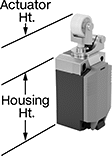 | 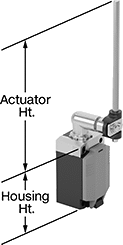 |
Style C | Style F |
Protect machinery and ensure the safety of personnel—these switches have positive-force contacts that will open the circuit when actuated even if a spring fails or the contacts stick. When an object in motion comes into contact with the actuator, it sends a signal to open or close a circuit. These switches have the rapid-closing action of a snap-acting switch, but with a larger actuator. This makes them a good choice for use with large objects—for instance, a box on a conveyor runs into the switch, stopping the conveyor.
Roller Lever Actuator—Switches with a roller lever actuator use a lever with a roller at the end to activate. This allows parts to glide across the actuation surface with minimal friction, limiting wear and tear on your switch.
Rod Actuator—Switches with a rod actuator use a rod extending out of the body to actuate, so they’ll activate even if an object is far away.
Style F—Styles D, E, and F have an actuator that allows you to adjust its height, making it easier to align switch with the target during installation.
Plastic Actuator—Switches with a plastic actuator limit wear and tear on passing objects better than switches with a steel actuator.
Steel Actuator—Switches with a steel actuator are more durable than switches with a plastic actuator. They also handle higher loads.
Housing | |||||||||||||||||||||
|---|---|---|---|---|---|---|---|---|---|---|---|---|---|---|---|---|---|---|---|---|---|
Style | No. of Circuits Controlled | Switch Starting Position | Switch Action | Switch Designation | Actuator Material | Switching Current @ Voltage | Max. Voltage | Actuation Torque, in·ozf | Operating Temp. Range, ° F | Actuator Ht. | No. of Terminals | Lg. | Ht. | Dp. | Housing Material | Conduit Thread Size | Enclosure Rating | Each | |||
Roller Lever Actuator | |||||||||||||||||||||
Screw-Terminal Wire Connection | |||||||||||||||||||||
| C | 1 | 1 Off or 1 On | Momentary | SPDT | Plastic | 3 amp @ 240V AC, 1.5 amp @ 24V DC | 240V AC 24V DC | — | -22 to 165 | 1.5" | 4 | 1.7" | 2.9" | 1.6" | Plastic | M20 | NEMA 4X, IP66, IP67 | 65745K45 | 0000000 | ||
Rod Actuator | |||||||||||||||||||||
Screw-Terminal Wire Connection | |||||||||||||||||||||
| F | 1 | 1 Off or 1 On | Momentary | SPDT | Steel | 3 amp @ 240V AC, 1.5 amp @ 24V DC | 240V AC 24V DC | 24.8 | -22 to 165 | 0.5" to 8" | 4 | 1.7" | 2.9" | 1.6" | Plastic | M20 | NEMA 4X, IP66, IP67 | 65745K46 | 000000 | ||
