McMaster-Carr logo
    Enter e-mail addresses in the fields below
    Message
    Cancel
    Comments
    E-mail address (if you would like a response)
    6 Products

    High-Density Low-Melting-Point Solder

    This bismuth-tin solder has similar performance properties to lead solder, but is also safe for use in food-processing equipment and copper water pipes. It has a lower melting point than most solders, so it’s good for sensitive assemblies, such as semiconductors and electronic components, as well as for step soldering with traditional solders. However, it’s less thermally conductive than other metals and more brittle than lead. Flux isn’t required, but for easier cleanup use it with no-clean soldering flux. Do not use this solder on drinking water pipes.
    Lead-Free, No Flux Required
    Image of Product. Front orientation. Solder. High-Density Low-Melting-Point Solder.
    Lead-free solder is safer to use than leaded solder and helps meet industry regulations.
    1% Silver—Solder with 1% silver forms stronger bonds than solder without silver. It’s also more malleable and ductile. However, it has a higher melting point, so it takes longer to solder.
    Material
    Composition
    0.12 oz.
    Solder
    Alloy
    Bismuth
    Tin
    Silver
    Lead
    Dia.
    Melting
    Temp., ° F
    Lg.
    Each
    For Joining Aluminum, Brass, Bronze, Copper, Nickel, Stainless Steel, Steel, and Zinc
    Bi57Sn42Ag157%42%1%0%0.030"28536"000000000000000
    Bi58Sn4258%42%0%0.030"28036"00000000000000
     

    Low-Melting-Point Solder for Low-Temperature Applications

    Even as temperatures approach absolute zero, this indium solder remains soft and malleable, allowing it to form an airtight seal between metal and certain non-metal materials. It’s often used in cryogenic applications, including those with liquid nitrogen. This solder has a lower melting point than most solders, so it’s good for sensitive assemblies, such as semiconductors and electronic components. Unlike commonly used tin-based solders, this solder won’t damage gold plating on circuit boards. It’s also a good conductor of heat and electricity. More durable than standard tin-lead solder, this solder is less likely to crack from repeated temperature swings. It’s low outgassing, so it’s good for use in high-vacuum applications.
    This indium-based solder can be cold welded, meaning it will bond to itself without heat. You can also use it for step soldering with traditional solders. It does not have a flux core; choose soldering flux to prepare workpieces for this solder.
    Lead-Free, Flux Required
    Image of Product. Front orientation. Solder. Low-Melting-Point Solder for Low-Temperature Applications.
    Lead-free solder is safer to use than leaded solder and helps meet industry regulations.
    100% Indium—Solder that is 100% indium has better thermal conductivity than solder that contains tin, and will cold weld more easily. However, it has lower tensile and shear strength than solder with tin.
    48% Tin—Solder with 48% tin has greater tensile and shear strength than 100% indium solder, but lower thermal and electrical conductivity.
    Material
    Composition
    0.11 oz.
    Solder
    Alloy
    Indium
    Tin
    Lead
    Dia.
    Melting
    Temp., ° F
    Thermal Conductivity,
    W/(m⋅°C)
    Tensile Strength,
    psi
    Each
    For Joining Aluminum, Brass, Bronze, Ceramic, Glass, Nickel, Quartz, Stainless Steel, Steel, and Zinc
    In52Sn4852%48%0%0.030"245341,72000000000000000
    In100100%0%0.030"315862700000000000000
     

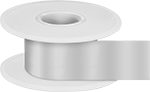
    Low-Melting-Point Solder Ribbon for Low-Temperature Applications

    Made with indium this solder is soft and malleable—even as temperatures approach absolute zero—allowing this solder to form an airtight seal between metal and certain non-metal materials. It’s often used in cryogenic applications, including those with liquid nitrogen. Thanks to its ribbon shape, this solder is easier to use on large, flat areas than wire solder.
    This solder has a lower melting point than most solders, making it good for sensitive assemblies, such as semiconductors and electronic components. Unlike commonly used tin-based solders, this solder won’t damage gold plating on circuit boards. It’s also a good conductor of heat and electricity. More durable than standard tin-lead solder, this solder is less likely to crack from repeated temperature swings. It’s low outgassing, so you can also use it in high-vacuum applications.
    This indium-based solder can be cold welded, meaning it will bond to itself without heat. You can also use it for step soldering with traditional solders. It does not have a flux core, choose soldering flux to prepare workpieces for this solder.
    Lead-Free, Flux Required
    Image of Product. Front orientation. Solder. Low-Melting-Point Solder Ribbon for Low-Temperature Applications.
    Lead-free solder is safer to use than leaded solder and helps meet industry regulations.
    Material
    Composition
    0.1 oz.
    Solder
    Alloy
    Indium
    Tin
    Lead
    Melting
    Temp., ° F
    Thermal Conductivity,
    W/(m⋅°C)
    Tensile Strength,
    psi
    Lg.
    Wd.
    Thk.
    Each
    For Joining Aluminum, Brass, Bronze, Ceramic, Glass, Gold, Nickel, Quartz, Stainless Steel, Steel, Zinc
    In52Sn4852%48%0%245341,72012"1"0.002"00000000000000
    In100100%0%3158627012"1"0.002"0000000000000
     
    back to top