We will reply to your message within an hour.
More
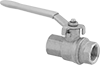
Use these valves in general purpose applications, such as those with water, oil, air, and inert gas.
Attach a gauge to the side port on these valves to monitor pressure, temperature, and other measurements in your line. Use with water and air.
An easy-to-read flow-indicating handle shows the percentage the valve is open. These valves are for use with water, oil, inert gas, and steam.
For installation through thick insulation, these valves have an extra-long stem.
A built-in strainer traps debris and allows you to replace the screen without disconnecting your pipeline.
These valves handle twice the pressure of other compact valves. Install them in tight spots, such as where pipelines are crowded together. Use with water, oil, air, and inert gas.
Install these valves in tight spots, such as where pipelines are crowded together. They’re less than half as long as standard threaded valves and one-third shorter in height. Use with water, oil, air, and inert gas.
Access the handle of these valves while protecting your line behind an instrument panel. They have threads and a hex nut below the handle for panel mounting.
Start or stop flow with the flip of a toggle switch or the push of a button. They fit through a cutout, so the body of the valve stays safe inside your instrumentation panel.
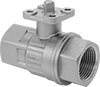
For fast installation and removal from pipelines, these valves have a union fitting that disassembles into multiple pieces. They’re for use with water, oil, air, inert gas, and steam.
These valves have barbs that grip onto tubing, providing a secure hold. Because they’re made of metal, they are more durable than plastic valves and withstand higher temperatures.
For extra gripping power and a strong seal, the Yor-Lok fittings on these valves have two sleeves that bite into tubing as you tighten the nut. All are compatible with Swagelok®, Let-Lok, and Parker A-Lok fittings. These valves are for use with water, oil, air, and inert gas.
Easily access the handle of these valves while protecting your line behind an instrument panel. They have threads and a hex nut below the handle for panel mounting. For extra gripping power and a strong seal, they have Yor-Lok fittings with two sleeves that bite into tubing as you tighten the nut. They’re compatible with Swagelok®, Let-Lok, and Parker A-Lok fittings.
Built to withstand pressures up to 4,500 psi, these valves are ideal for high-pressure lines. For extra gripping power and a strong seal, they have Yor-Lok fittings with two sleeves that bite into tubing as you tighten the nut. All are compatible with Swagelok®, Let-Lok, and Parker A-Lok fittings
A short body length and low profile make these valves ideal for installation in tight spaces, such as between pipelines. They have a compression sleeve that bites into tubing as you tighten the nut.
Install these valves in lines that require frequent maintenance or cleaning. They give you a leak-tight, permanent solder connection to your tubing with the ease of a union fitting to install them without disrupting your line.
Crimp these valves to metal tubing for a permanent, leak-tight connection that doesn’t require heat or soldering.
To withstand aggressive and corrosive solutions in miniature chemical-processing pipelines, these tiny valves have a chemical-resistant fluoroelastomer seal and a corrosion-resistant 303 stainless steel body.
To withstand aggressive and corrosive solutions in chemical-processing applications, these valves have a fluoroelastomer seal and a PVC or CPVC body.
No need to remove these valves from your line to access their internal components—the three-piece bolted body comes apart. Ideal in chemical-processing applications, the seal and polypropylene body stand up to aggressive and corrosive solutions.
There’s no need to unbolt these valves for cleaning—remove the valve handle and slide the valve apart for inline access to internal components. Also known as elliptical valves, they have a fluoroelastomer seal and a polypropylene body to withstand aggressive and corrosive solutions in chemical-processing applications.
For fast installation and removal from pipelines, these valves have union fittings that disassemble into multiple pieces. All have a fluoroelastomer seal and a plastic body that can stand up to aggressive and corrosive solutions in chemical-processing applications.
Insert tubing into the fittings on these valves—no heat, solder, or flux required. To withstand aggressive and corrosive solutions, they have a chemical-resistant fluoroelastomer seal and a plastic body.
Barbs grip onto tubing, providing a secure hold. To withstand aggressive and corrosive solutions in chemical-processing applications, these valves have a plastic body and a chemical-resistant seal.
Streamline your installation and removal process. These valves give you the leak-tight permanent connection of a socket connect with the ease of fittings that come apart.
Insert unthreaded pipe into the socket ends and bond with primer and cement to create a permanent, leak-tight connection. These valves have a fluoroelastomer seal and a plastic body that can withstand aggressive and corrosive solutions in chemical-processing applications.
Bolt these valves to ANSI flanges—they meet ASME dimensional standards. They have a plastic body and a seal that withstand aggressive and corrosive solutions in chemical-processing applications.
No need to completely remove these valves from your line for cleaning and repairs. The bolted three-piece body comes apart, so you can easily access their internal components.
Service these valves without cutting soldered connections. The three-piece bolted body disassembles to access internal components, so you can clean and repair these valves without removing them from your line. They meet NSF/ANSI 61 for safe use in drinking water systems.
Protect personnel and equipment in the presence of diesel fuel, fuel oil, gasoline, and kerosene. Fire-tested to meet American Petroleum Institute (API) 607, Edition 4, these valves are designed to securely isolate fluid and prevent the spread of fire.
These valves have socket-weld connections for bonding to unthreaded male plastic pipe.
For use with threaded pipe, these valves have NPT connections.
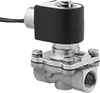
These solenoid valves operate on electricity to automatically start and stop flow. The actuator is directly mounted to the valve body to minimize movement and reduce wear.
Less than half the size of our other compact valves, these have small pipe connections for miniature lines.
Use with coolant and detergent such as ethylene glycol or soap solutions.
Reduce your pipeline footprint with these low-profile valves that are about half the size of standard valves for coolant.
Often used to control single-acting, spring-return air cylinders, these valves have a third threaded port to exhaust media.
These valves have threaded NPT connections.
With a plastic body and a fluoroelastomer seal, these valves can stand up to aggressive and corrosive solutions in chemical-processing applications.
Supply fuel oil to boilers, furnaces, and other equipment.
For use in general purpose applications with water, oil, and inert gas.
Limit wear and damage in high-cycling applications—these valves have additional seals that prevent leakage to reduce maintenance time.
Also known as piston valves, these have a compact, lightweight actuator that allows them to be installed in any mounting orientation. They’re often used in water-treatment applications.
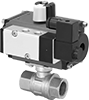
Also known as actuated ball valves, these provide higher flow rates than other air-driven valves.
All valves have threaded NPT connections.
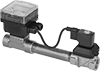
Accurately and consistently dispense a specific amount of liquid—these actuated valves have a screen and buttons for programming batch size and calibration.
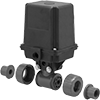
Automatically or manually start and stop flow in your line with these valve bodies, which attach to your actuator.
Attach these valve bodies to your actuator to automatically or manually control flow in your line.
Threads and a hex nut below the handle let you install these valves through instrument panels. They are for use with water, oil, air, and inert gas. All divert flow between ports.
Control flow in two directions from a single source—these valves have two handles for independent operation of each outlet. Use them with water, oil, and inert gas.
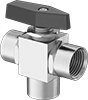
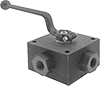
These valves divert flow between ports. Use with water, oil, air, and inert gas.
There’s no need to unbolt these valves for cleaning—remove the handle and slide the valve apart for inline access to internal components. Also known as elliptical valves, they have a fluoroelastomer seal and a polypropylene body for diverting flow in chemical-processing applications.
Perform valve maintenance without unthreading pipe connections. These valves have a three-piece bolted body that comes apart for inline access to internal components. The fluoroelastomer seal and glass-filled polypropylene body can withstand aggressive and corrosive solutions for diverting flow in chemical-processing applications.
For easy installation and removal from pipelines, all ends on these valves have union fittings that disassemble into multiple pieces. Their fluoroelastomer seal and plastic body can withstand aggressive and corrosive solutions for diverting flow between ports in chemical-processing applications.
Barbed fittings on these valves grip onto tubing, providing a secure hold. To divert flow between ports in chemical-processing applications, they have a chemical-resistant seal and a PVDF body to withstand aggressive and corrosive solutions.
Insert tubing into the fittings on these valves—no heat, solder, or flux required. Designed for diverting flow between ports in chemical tubing lines, they have a fluoroelastomer seal and a PVDF body to withstand aggressive and corrosive solutions.
Use these couplings at pressures up to 5,000 psi. They consist of a plug and socket that connect and disconnect quickly. Use them if you need frequent access to a line. They are compatible with International Standard ISO B-shape plugs and sockets.
Couplings consist of a plug and a socket that connect and disconnect quickly. Use them if you need frequent access to a line. They are designed for coolant applications up to 200 psi. Also known as coolant-line mold couplings.
Minimize spills if a driver pulls away from your diesel exhaust fluid (DEF) pump too soon. Both halves of these couplings have a shut-off valve that stops the flow they’re separated.
Often used for loading and unloading gas tankers, these couplings are tough enough to handle frequent connections and designed to be virtually spill-free.
Use these couplings when you need frequent access to a gas line. A complete coupling consists of a plug and a socket that connect and disconnect quickly.
To minimize fluid loss when connecting and disconnecting your line, these couplings have flat faces for a close fit and shut-off valves to stop the flow—they meet ISO 16028, which is an international standard for hose couplings.
Minimize chemical and petroleum spills during accidental disconnects, such as a driver pulling away during loading. These couplings have a shut-off valve on each half to stop flow when they’re separated.
Couplings are compatible with quick-disconnect Plastic-shape plugs and sockets. They are designed for food and beverage applications and won’t impart tastes or odors to the product. They consist of a plug and a socket that connect and disconnect quickly so you can frequently access your line. Use at pressures up to 100 psi.
Quickly connect and disconnect hose lines used with a variety of chemicals, from adhesives to isopropyl alcohol and ink. Any part of these couplings that contacts fluid is made from 316 stainless steel, C-276 Hastelloy, PTFE, or fluoroelastomer to withstand the chemicals in your line.
Also known as dry disconnects and double shut-off couplings, these couplings make connecting and disconnecting your line quick and virtually spill-free. Built to stand up to petroleum products, such as diesel fuel and gasoline, their body and gasket are made from materials that won’t corrode from oil.
Made of polypropylene, these couplings are lighter in weight than metal cam-and-groove couplings. Also known as dry disconnects and double shut-off couplings, they have a shut-off valve in the plug and the socket for minimal fluid loss when disconnecting your hose line.
Couplings are metal, which has better durability than plastic cam-and-groove hose couplings. Also known as dry disconnects and double shut-off couplings, they have a shut-off valve in the plug and the socket for minimal fluid loss when disconnecting your hose line.
Start and stop flow with a quarter turn of the handle. Also known as ball valves.
Lock the handle using a padlock.
Turn the handle to direct flow between ports.