We will reply to your message within an hour.
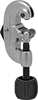
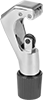
A small swing radius lets you cut tubing in tight spaces.
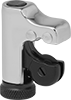
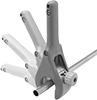
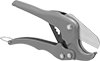
An enclosed ratchet feed opens quickly to accept tubing and instantly slides to cutting position.
For smooth cuts and trouble-free operation, these cutters have enclosed steel bearings.
This cutter has two sets of guide wheels that ride in the corrugations for stability so you get clean, precise cuts.
After cutting, crimp tubing in preparation for making connections.
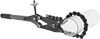
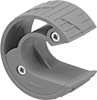
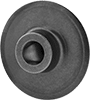
A spring-loaded cutting wheel tightens as you spin these cutters around tubing without a handle to get in your way.
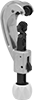
Ratchet action permits cutting in cramped areas.
Made of materials that are FM approved, these cutters satisfy OSHA requirements that specify nonsparking tools for locations where flammable vapors and combustible residues are present.
An insulated handle protects against shock from accidental contact with live electrical circuits. These cutters are tested to 1,000 volts to meet IEC 60900 and ASTM F1505.
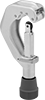
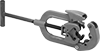
These heavy duty cutters have an iron frame for exceptional durability.
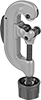
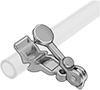
Turn this cutter 360° around a pipe to make a cut.
Cut pipe with just 90°-110° of handle swing and 4" of clearance.
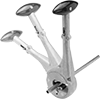
Ratchet action moves the cutter 360° around a pipe with only 10° of handle swing.
A fast-acting release lever opens the cutter to maximum size. Push the handle to quickly slide the cutting wheel onto the pipe.
Make cuts in most rigid plastic tubing.
Access clay and cast iron soil pipe in tight spots.
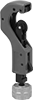
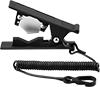
Apply fingertip pressure to this spring-loaded cutter while rotating the tubing.
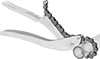
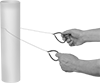
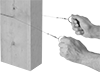
Wrap the cutter chain around tubing, then squeeze the handles while rotating the tubing.
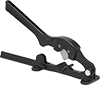
Ratchet action increases leverage to cut through hose, soft rubber tubing, or plastic pipe.
Cut plastic and rubber pipe, tubing, and hose.
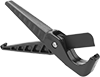
Fit this compact cutter into your pocket or tool belt.
Cut plastic and rubber tubing from your bench top.
Cut PEX tubing with one or two twists.
Melt through irrigation, plumbing, and electrical grade PVC pipe with heat friction.
Cut through branches and logs in hard-to-reach areas.
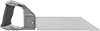
A blade made of carbon steel cuts plastic pipe, plasterboard, and plywood.
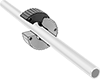
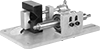
Use this clamp with your 1/2" chuck capacity drill and a hole saw to cut notches in pipe and tubing to make intersecting connections.
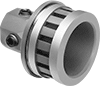
Add or replace parts such as die sets, power drives, and die head adapters on Ridgid Pipe and Conduit Threaders.
Add or replace parts such as drive adapters, die sets, and drive bars for the Ridgid Large Size Pipe and Conduit Threader Adapter.
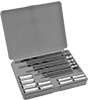
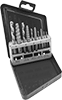
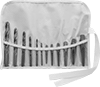
The extractors in this set are matched with the right drill bit sizes as well as bushings to help you drill a centered hole into the broken part.
The extractors in these sets provide the tightest fit and the most contact with the part to be removed but also cause the most expansion.
These extractors provide the tightest fit and the most contact with the part to be removed but also cause the most expansion.
No more searching for the right drill bit sizes—these sets match them with the corresponding extractors.
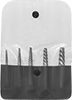
Keep a selection of extractors on hand to back out a variety of broken parts without damaging the threads around them.
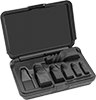
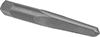
Drill a hole in the broken part, insert the extractor, and turn. The part will back out without damaging the threads around it.
These sets include a variety of extractors with deep flutes to provide a strong grip and reduced expansion of the part you need to extract.
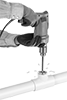
Deep flutes provide a strong grip and reduced expansion of the part you need to extract.
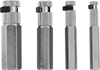
Drill old pipe stubs out of fittings when replacing plastic pipe. These extractors let you reuse difficult-to-remove fittings, such as those in concrete floors, and install new pipe.
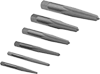
The extractors in these sets have a tapered wedge shape that won’t expand the broken part, making it easier to remove. After drilling, tap in with a hammer and turn.
The tapered wedge shape of these extractors won’t expand the broken part, making it easier to remove. After drilling, tap in with a hammer and turn.
The tapered wedge shape of these extractors won’t expand the broken part, making it easier to remove. Sets include the matching drill bit sizes.
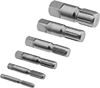
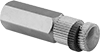
Insert the extractors in these sets into a pipe or fitting and turn with a wrench—the knurls will grip the part so you can twist it out.
Insert these extractors into a pipe or fitting and turn with a wrench—the knurls will grip the part so you can twist it out.
Use this tool to cut and strip weld-spatter-resistant tubing in order to attach fittings.
Use these reamers before tapping with taper-pipe taps.