


Filter by
System of Measurement
Output Voltage

Input Voltage
Output Power
Mounting Location
Input Current @ Voltage
Number of Output Power Connections
Electrical Phase
Control Type

Output Socket Connection

Input Frequency
Electrical Connection


Output Voltage Type
Adjustability
Electrical Protection Type
Input Number of Blades

U.S.–Mexico–Canada Agreement (USMCA) Qualifying
DFARS Specialty Metals
Bench-Mount Power Supplies
1 Output Power Connection—Banana Jack Socket
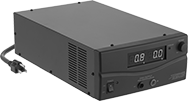 |
Output Voltage Selector Switch—Power supplies with output voltage selector switch let you choose either an adjustable output, which you control with a dial, or an output fixed at 13.8V DC.
Output | ||||||||||||||
|---|---|---|---|---|---|---|---|---|---|---|---|---|---|---|
Connection | Voltage | Current | Power | Max. Noise Peak-to-Peak | Output Connection Location | Output Features | Ht. | Wd. | Dp. | Electrical Protection Type | Each | |||
Single Phase—120V AC Input Voltage | ||||||||||||||
| Standard Banana Socket | 13.8V DC, 3V DC to 15V DC | 40 amp | 552 W, 120 W to 600 W | 30 mV DC | Front | Constant Current, Constant Voltage, Output Voltage Selector Switch | 4.4" | 11.9" | 8.6" | Over Temperature, Overcurrent, Overload, Overvoltage | 5772N12 | 0000000 | ||
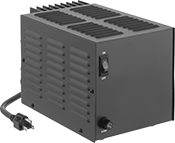
Fixed-Voltage Bench-Mount Power Supplies
 | 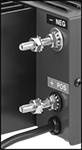 |
Stud Terminal on Back |
No need to adjust the voltage on these power supplies—they’re specifically designed to convert 120V AC to 13.8V DC. This voltage is common in radio transmitters, battery chargers, and automotive electrical systems, so these power supplies are often used to develop and test electronics that will be used in those applications. Since they are not adjustable, there’s no risk of supplying the wrong voltage and damaging your equipment. Power supplies have a stud terminal output connection to work with wire leads. Wrap the wire around the stud and secure with the included nuts, or attach alligator clips to the studs.
These power supplies have linear voltage regulation, which means they produce the same voltage regardless of changes in the input voltage or the amount of current being drawn. They are also known as linear power supplies. They have extremely low noise output, meaning that they keep electronic interference (also known as output noise or ripple noise) from being passed on to your device. However, these power supplies are larger, use more energy, and give off more heat than switching power supplies with a similar output.
If you exceed the maximum load or current, they’ll shut down to protect both the power supply and the connected equipment.
Overvoltage—Power supplies with overvoltage protection will also shut down if you exceed the maximum voltage.
Output | ||||||||||||||
|---|---|---|---|---|---|---|---|---|---|---|---|---|---|---|
No. of Power Connections | Voltage | Current | Power | Max. Noise Peak-to-Peak | Ht. | Wd. | Dp. | Electrical Protection Type | Output Connection Location | Output Features | Each | |||
Single Phase—120V AC Input Voltage | ||||||||||||||
Stud-Terminal Output Connection | ||||||||||||||
| 1 | 13.8V DC | 25 amp | 331.2 W | 16 mV DC | 6.8" | 6.3" | 10.3" | Overcurrent, Overload, Overvoltage | Back | Constant Voltage | 5770N18 | 0000000 | ||
| 1 | 13.8V DC | 40 amp | 532.3 W | 30 mV DC | 6.8" | 10.5" | 11.5" | Overcurrent, Overload, Overvoltage | Back | Constant Voltage | 5770N2 | 000000 | ||
| 1 | 13.8V DC | 60 amp | 780.5 W | 28 mV DC | 6.8" | 10.5" | 11.5" | Overcurrent, Overload, Overvoltage | Back | Constant Voltage | 5770N22 | 000000 | ||
