We will reply to your message within an hour.
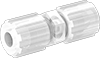
Not only do these PFA fittings have the chemical resistance to handle acid and salt water, they also have better crack resistance than other plastic pipe fittings for chemicals. They are commonly used in high-purity chemical flow processes, such as semiconductor and clean room applications.
These fittings have excellent corrosion resistance to handle a wide range of acids and other highly-corrosive chemicals. They are commonly used in metal surface treating applications, plating solution lines, and other chemical process applications. Reinforced with layers of fiberglass, they have better strength and durability than any of our other pipe fittings for chemicals.
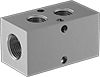
Distribute air or fluid to multiple locations from a single supply source with these manifolds. They are also known as headers.
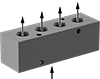
Unlike other manifolds, which have an inlet on either end, these have one inlet on the opposite side from the outlets. This design allows air or fluid to follow a straight path, improving flow through your system. Also known as headers.
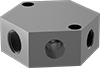
When you’re short on vertical space, these manifolds are a good fit—they have outlets on the side instead of on top, so they have a lower profile than rectangular manifolds. Use them to distribute air or fluid to five locations from a single supply source.
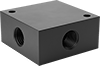
With outlets on the side instead of on top, these manifolds have a lower profile than rectangular manifolds and fit well in cramped spaces. Use them to distribute air or fluid to three locations from a single supply source.
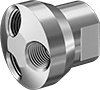
Mount these manifolds on the end of a hose line to distribute air, water, or hydraulic fluid to three locations from a single supply source.
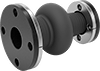
Connect different pipe sizes in your line while adding a point of flexibility between them. These expansion joints absorb movement between two connected pipes to reduce stress, vibration, and noise.
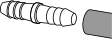
Fittings have a barb that grips onto tubing. Use in applications up to 120 psi.
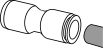
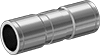
Also known as instant fittings, these chemical-resistant plastic fittings connect to tubing with a push. An internal gripping ring holds the tubing tight.
Fittings are 316 stainless steel, which has excellent chemical resistance and is more durable than plastic.
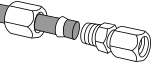
Fittings have a sleeve that bites into tubing as you tighten the nut to form a seal in applications up to 120 psi. Also known as flareless fittings.