


Filter by
System of Measurement
Mounting Location
Switch Starting Position

Electrical Phase


Operation Type
Switch Action
Electrical Connection
Certification
Control Current
Enclosure Rating
Timing Adjustment Style

Timer Function
DFARS Specialty Metals
Export Control Classification Number (ECCN)
Circuit Board Safety Relays
 |
8 Terminals |
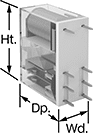
Reduce connection errors on circuit boards that control machine guards and other safety devices. Also known as force-guided contact relays, they have contact pairs that won’t close at the same time, even if contacts stick or weld shut. These relays take up less space on a board than those with electrical wiring because their solder pin terminals mount directly through circuit board holes. Use them to control high-power components, such as fans and heaters, from a low-power circuit.
Mechanical Indicator—Relays with a mechanical indicator show you whether they’re switched on or off with a flag. Peek through the window on the side to quickly check the flag’s position.
No. of Terminals | Input Voltage, V DC | Control Current, mA | Switching Current @ Voltage | Max. Switching Voltage | Mechanical Life Cycles | Ht. | Wd. | Dp. | Pin Lg. | Features | Each | |||
|---|---|---|---|---|---|---|---|---|---|---|---|---|---|---|
2 Circuits Controlled with 2 Off or 2 On—DPDT | ||||||||||||||
| 8 | 24 | 29 | 3 amp @ 240V AC/24V DC | 250V AC, 125V DC | 10,000,000 | 1.1" | 0.5" | 1" | 0.16" | Interlocked Opposing Contacts, Mechanical Indicator | 6253N12 | 000000 | ||
| 8 | 24 | 29 | 8 amp @ 240V AC | 250V AC | 10,000,000 | 1.1" | 0.5" | 1" | 0.2" | Interlocked Opposing Contacts | 6253N11 | 00000 | ||
Interface Safety Relays
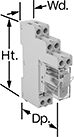 |
These relays pair the transmission reliability of an interface relay with the fail-safe operation of a safety relay. Use them to communicate signals to devices like motors or sensors. They have interlocking contacts—also known as force-guided or mechanically linked contacts—so opposing contacts won't close at the same time. This minimizes the chance of arcing, so electricity won't jump across the contacts and interfere with your relay or system. They also have an interface that isolates input and output circuits to prevent damage from voltage spikes, reduce signal interference, and amplify signal. Mount them on 35 mm DIN rail (also known as DIN 3 rail). The relays disconnect from the socket for quick replacement.
Safety Relays | Replacement Safety Relays | |||||||||||||||
|---|---|---|---|---|---|---|---|---|---|---|---|---|---|---|---|---|
No. of Terminals | Input Voltage, V DC | Control Current, mA | Switching Current @ Voltage | Max. Switching Voltage, V AC | hp @ Switching Voltage | Mechanical Life Cycles | Ht. | Wd. | Dp. | Features | Each | Each | ||||
2 Circuits Controlled with 2 Off or 2 On—DPDT | ||||||||||||||||
| 8 | 24 | 29 | 8 amp @ 240V AC | 250 | 1/2 hp @ 230V AC | 10,000,000 | 3.1" | 0.6" | 2.4" | Interlocked Opposing Contacts | 8722N11 | 000000 | 6253N11 | 000000 | ||
Hazardous Location Relays
 |  |
Screw Terminals | Spring-Clamp Terminals |
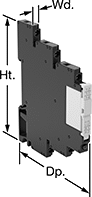
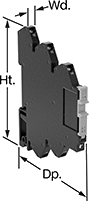
Sealed for safety, these relays are a good choice for hazardous locations where combustible or corrosive gases may be present.
Screw Terminals—Relays with screw terminals are considered interface relays, so they’re placed between your controller and components to isolate the input and output circuits. This means they protect your component from voltage spikes while amplifying the relay’s signal and reducing interference for reliable transmission. They are often used for switching applications, such as small motors and pilot lights. The included relay socket mounts on 35 mm DIN rail (also known as DIN 3 rail).
Spring-Clamp Terminals—Relays with spring-clamp terminals are considered interface relays, so they’re placed between your controller and components to isolate the input and output circuits. This means they protect your component from voltage spikes while amplifying the relay’s signal and reducing interference for reliable transmission. They are often used for switching applications, such as small motors and pilot lights. The included relay socket mounts on 35 mm DIN rail (also known as DIN 3 rail). Relays with spring-clamp terminals connect and disconnect to wires without needing to turn screws. With no screws to shake loose with vibration, the terminals hold tight over time.
No. of Terminals | Input Voltage | Control Current, mA | Switching Current @ Voltage | Max. Switching Voltage | Ht. | Wd. | Dp. | Enclosure Rating | Hazardous Location Rating | Each | |||
|---|---|---|---|---|---|---|---|---|---|---|---|---|---|
Screw Terminals | |||||||||||||
1 Circuit Controlled with 1 Off or 1 On—SPDT | |||||||||||||
| 5 | 12V AC, 12V DC | 29 | 12 amp @ 240V AC/24V DC | 400V AC/300V DC | 2.9" | 0.6" | 3.5" | IP20 | NEC Class I Division 2 Groups A, B, C, D | 4190N312 | 000000 | ||
Spring-Clamp Terminals | |||||||||||||
1 Circuit Controlled with 1 Off or 1 On—SPDT | |||||||||||||
| 5 | 12V AC, 12V DC | 29 | 12 amp @ 240V AC/24V DC | 400V AC/300V DC | 2.9" | 0.6" | 3.7" | IP20 | NEC Class I Division 2 Groups A, B, C, D | 8163N14 | 00000 | ||
Solid State Surface-Mount Timer Relays
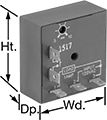 |
Attach these relays to a flat surface using the mounting hole. They have no moving parts, so compared to mechanical switches, they require less maintenance, last longer, and are quieter.
Delayed Start (Delay on Make)—Delayed start (delay on make) relays allow you to set how long it takes for the relay to turn on after input voltage is applied. For example, a drill starts pumping a lubricant immediately, but it does not start rotating until the set time has elapsed.
Timing Range | ||||||||||||
|---|---|---|---|---|---|---|---|---|---|---|---|---|
No. of Terminals | Input Voltage | Control Current, mA | No. of | Overall, sec. | Switching Current @ Voltage | Ht. | Wd. | Dp. | Each | |||
Delayed Start (Delay on Make) | ||||||||||||
1 Circuit Controlled with 1 Off or 1 On—SPDT | ||||||||||||
| 5 | 120V AC | 29 | 1 | 0.05 to 1 | 8 amp @ 240V AC | 2" | 2" | 0.9" | 77055K45 | 0000000 | ||
| 5 | 120V AC | 29 | 1 | 0.25 to 5 | 8 amp @ 240V AC | 2" | 2" | 0.9" | 77055K46 | 000000 | ||
| 5 | 120V AC | 29 | 1 | 0.5 to 10 | 8 amp @ 240V AC | 2" | 2" | 0.9" | 77055K47 | 000000 | ||
| 5 | 120V AC | 29 | 1 | 3 to 60 | 8 amp @ 240V AC | 2" | 2" | 0.9" | 77055K48 | 000000 | ||
| 5 | 120V AC | 29 | 1 | 15 to 300 | 8 amp @ 240V AC | 2" | 2" | 0.9" | 77055K49 | 000000 | ||
| 5 | 120V AC | 29 | 1 | 30 to 10 | 8 amp @ 240V AC | 2" | 2" | 0.9" | 77055K51 | 000000 | ||
