


Filter by
System of Measurement
Number of Circuits Controlled
Mounting Location

Switch Designation
Relay Type

Number of Terminals
Switch Starting Position
Operation Type
Switch Action

Wire Connection


Electrical Connection


U.S.–Mexico–Canada Agreement (USMCA) Qualifying
Adjustment Mechanism
RoHS
DFARS Specialty Metals
Export Control Classification Number (ECCN)
Enclosure Rating
Current-Monitoring Relays
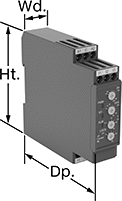 | 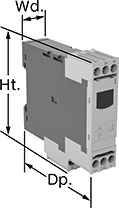 | 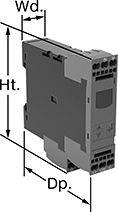 |
Screw Terminals Knob Adjustment | Screw Terminals with IO-Link, Keypad Adjustment | Spring-Clamp Terminals with IO-Link, Keypad Adjustment |
Protect electrical equipment from overcurrent and undercurrent damage—these relays continuously monitor current flow. When current is outside a set range, they trip and cut power to prevent overheating, fire hazards, and stalling. Rated IP20, these relays have recessed terminals that keep fingers and other objects from touching live circuits. Mount them on a 35 mm DIN rail (also known as DIN 3 rail) for fast installation.
Spring-Clamp-Terminal Wire Connection—Relays with spring-clamp terminals connect and disconnect to wire without screws. Because there’s no screw, these connections are less likely to loosen over time, even in high-vibration environments.
IO-Link Communication Protocol—Relays with IO-Link can be programmed, monitored, and reset remotely by connecting them to a programmable logic controller (PLC), human-machine interface (HMI), or computer. If you want to program them locally, they have a keypad.
Knob Adjustment—Relays with knob adjustments have knobs right on the front where you can set your trip current. You can see that they're wired correctly and when they're actuated based on the LED indicators.
No. of Terminals | Input Voltage | Trip Current Setting, amp | Trip Current, amp | Trip Time, sec. | Reset Type | Switching Current @ Voltage | Max. Switching Voltage | Adjustment Mechanism | Ht. | Wd. | Dp. | Digital Display Type | Each | |||
|---|---|---|---|---|---|---|---|---|---|---|---|---|---|---|---|---|
Screw Terminals | ||||||||||||||||
1 Circuit Controlled with 1 Off or 1 On—SPDT | ||||||||||||||||
| 9 | 24V AC, 24V DC | 0.1 to 1, 0.5 to 5, 0.8 to 8 | — | 0.1 to 30 | Automatic, Manual | 5 amp @ 240V AC 5 amp @ 30V DC | 250V AC 30V DC | Knob | 3.5" | 0.9" | 3.9" | — | 8123N14 | 0000000 | ||
| 9 | 120V AC, 240V AC | 0.1 to 1, 0.5 to 5, 0.8 to 8 | — | 0.1 to 30 | Automatic, Manual | 5 amp @ 240V AC 5 amp @ 30V DC | 250V AC 30V DC | Knob | 3.5" | 0.9" | 3.9" | — | 8123N13 | 000000 | ||
Screw Terminals with IO-Link | ||||||||||||||||
1 Circuit Controlled with 1 Off or 1 On—SPDT | ||||||||||||||||
| 9 | 24V DC | — | 0.05 to 10 | 0 to 999 | Automatic | 3 amp @ 240V AC 1 amp @ 24V DC | 400V AC 250V DC | External Controller, Keypad | 3.6" | 0.9" | 3.4" | LCD | 8123N11 | 000000 | ||
Spring-Clamp Terminals with IO-Link | ||||||||||||||||
1 Circuit Controlled with 1 Off or 1 On—SPDT | ||||||||||||||||
| 9 | 24V DC | — | 0.05 to 10 | 0 to 999 | Automatic | 3 amp @ 240V AC 1 amp @ 24V DC | 400V AC 250V DC | External Controller, Keypad | 3.8" | 0.9" | 3.4" | LCD | 8123N12 | 000000 | ||
