We will reply to your message within an hour.
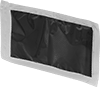
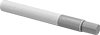
Knead the epoxy-coated patch and resin together to make repairs to pipes, tanks, drums, and containers in the field.
These surface fillers can be used on vertical surfaces without sagging. They repair cracked, worn, and damaged surfaces.
Spray to fill in small dents, cracks, and scratches. These surface fillers build on themselves to cover minor surface imperfections.
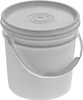
Make castings and fill voids with these two-part pourable epoxies.
An easy way to make repairs in the field. Cut patches to size, peel off the backing, and press into place. Expose them to sunlight or a UV lamp and they begin to harden immediately.
Press these putty surface fillers in place to fill in holes, cracks, and dents. When exposed to sunlight or a UV lamp, they begin to harden immediately.
These surface fillers come in a pen for precision application. After applying, use the LED on the back of the pen to instantly cure.
Mix these two-part epoxy surface fillers to create a strong repair in wet environments or underwater.
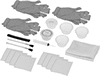
Everything you need to repair cracked, worn, and damaged surfaces—even underwater.
Repair small leaks and cracks in coolant tanks for commercial vehicles and industrial equipment. These surface fillers meet ASTM D3147 for their ability to stop leaks in engine cooling systems.
Able to withstand temperatures up to 2300° F, these ceramic surface fillers are often used as thermal insulation on brick, mortar, burner blocks, furnace holders, and thermocouples.
Also known as sloshing compounds, these surface fillers bond to rough, rusty surfaces in fuel tanks to repair leaks and prevent further corrosion.
Stop leaks in metal tanks and equipment without draining the contents.
To stop leaks in metal tanks and equipment without draining the contents, heat the area with a heat gun or torch to melt the stick and form a permanent seal. The resulting patch can withstand pressure up to 600 psi.
Seal leaks around small holes.
Seal leaks around fasteners with a protruding head.
Stop leaks in metal tanks and equipment without draining the contents. Until a permanent repair can be made, rub these sticks into the leak to form a temporary seal.
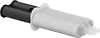
Mix these two-part surface fillers together to repair leaks and cracks as well as to rebuild rough spots in metal.
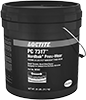
For use in processing equipment that carries small particles less than 1/16" in diameter, these ceramic-filled epoxies rebuild and repair surfaces exposed to abrasion from particles, such as dust collectors, fan blades, and fan housings.
For use in processing equipment that carries large particles 1/16" in diameter and larger, these ceramic-filled epoxies rebuild and repair surfaces exposed to abrasion from particles, such as pump housings, chute linings, and hoppers.
These rubber-filled epoxies have excellent wear and impact resistance. Use them to repair and rebuild surfaces such as pump liners, hoppers, and vibrating feeders.
Chemicals will not affect these two-part epoxies. They repair cracked, worn, and damaged surfaces.
Repair and rebuild metal surfaces that are exposed to heat. These surface fillers withstand temperatures over 450° F.
A high silver content allows these surface fillers to conduct electricity and heat. Use them to fill gaps and rebuild missing material on electrical connections or to assemble new components.
Repair stripped threads on female connections, such as oil pans, valve covers, and distributor caps.
Make flexible, waterproof repairs to rips and tears in canvas, leather, and acrylic fabric.
Mend rips, tears, and holes on vinyl surfaces, such as awnings and upholstery, with these flexible, waterproof surface fillers.
Waterproof and strong, these surface fillers remain flexible when repairing rips, tears, and holes in neoprene rubber. They're often used on wetsuits.
Use these two-part fillers to rebuild cracked or worn plastic surfaces.
Repair worn and torn rubber parts. These two-part fillers are self leveling and form a tough, flexible new surface. They're often used with conveyor belts, mill liners, and pumps.
Spray these surface fillers on molded plastic parts that have surface blemishes, scratches, and mold lines. Use with ABS, polystyrene, and glass-filled nylon.
These crack fillers come in an easy-to-pour jug for filling cracks in asphalt up to 1/2” wide.
Spread patching compounds in dry, wet, and even water-filled holes.
Cut rope to the length you need, pack it in cracks up to 1" wide, and heat with a propane torch.
Fill cracks in horizontal, vertical, and overhead concrete surfaces.
Fill cracks up to 10" deep on vertical and overhead surfaces.
Fill cracks up to 4" deep on horizontal surfaces, such as floors and sidewalks.
Pour these ready-to-use fillers in cracks up to ½" wide and ¼" deep on horizontal surfaces to make fast, light duty repairs.
Stop slow-flowing and weeping leaks in concrete. Also known as hydraulic cement, these crack fillers begin to harden in three to five minutes to create a permanent fix that won't shrink.
Stop active leaks of up to 50 gallons per minute in concrete, brick, and stone. These crack fillers begin to harden within seconds to create a permanent fix that won't shrink.
Cover large sections of damaged concrete with these durable patching compounds. Made up of a resin, hardener, and aggregate, they cover more area than any of our other concrete patching compounds.
Patch concrete floors, stairs, and walls with these compounds.
Use these two-part compounds to patch concrete floors, stairs, and walls in cold environments, such as freezers. At room temperature, they cure faster than any of our other concrete patching compounds.
For use when thickness will be more than 2", concrete mixes consist of cement, sand, and gravel.
Not only do these leveling compounds withstand severe abrasion, wear, and impact, they also stand up to steel wheels and heavy blows without cracking.
For use when thickness will be less than 2", sand mixes consist of cement and sand.
Repair sidewalks and factory floors in areas with heavy pedestrian traffic. They can also be used to fill minor depressions and cracks.
These leveling compounds stand up to acid and chemical spills, making them a good choice for corrosive environments. They also withstand steel wheels and heavy impacts.
Fill in and shape horizontal, vertical, and overhead concrete surfaces, such as steps and columns.
Keep the surface of your porcelain fixtures looking like new.
Make removing form-board stakes easier.
Stakes provide a firm anchor for concrete form boards.
Slide these tools along the perimeter of poured concrete slabs to create a rounded edge for a finished appearance that resists chipping.
Also known as mortar hoes, the blade on these tools has holes to allow concrete to pass through as you mix.
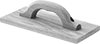
Use floats after edging and grooving to smooth the surface and allow trapped air and water to escape.
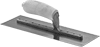
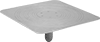
Once concrete begins to set up and surface water reabsorbs, finish with a trowel to compact the top layer for a smooth, hard surface.
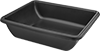
With a durable one-piece construction, these boxes have no seams or welds to crack and leak.
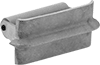
Create grooves in poured concrete slabs to control cracking caused by drying, settling, and freezing.
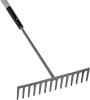
Push and pull freshly-poured concrete.
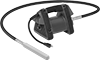
Improve the strength of your concrete mix by eliminating trapped air.
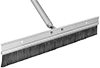
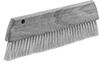
Drag these brooms along hardening concrete to create a rough surface for traction in slippery environments.
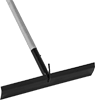
Spread and level asphalt.
Remove hardened flecks of mortar, dirt, and other debris.
Spread, scrape, and shape mortar.
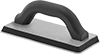
Smooth and spread grout between tiles.
Rub these tools along the mortar between bricks for a uniform, finished appearance.
Keep drywall compound close at hand so you can apply it over seams quickly and efficiently.
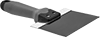
A thin, flexible blade makes easy work of smoothing and feathering drywall compound.
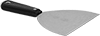
These knives have a sturdy blade for scraping paint and debris and for applying and smoothing joint and spackling compounds.
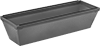
Also known as mud pans, use these to mix small amounts of drywall compound or to bring it to your work area.
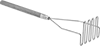
Use these mashers to mix drywall compound in large containers.
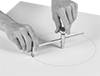
Cut perfect circles up to 16" in diameter to create openings for pipes, conduit, or lighting fixtures.
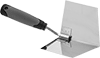
Smooth joint compound on both sides of an interior corner with these trowels.
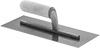
Thicker than taping knives, trowels can apply and spread large amounts of drywall compound quickly.
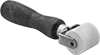
Roll the seams where wall coverings meet for an even, continuous appearance.
These long, thin brushes have semi-soft bristles to smooth out wrinkles and air bubbles after wall coverings are applied without damaging the wall covering itself.
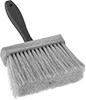
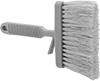
Use these brushes to apply paste for wall coverings.
Fix damaged wood or build up and replace missing wood.
Press these putty-like fillers into cracks in wood up to 1/8" wide.
Use this kit to prevent bull's eye breaks and minor chips from getting bigger.
These patching compounds are the most flexible and watertight we offer.
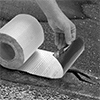
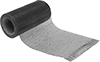
Roll out a fast fix for leaky roofs and gutters with these peel-and-stick rolls.
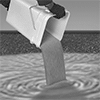
Make a temporary repair to cracks in any flat roof. These patching compounds are a powder that forms a thick gel in minutes when poured directly into standing water and rain.
Repair holes and seal gaps in roofing and gutters. These patching compounds are durable and water resistant.
Reinforce hot- and cold-applied asphalt patching compounds and coatings with this flexible fabric.
Also known as Plaster of Paris, these fillers conceal small cracks, nail holes, and blemishes. Mix with water.
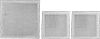
Assortments include two 4" × 4" patches and a 6" × 6" patch.
Fill and conceal small cracks, nail holes, and blemishes. Compounds are ready to use.
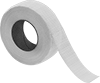
Tape hides seams and smooths out corners. It has an adhesive back for bonding and requires joint compound for finishing. It can also be used to repair damaged walls.
Simplify and speed up hole repairs—stick a patch over the area and cover with spackling compound.
Tape hides seams and smooths out corners. Joint compound is required for bonding and finishing.
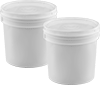
Fix cracks in drywall and stop them from spreading. Place the included fabric over wall cracks and cover with the acrylic paste. This results in a flexible, nonshrinking repair that prevents cracks from reappearing as the building continues to settle.
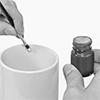
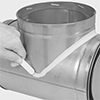
Also known as drywall mud, these joint compounds are ready to use. Apply with drywall tape over seams for a finished appearance.
Mix this two-part epoxy—a resin-aggregate blend and a pigmented hardener—to create a grout that resists chemicals and doesn't require sealing. Use on ceramic, concrete, and stone floor and wall tiles.
Used for brick, block, and stone laying as well as for repairing masonry, mortar mixes consist of fine sand and masonry cement.
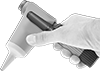
Used on ceramic, concrete, and stone floor and wall tiles, grout consists of fine sand, masonry cement, and coloring.
Apply these sealants in cold temperatures, on wet surfaces, and even through running water.
Clear enough to read through, this UV-resistant sealant allows optimal light transmission for use with solar cells and fiber optics.
Also known as Torr Seal, this sealant forms a rigid bond that seals leaks on vacuum systems or components.
Fix roof leaks in cold and wet conditions. These sealants can even be applied underwater.
Thinner than non-sagging sealants, these flow easily into cracks and have a smooth finish.
These non-sagging sealants will not drip while hardening on vertical and overhead surfaces.
Even when used under water, these adhesives maintain their strength.
For quick repairs, these epoxies begin to harden in 6 minutes or less.
These machinable epoxies are mixed with steel, but won’t rust, so they can be used to repair cracks and threaded holes.
Epoxies are the strongest and most weather- and chemical-resistant structural adhesives. They work especially well on metals.
For invisible bond lines, these adhesives dry clear.
To allow time to adjust and position parts, these epoxies remain workable for at least 90 minutes.
Urethane adhesives are the most flexible, so they bond dissimilar materials and damp vibration.
An alternative to solder, these flexible, silver-filled adhesives accommodate joint movement. Use them to bond electrical components and repair circuits.
Often used on diesel engines, exhaust systems, and gas turbines, these adhesives withstand high temperatures and provide excellent electrical insulation.
Extract all the contents from tubes of adhesives and sealants.
Fill gaps up to 0.02" to secure worn unthreaded cylindrical metal parts such as shafts, bearings, and press-fit assemblies.
Cover adhesive and sealant cartridges to keep contents from hardening.
Repair rips, split seams, and detached soles to stop leaks in shoes, boots, and waders.
Extend the life of your footwear with these abrasion- and water-resistant epoxies.
Also known as brushable ceramic, these coatings create a hard, low-friction surface. They're often used on liquid processing equipment to protect worn areas and reduce turbulence.
Formulated to draw heat away from sensitive electronic components, these potting compounds have higher thermal conductivity than standard potting compounds.