We will reply to your message within an hour.
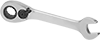
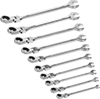
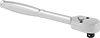
A lever reverses the ratchet direction.
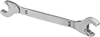
Flip these wrenches over to ratchet in the opposite direction.
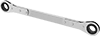
A spline-shaped box end turns spline, hex, and 12-point fasteners. This shape also gets a better grip on rounded fasteners that can be difficult to turn with a traditional wrench.
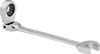
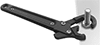
Pivot the box end for access to fasteners in tight spots.
Made in the U.S.A., these tools handle the toughest industrial applications, provide the best grip on fasteners, and have a superior finish.
Suitable for occasional maintenance work, these sets are imported.
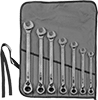
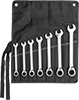
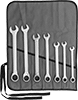
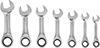
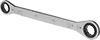
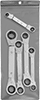
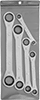
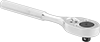
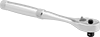
A ratchet mechanism allows you to turn fasteners in tight spaces without removing and repositioning the wrench.
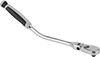
Ratchet mechanisms allow you to turn fasteners in tight spaces without removing and repositioning the tool.
An insulated handle protects against accidental contact with live electrical circuits. These wrenches are tested to 1,000 volts to meet IEC 60900.
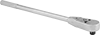
An extra-long handle provides access to hard-to-reach fasteners and increases leverage.
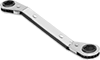
The 25° offset heads give you additional clearance to turn hard-to-reach fasteners.
The offset head gives you additional clearance to turn hard-to-reach fasteners.
Open the jaws to fit around a fastener like an open-end wrench; close the jaws and the wrench acts like a ratcheting box wrench.
The heads are offset to provide clearance for reaching over obstructions.
Turn sockets in the most confined spaces.
A ratchet mechanism allows you to turn fasteners without removing and repositioning the wrench.
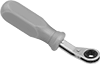
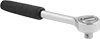
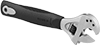
The handle is covered in rubber for a comfortable grip.
When the ratchet head becomes worn or damaged, change it out for a new one.
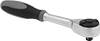
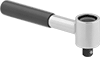
Twist the grip to rapidly turn a socket before final tightening or to remove a fastener once loosened. The handle also swings like a traditional ratchet wrench.
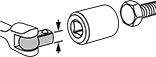
No need to pull the socket off the tool—push a button to release.
A gasket seals in permanent lubrication and keeps out dirt, dust, and moisture.
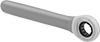
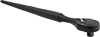
Also known as a construction or spud handle, wrenches use the pointed end to align bolt holes.
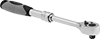
The shaft on these wrenches extends and locks.
Made of aluminum-bronze, these wrenches satisfy OSHA requirements that specify nonsparking tools for locations where flammable vapors and combustible residues are present.
Insulated to protect against accidental contact with live electrical circuits, these wrenches are tested to 1,000 volts to meet IEC 60900.
Rather than teeth, these wrenches use a series of rollers to engage the ratchet, enabling work in the tightest of spaces. Also known as silent ratchets, they don't make the traditional click sound when turned.
The 20° offset head provides clearance when reaching over obstructions.
Pivot the head to access fasteners in tight spots.
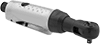
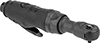
The ratcheting mechanism turns sockets quickly.
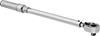
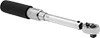
When the set torque is reached, these wrenches signal with an audible click and an impulse in the grip.
Made of beryllium copper, these wrenches satisfy OSHA requirements that specify nonsparking tools for locations where flammable vapors and combustible residues are present.
These wrenches slip to disengage and stop turning the fastener when the set torque is reached, preventing overtightening.
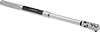
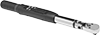
The most advanced torque wrenches we offer, these tools store and recall up to 1,500 torque and angle measurements.
Turn sockets from above when there's not room to swing a standard wrench handle.
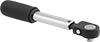
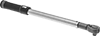
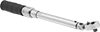
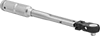
Set the desired torque and the wrench indicates when it's reached with an audible click and an impulse in the grip.
Measure with an accuracy of ±2%.
Unlike most torque wrenches, you don’t have to return the torque setting to the lowest value after use. These tools are also known as split-beam torque wrenches.
These wrenches have an accuracy of ±2.0%.
Use these tools for general shop applications.
Built for durability, these wrenches handle the demands of high-volume production and tough maintenance applications.
A ratchet mechanism in the heads lets you turn fasteners in tight spaces without removing and repositioning the wrench.
Change heads to use these tools as an open-end, box, square drive, or hex-key wrench.
A ratchet mechanism in the head allows you to turn fasteners in tight spaces without removing and repositioning the wrench.
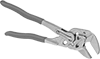
Turn fasteners with the firm grip of a wrench and the adjustability of pliers.
The 5-point opening fastens the nuts and caps on fire hydrants. These wrenches have a ratcheting mechanism that allows you to turn fasteners without removing and repositioning the wrench.