


Combination Disc and Belt Sanders
Versatile enough to handle both detail work and heavy material removal, these are a disc and belt sander in one. The disc sander smooths edges, while the belt sander removes a lot of material on large surfaces. Adjustable belt tracking lets you maintain proper tension. Sanders with two voltages are wired for the lower voltage listed.
Dust-collecting sanders remove particles from the air and surface of the disc and belt to extend their life. They have a port that connects to a dust collector or vacuum system.
Sanders with a variable-speed motor let you set the speed for any task, so you can switch between materials or adjust for aggressive and fine sanding.
Sanders with a miter gauge make it easy to sand angles.
Sanders with a detachable platen make it easy to sand contours.
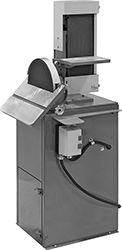
For Adhesive-Back Disc | For Belt | |||||||||||||||
|---|---|---|---|---|---|---|---|---|---|---|---|---|---|---|---|---|
| hp | Dia. | Table Wd. | Table Lg. | Max. No-Load Speed, rpm | Wd. | Lg. | Orientation | Table Wd. | Table Lg. | Max. No-Load Speed, sfpm | Voltage | Current, A | Motor Speed, rpm | Features | Each | |
Variable Speed | ||||||||||||||||
Three-Prong Plug (Single Phase) with Miter Gauge and One-Piece Steel Stand | ||||||||||||||||
| 2 | 14" | 7 1/4" | 15 1/2" | 1,775 | 6" | 48" | Any Angle and Horizontal and Vertical | 6" | 8 1/2" | 2,250 | 120V AC 240V AC | 12.5 6.2 | 1,720 | Adjustable Belt Tracking, Dust Extraction Port, Belt Guard, Detachable Platen | 4739A122 | 000000000 |
Adjustable-Configuration Stationary Belt Sanders
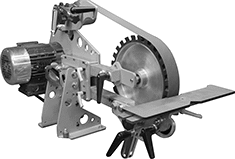
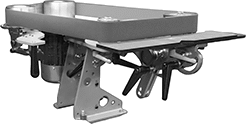
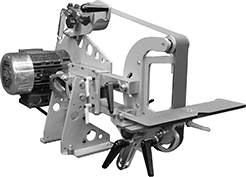
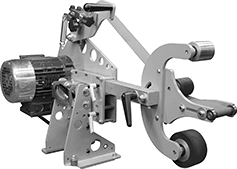
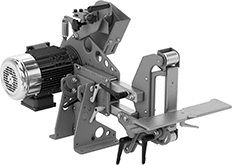
The most versatile sanders we offer—you can set them up in four different ways to sand flat edges, curved surfaces, inner radii, and more. Threaded handles lock and unlock each configuration and tilt the worktable, so it takes less than a minute to switch between setups and doesn’t require tools. Use either the flat platen or contact wheel to position your sanding belt both vertically and horizontally.
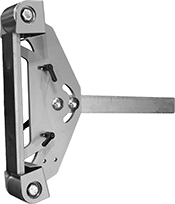
Use the flat platen when you need to sand flat surfaces, bevel edges, or debur something. When you use it in the horizontal position, it will give you a longer section of sanding belt to work with. To sand curved surfaces, such as tubing or pipe, you can remove the platen to loosen the belt so it wraps around your workpiece.
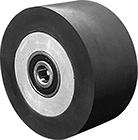
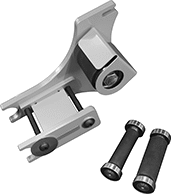
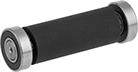
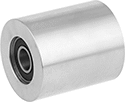
Use the contact wheel to quickly remove a lot of material. It moves at high speeds, but makes less contact with your sanding belt than the flat platen, so it won’t overheat and burn or discolor your workpiece. The small wheel attachment aligns horizontally to configure your belt into a spindle sander. The tight curve on the spindle is great for sanding corners, inner radii, and tricky shapes.
These sanders have a variable speed motor, so you can adjust them to suit everything from coarse sanding to fine finishing. These sanders and their attachments meet OSHA safety standards for machine guards.
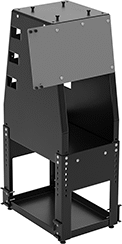
They’re small enough that you can use them on your benchtop. Or add a stand (sold separately). You can adjust the stand height in 1" increments and store attachments on the tool arm slots.
For Belt | Table | |||||||||||||
|---|---|---|---|---|---|---|---|---|---|---|---|---|---|---|
| Wd. | Lg. | Orientation | Wd. | Lg. | Max. No-Load Speed, sfpm | No. of Speeds | Voltage | Current, A | Motor Speed, rpm | hp | Phase | Includes | Each | |
| 2" | 72" | Horizontal and Vertical | 4" | 16" | 4,700 | Variable | 120V AC/240V AC | 5.5/2.6 | 3,600 | 2 | Single | Flat Platen, Contact Wheel, Small Wheel Attachment | 9402N11 | 000000000 |
| Ht. Adjustment Range | Material | Each | |
| 33" to 39" | Steel | 9402N12 | 0000000 |
| Material | Each | |
| Steel | 9402N15 | 0000000 |
| Includes | Each | |
| One 3/4" OD Wheel, One 1" OD Wheel | 9402N13 | 0000000 |
| OD | Material | Each | |
| 2" | Aluminum | 9402N18 | 000000 |
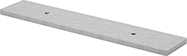
| Lg. | Wd. | Material | Each | |
| 10" | 2" | Steel | 9402N16 | 000000 |
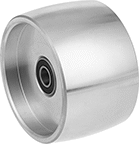
| OD | Material | Each | |
| 4" | Aluminum | 9402N19 | 000000 |
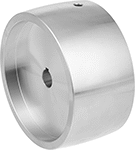
| OD | Material | Each | |
| 5" | Aluminum | 9402N21 | 000000 |
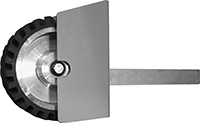
| Each | ||
| 9402N14 | 0000000 |