


Filter by
Actuator Style


Wire Connection
Switch Action


Number of Wire Leads
Environment
Enclosure Rating
Switch Designation
Electrical Connection
Switch Starting Position
Number of Mounting Holes
U.S.–Mexico–Canada Agreement (USMCA) Qualifying
Export Control Classification Number (ECCN)

REACH
RoHS
DFARS Specialty Metals
Enclosed Wet-Location Snap-Acting Switches
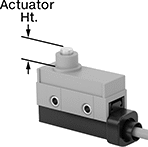 | 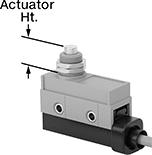 | 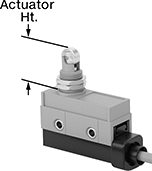 |
Plunger Actuator Style | Plunger Actuator Style For 9/16" Panel Cutout Dia. | Roller Plunger Actuator Style For 9/16" Panel Cutout Dia. |
Housing | ||||||||||||||||
|---|---|---|---|---|---|---|---|---|---|---|---|---|---|---|---|---|
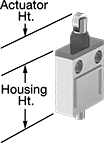
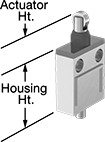
No. of Circuits Controlled | Switch Starting Position | Switch Action | Switch Designation | Switching Current @ Voltage | Max. Voltage | Operating Temp. Range, ° F | Actuator Ht. | Lg. | Ht. | Dp. | Enclosure Rating | Certification | Each | |||
Plunger Actuator Style | ||||||||||||||||
With Three 39" Wire Leads Hardwire | ||||||||||||||||
| 1 | 1 Off or 1 On | Momentary | SPDT | 10 amp @ 250V AC 0.5 amp @ 125V DC | 250V AC 250V DC | 15 to 175 | 0.45" | 2.76" | 1.61" | 0.85" | IP67 | UL Recognized Component, CE Marked | 5647N11 | 0000000 | ||
Plunger Actuator Style For 9/16" Panel Cutout Dia. | ||||||||||||||||
With Three 39" Wire Leads Hardwire | ||||||||||||||||
| 1 | 1 Off or 1 On | Momentary | SPDT | 10 amp @ 250V AC 0.5 amp @ 125V DC | 250V AC 250V DC | 15 to 175 | 0.68" | 2.76" | 1.61" | 0.85" | IP67 | UL Recognized Component, CE Marked | 5647N12 | 000000 | ||
Roller Plunger Actuator Style For 9/16" Panel Cutout Dia. | ||||||||||||||||
With Three 39" Wire Leads Hardwire | ||||||||||||||||
| 1 | 1 Off or 1 On | Momentary | SPDT | 10 amp @ 250V AC 0.5 amp @ 125V DC | 250V AC 250V DC | 15 to 175 | 1.04" | 2.76" | 1.61" | 0.85" | IP67 | UL Recognized Component, CE Marked | 5647N13 | 000000 | ||
With Three 108" Wire Leads Hardwire | ||||||||||||||||
| 1 | 1 Off or 1 On | Momentary | SPDT | 10 amp @ 250V AC 0.5 amp @ 125V DC | 250V AC 250V DC | 15 to 175 | 1.04" | 2.76" | 1.61" | 0.85" | IP67 | UL Recognized Component, CE Marked | 5647N14 | 000000 | ||
Limit Switches
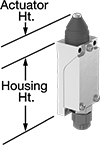 |  |
Style A | Style B |
 |  |
Style D | Style E |
 |
M12 Connection |
When a moving object contacts the actuator on these switches, they open or close a circuit. They have the rapid-closing action of a snap-acting switch, but with a larger actuator. This makes them a good choice for use with large objects—for instance, a box on a conveyor runs into the switch, stopping the conveyor.
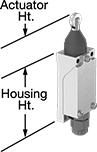
Plunger Actuator—Switches with a plunger actuator require a push to actuate, similar to a button.
Roller Plunger Actuator—Switches with a roller plunger actuator have a roller that moves when an object pushes the actuator. This reduces friction during actuation to limit wear and tear on your switch.
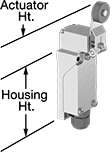
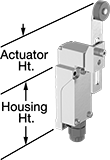
Roller Lever Actuator—Switches with a roller lever actuator use a lever with a roller at the end to activate. This allows parts to glide across the actuation surface with minimal friction, limiting wear and tear on your switch.
4-Pole M12 Connection—Switches with a 4-pole M12 plug connect to cords with a socket (sold separately), allowing you to quickly connect and disconnect the switch.
Style E—Styles E and F let you adjust the actuator’s height to align it with your target.
IP67 Enclosure Rating—Switches rated IP67 are protected against dust and temporary submersion.
Switches | Cords | ||||||||||||||||||
|---|---|---|---|---|---|---|---|---|---|---|---|---|---|---|---|---|---|---|---|
Housing | |||||||||||||||||||
Style | No. of Circuits Controlled | Switch Starting Position | Switch Action | Switch Designation | Switching Current @ Voltage | Max. Voltage | Operating Temp. Range, ° F | Actuator Ht. | Lg. | Ht. | Dp. | Housing Material | Enclosure Rating | Each | Each | ||||
Plunger Actuator | |||||||||||||||||||
4-Pole M12 Connection | |||||||||||||||||||
| A | 1 | 1 Off or 1 On | Momentary | SPDT | 3 amp @ 250V AC, 10 amp @ 250V DC | 250V AC 250V DC | -22 to 158 | 0.8" | 1.1" | 2.5" | 1.2" | Plastic | IP67 | 7988K101 | 000000 | 7628K99 | 000000 | ||
Roller Plunger Actuator | |||||||||||||||||||
4-Pole M12 Connection | |||||||||||||||||||
| B | 1 | 1 Off or 1 On | Momentary | SPDT | 3 amp @ 250V AC, 10 amp @ 250V DC | 250V AC 250V DC | -22 to 158 | 1.2" | 1.1" | 2.5" | 1.2" | Plastic | IP67 | 7988K102 | 00000 | 7628K99 | 00000 | ||
Roller Lever Actuator | |||||||||||||||||||
4-Pole M12 Connection | |||||||||||||||||||
| D | 1 | 1 Off or 1 On | Momentary | SPDT | 3 amp @ 250V AC, 10 amp @ 250V DC | 250V AC 250V DC | -22 to 158 | 1.5" | 1.1" | 2.5" | 1.2" | Plastic | IP67 | 7988K103 | 00000 | 7628K99 | 00000 | ||
| E | 1 | 1 Off or 1 On | Momentary | SPDT | 3 amp @ 250V AC, 10 amp @ 250V DC | 250V AC 250V DC | -22 to 158 | 1.5" to 3.3" | 1.1" | 2.5" | 1.2" | Plastic | IP67 | 7988K104 | 000000 | 7628K99 | 00000 | ||
Sealed Low-Profile Limit Switches
 |  |  |
Style B | Style C | Style D |
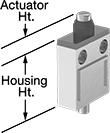
A sealed actuator prevents these switches from jamming, even when exposed to sand, mud, or dirt. They're also rated IP67 for temporary submersion. With a slim design, you can stack them or fit them in tight spaces. When an object in motion comes into contact with the actuator, it sends a signal to open or close a circuit. These switches have the rapid-closing action of a snap-acting switch, but with a larger actuator. This makes them a good choice for use with large objects. For instance, a box on a conveyor runs into the switch, stopping the conveyor.
Plunger Actuator—Switches with a plunger actuator require a push to actuate, similar to a button.
Roller Plunger Actuator—Switches with a roller plunger actuator have a roller that moves when an object pushes the actuator. This reduces friction during actuation to limit wear and tear on your switch.
Cross Roller Plunger Actuator—Switches with a cross roller plunger actuator have a roller that moves when an object pushes the actuator. This reduces friction during actuation to limit wear and tear on your switch. The roller moves perpendicular to the mounting direction.
4-Pole M12 Connection—Switches with a 4-pole M12 plug connect to cords with a socket (sold separately), allowing you to quickly connect and disconnect the switch.
Switches | Cords | ||||||||||||||||||
|---|---|---|---|---|---|---|---|---|---|---|---|---|---|---|---|---|---|---|---|
Housing | |||||||||||||||||||
Style | No. of Circuits Controlled | Switch Starting Position | Switch Action | Switch Designation | Switching Current @ Voltage | Max. Voltage | Operating Temp. Range, ° F | Actuator Ht. | Lg. | Ht. | Dp. | Housing Material | Enclosure Rating | Each | Each | ||||
Plunger Actuator | |||||||||||||||||||
4-Pole M12 Connection | |||||||||||||||||||
| B | 1 | 1 Off or 1 On | Momentary | SPDT | 1 amp @ 30V DC | 30V DC | 14 to 158 | 0.6" | 1.6" | 2.2" | 0.6" | Aluminum | IP67 | 7317K102 | 0000000 | 7628K99 | 000000 | ||
| B | 1 | 1 Off or 1 On | Momentary | SPDT | 1 amp @ 125V AC | 125V AC | 14 to 158 | 0.6" | 1.6" | 2.2" | 0.6" | Aluminum | IP67 | 7317K101 | 000000 | 7628K99 | 00000 | ||
Roller Plunger Actuator | |||||||||||||||||||
4-Pole M12 Connection | |||||||||||||||||||
| C | 1 | 1 Off or 1 On | Momentary | SPDT | 1 amp @ 30V DC | 30V DC | 14 to 158 | 1" | 1.6" | 2.2" | 0.6" | Aluminum | IP67 | 7317K104 | 000000 | 7628K99 | 00000 | ||
| C | 1 | 1 Off or 1 On | Momentary | SPDT | 1 amp @ 125V AC | 125V AC | 14 to 158 | 1" | 1.6" | 2.2" | 0.6" | Aluminum | IP67 | 7317K103 | 000000 | 7628K99 | 00000 | ||
Cross Roller Plunger Actuator | |||||||||||||||||||
4-Pole M12 Connection | |||||||||||||||||||
| D | 1 | 1 Off or 1 On | Momentary | SPDT | 1 amp @ 125V AC | 125V AC | 14 to 158 | 0.9" | 1.6" | 2.2" | 0.6" | Aluminum | IP67 | 7317K105 | 000000 | 7628K99 | 00000 | ||
