


Filter by
Number of Teeth

Shaft Type


Strand Type


Component


REACH

RoHS
Chain Type

Shaft Mount Type


Sprocket Type
DFARS Specialty Metals
Export Control Classification Number (ECCN)
Sprockets
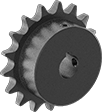 |
Finished Bore |
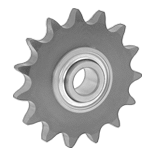
Sprocket teeth mesh with your roller chain to smoothly transmit power. These U.S.-made sprockets have machined teeth for a more precise fit than flame-cut or punched teeth, allowing them to glide in and out of the chain to reduce wear and extend chain life.
Steel—Steel is strong, but best for dry environments since moisture will cause it to rust.
Finished Bore—Mount these sprockets onto your shaft and secure with a set screw—no machining required.
For Roller Chain | Keyway | |||||||||||
|---|---|---|---|---|---|---|---|---|---|---|---|---|
Trade No. | Std. | Pitch | No. of Teeth | OD | Bore Type | For Shaft Dia. | Wd. | Dp. | Each | |||
For Single Strand | ||||||||||||
Steel | ||||||||||||
| 40 | ANSI | 1/2" | 96 | 15 9/16" | Finished | 1" | 1/4" | 1/8" | 2737T851 | 0000000 | ||
| 40 | ANSI | 1/2" | 96 | 15 9/16" | Finished | 1 1/4" | 1/4" | 1/8" | 2737T852 | 000000 | ||
| 40 | ANSI | 1/2" | 96 | 15 9/16" | Finished | 1 3/8" | 5/16" | 5/32" | 2737T853 | 000000 | ||
| 40 | ANSI | 1/2" | 96 | 15 9/16" | Finished | 1 1/2" | 3/8" | 3/16" | 2737T854 | 000000 | ||
| 41 | ANSI | 1/2" | 96 | 15 9/16" | Finished | 1" | 1/4" | 1/8" | 2737T961 | 000000 | ||
| 41 | ANSI | 1/2" | 96 | 15 9/16" | Finished | 1 1/4" | 1/4" | 1/8" | 2737T962 | 000000 | ||
| 41 | ANSI | 1/2" | 96 | 15 9/16" | Finished | 1 1/2" | 3/8" | 3/16" | 2737T964 | 000000 | ||
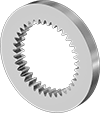
Metal Internal Spur Gears
 |
Gear Pitch | No. of Teeth | Gear Pitch Dia. | OD | ID | Face Wd. | Material | Each | |||
|---|---|---|---|---|---|---|---|---|---|---|
20° Pressure Angle | ||||||||||
Brass | ||||||||||
| 32 | 96 | 3" | 3.75" | 2.961" | 3/16" | Brass | 2696N6 | 0000000 | ||
Metal Spur Gears
Gears
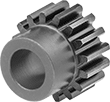 | 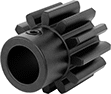 |
20° Pressure Angle Round Bore | Gear with Round Bore and Set Screw |
20° Pressure Angle—The current industry standard, these 20° pressure angle spur gears have thicker, stronger teeth than 14½° pressure angle gears.
Steel—Steel gears have hard, strong, and wear-resistant teeth, although they will rust when exposed to moisture and corrosive chemicals.
Hub, mm | ||||||||||||||
|---|---|---|---|---|---|---|---|---|---|---|---|---|---|---|
Gear Module | No. of Teeth | Gear Pitch Dia., mm | OD, mm | Face Wd., mm | Dia. | Wd. | Bore Type | For Shaft Dia., mm | Tooth Heat Treatment | Material | Each | |||
20° Pressure Angle | ||||||||||||||
Steel | ||||||||||||||
| 0.8 | 96 | 76.8 | 78.4 | 8 | 28 | 8 | Round Bore with Set Screw | 8 | Not Hardened | Black-Oxide 1045 Carbon Steel | 2664N349 | 000000 | ||
| 1 | 96 | 96 | 98 | 10 | 40 | 10 | Round Bore | 10 | Not Hardened | Black-Oxide 1045 Carbon Steel | 2664N375 | 00000 | ||
Gear Racks
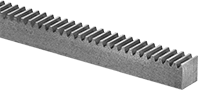 | 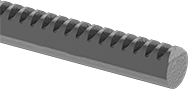 |
20° Pressure Angle—Rectangular | 20° Pressure Angle—Round |
These racks match with spur gears to convert rotary motion to linear motion. For components to mesh correctly, they must have the same pressure angle and pitch/module.
Steel—Steel gear racks have strong and wear-resistant teeth, although they will rust when exposed to moisture and corrosive chemicals.
Gear Module | Lg., mm | Pitch Ht., mm | Ht., mm | Face Wd., mm | Dia., mm | Tooth Heat Treatment | Material | Each | |||
|---|---|---|---|---|---|---|---|---|---|---|---|
20° Pressure Angle—Rectangular | |||||||||||
Steel | |||||||||||
| 0.8 | 100 | 11.5 | 12.3 | 8 | — | Not Hardened | Black-Oxide 1045 Carbon Steel | 2485N214 | 000000 | ||
| 1 | 100 | 11 | 12 | 10 | — | Not Hardened | Black-Oxide 1045 Carbon Steel | 2485N217 | 00000 | ||
| 1 | 300 | 11 | 12 | 10 | — | Not Hardened | Black-Oxide 1045 Carbon Steel | 2485N218 | 00000 | ||
| 1 | 500 | 8.8 | 9.8 | 10 | — | Not Hardened | 1045 Carbon Steel | 2485N201 | 00000 | ||
| 1 | 1,000 | 8.8 | 9.8 | 10 | — | Not Hardened | 1045 Carbon Steel | 2485N202 | 000000 | ||
20° Pressure Angle—Round | |||||||||||
Steel | |||||||||||
| 1 | 500 | 9 | — | — | 10 | Not Hardened | Black-Oxide 1045 Carbon Steel | 2485N226 | 000000 | ||
Internal Gears
|
Save space without losing power. Insert a standard spur gear inside one of these gears for a compact assembly that smoothly transmits motion. Combine gears with different numbers of teeth to change speed and torque in your assembly. For components to mesh correctly, they must have the same pressure angle and pitch/module.
Steel—Steel gears have strong and wear-resistant teeth, although they will rust when exposed to moisture and corrosive chemicals.
Plastic Spur Gears
Gears
 | |
20° Pressure Angle | 14 1/2° Pressure Angle, Round Bore |
20° Pressure Angle—The current industry standard, these 20° pressure angle spur gears have thicker, stronger teeth than 14½° pressure angle gears.
14 1/2° Pressure Angle—A former industry standard, 14½° pressure angle gears are often found in older machinery.
Acetal—Acetal gears absorb less water than nylon gears, so they’re less likely to swell.
Nylon—Nylon gears are wear resistant, but will swell and weaken over time when wet.
Hub | |||||||||||||
|---|---|---|---|---|---|---|---|---|---|---|---|---|---|
Gear Pitch | No. of Teeth | Gear Pitch Dia. | OD | Face Wd. | Dia. | Wd. | Bore Type | For Shaft Dia. | Color | Each | |||
20° Pressure Angle | |||||||||||||
Acetal | |||||||||||||
| 48 | 96 | 2" | 2.04" | 1/8" | 0.609" | 0.25" | Round Bore | 1/4" | White | 2662N26 | 00000 | ||
| 32 | 96 | 3" | 3.06" | 3/16" | 0.813" | 0.313" | Round Bore | 5/16" | White | 2662N19 | 0000 | ||
14 1/2° Pressure Angle | |||||||||||||
Nylon | |||||||||||||
| 48 | 96 | 2" | 2.04" | 1/8" | 1" | 0.25" | Round Bore | 1/4" | White | 57655K31 | 00000 | ||
Gear Racks
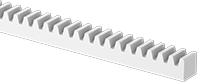 |
20° Pressure Angle—Rectangular |
|
14 1/2° Pressure Angle—Rectangular |
