


Filter by
Maximum Holding Torque
Motor Frame Size
Shaft Diameter
Maximum Rotation Speed


Voltage

Component

Body Shape


Wire Connection


Mounting Position
Number of Shafts
Direction of Operation


Full Step Increment
Thrust Load Capacity
DFARS Specialty Metals
Export Control Classification Number (ECCN)
RoHS
Stepper Motors
Motors
 |
Square Body |
 |
 |
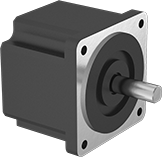
These stepper motors are good for precise, repetitive movements, such as those made by the head of a 3D printer. Similar to the hands of a clock, their shaft turns in small, equal increments. When the shaft stops, it holds its position even when a counteracting force is applied to the load. You can control the position of the load without having to configure encoders or sensors. All are bipolar hybrid stepper motors, so the current can flow in both directions. This helps them deliver higher torque, precision, and efficiency than unipolar stepper motors.
All motors require a controller and drive (not included).
For the Manufacturer User Manual, click on a part number and select Product Detail.
8 Wire Leads—Motors with 8 wire leads can be connected to a drive in two different ways, so you can choose between more speed or more torque. Depending on your application, you could configure the motor for high torque at low speeds or for low torque at high speeds.
Maximum Holding Torque—Holding torque is the force needed to move the shaft out of position when it is stationary. When the shaft is in motion, torque generally decreases as speed increases. Use a torque-speed curve to confirm which motor will work for your application. Click on a part number and select “Product Detail” to view the curve for a motor.
Full Step Increment—Full step increment is the rotation of the shaft from one position to the next. A smaller full step increment means the rotor has more teeth, producing smoother and more precise motion. 1.8° is considered standard.
Overall | Shaft | Temp. Range, ° F | |||||||||||||||||
|---|---|---|---|---|---|---|---|---|---|---|---|---|---|---|---|---|---|---|---|
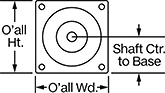
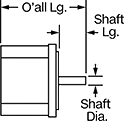
Max. Holding Torque, in·ozf | Max. Rotation Speed, rpm | Max. Current per Phase, amp | Full Step Increment | Stepper Motor Polarity | No. of Wire Leads | Lg. | Wd. | Ht. | Dia. | Lg. | Ctr.-to-Base Lg. | Type | No. of Shafts | Min. | Max. | Each | |||
Square Body | |||||||||||||||||||
NEMA 34 Frame Size | |||||||||||||||||||
| 1,700 | 1,500 | 10 | 1.8° | Bipolar | 8 | 7.4" | 3.4" | 3.4" | 5/8" | 1 1/4" | 1.69" | Keyed | 1 | 0 | 120 | 6627T681 | 0000000 | ||
| 2,124.1 | 360 | 5 | 1.8° | Bipolar | 4 | 7.4" | 3.4" | 3.4" | 5/8" | 1" | 1.7" | Keyed | 1 | 0 | 120 | 6627T924 | 000000 | ||
Motor/Drives
 |
 |
 |
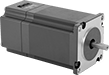
Reduce the size and complexity of your stepper motor setup—these motors have a drive built in, so you don’t need to run cable to a standalone drive. The drive delivers power to the motor based on signals from a PLC, pulse generator, or other controller. These motors are good for precise, repetitive movements, such as those made by the head of a 3D printer. Similar to the hands of a clock, their shaft turns in small, equal increments for smooth motion. When the shaft stops, it holds its position even when a counteracting force is applied to the load. You can control the position of the load without having to configure encoders or sensors. All are bipolar hybrid stepper motors, so the current can flow in both directions. This helps them deliver higher torque, precision, and efficiency than unipolar stepper motors.
For the Manufacturer User Manual, click on a part number and select Product Detail.
Maximum Holding Torque—Holding torque is the force needed to move the shaft out of position when it is stationary. When the shaft is in motion, torque generally decreases as speed increases. Use a torque-speed curve to confirm which motor will work for your application. Click on a part number and select “Product Detail” to view the curve for a motor.
Full Step Increment—Full step increment is the rotation of the shaft from one position to the next. A smaller full step increment means the rotor has more teeth, producing smoother and more precise motion. 1.8° is considered standard.
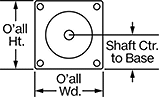
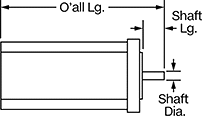
Step Resolution—You can adjust the step resolution down to 1/256 of a full step, which translates to 51,200 microsteps per revolution. Increasing the number of steps directs an even more precise position and reduces the step-step-step motion to mimic a smooth, continuous rotation. The higher the number of step resolution settings, the greater the flexibility you have for determining the size of the motor’s step.
Current per Phase, amp | Overall | Shaft | Temp. Range, ° F | |||||||||||||||||
|---|---|---|---|---|---|---|---|---|---|---|---|---|---|---|---|---|---|---|---|---|
Max. Holding Torque, in·ozf | Max. Rotation Speed, rpm | Min. | Max. | Voltage, V DC | Full Step Increment | Step Resolution | Stepper Motor Polarity | Lg. | Wd. | Ht. | Dia. | Lg. | Ctr.-to-Base Lg. | Type | Min. | Max. | Each | |||
Square Body | ||||||||||||||||||||
NEMA 34 Frame Size | ||||||||||||||||||||
| 1,700 | 1,800 | 0.5 | 5 | 20 to 80 | 1.8° | 1 | Bipolar | 9.6" | 3.5" | 3.5" | 5/8" | 1 3/16" | 1.76" | Keyed | 0 | 120 | 6627T119 | 0000000 | ||
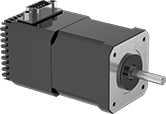
Stepper Motors with Integrated Motion Control
 |
Current per Phase, amp | Overall | Shaft | Temp. Range, ° F | |||||||||||||||||
|---|---|---|---|---|---|---|---|---|---|---|---|---|---|---|---|---|---|---|---|---|
Max. Holding Torque, in·ozf | Max. Rotation Speed, rpm | Min. | Max. | Voltage, V DC | Full Step Increment | Step Resolution | No. of Inputs/Outputs | Lg. | Wd. | Ht. | Dia. | Lg. | Ctr.-to-Base Lg. | Type | Min. | Max. | Each | |||
Motor/Controller/Drives | ||||||||||||||||||||
NEMA 34 Frame Size | ||||||||||||||||||||
| 1,700 | 1,800 | 0.5 | 5 | 20 to 80 | 1.8° | 1/10 | 2 Digital-Inputs, 1 Digital-Output | 9.6" | 3.5" | 3.5" | 5/8" | 1 1/4" | 1.76" | Keyed | 0 | 120 | 6627T128 | 0000000 | ||
Precision Beam Couplings
 | |
Spiral Cut |
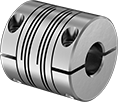
Machined with slits, these one-piece couplings flex to transfer full torque (zero backlash) and compensate for tiny misalignments.
Spiral Cut—Long slits along the surface help the coupling flex and handle greater misalignment than parallel cut couplings. They're also less rigid, so they're best used with light duty machinery, such as encoders and stepper drives. Also known as helical beam couplings.
303 Stainless Steel—More corrosion resistant and stronger than aluminum couplings, these withstand mild cleaning solutions, such as acetone and ammonia.
Aluminum—Lightweight and corrosion resistant.
Clamp-On Shaft Mount—Grip shafts evenly without marring them and hold tighter than set screws. Tighten the clamping screws to secure.
Misalignment Capability | |||||||||||||
|---|---|---|---|---|---|---|---|---|---|---|---|---|---|
For Shaft Diameter | OD | Overall Lg. | Max. Rotation Speed, rpm | Max. Torque, in·lbf | Parallel | Angular | Axial | For Shaft Type | Shaft Mount Type | Each | |||
Spiral Cut | |||||||||||||
303 Stainless Steel | |||||||||||||
| 5/8" × 3/8" | 1 1/2" | 2 1/4" | 6,000 | 145 | 0.03" | 3° | 0.015" | Round | Clamp On | 6259K34 | 0000000 | ||
| 5/8" × 1/2" | 1 1/2" | 2 1/4" | 6,000 | 145 | 0.03" | 3° | 0.015" | Round | Clamp On | 6259K35 | 000000 | ||
| 5/8" × 5/8" | 1 1/2" | 2 1/4" | 6,000 | 145 | 0.03" | 3° | 0.015" | Round | Clamp On | 6259K36 | 000000 | ||
| 3/4" × 5/8" | 1 1/2" | 2 1/4" | 6,000 | 145 | 0.03" | 3° | 0.015" | Round | Clamp On | 6259K38 | 000000 | ||
Aluminum | |||||||||||||
| 5/8" × 1/4" | 1 1/2" | 2 3/8" | 10,000 | 155 | 0.015" | 5° | 0.01" | Round | Clamp On | 6208K634 | 000000 | ||
| 5/8" × 5/16" | 1 1/2" | 2 3/8" | 10,000 | 155 | 0.015" | 5° | 0.01" | Round | Clamp On | 6208K635 | 000000 | ||
| 5/8" × 5/16" | 1 5/8" | 2 1/2" | 10,000 | 215 | 0.015" | 5° | 0.01" | Round | Clamp On | 6208K658 | 000000 | ||
| 5/8" × 3/8" | 1 1/2" | 2 3/8" | 10,000 | 155 | 0.015" | 5° | 0.01" | Round | Clamp On | 6208K636 | 000000 | ||
| 5/8" × 3/8" | 1 5/8" | 2 1/2" | 10,000 | 215 | 0.015" | 5° | 0.01" | Round | Clamp On | 6208K659 | 000000 | ||
| 5/8" × 3/8" | 1 3/4" | 2 3/4" | 10,000 | 250 | 0.015" | 5° | 0.01" | Round | Clamp On | 6208K684 | 000000 | ||
| 5/8" × 1/2" | 1 1/2" | 2 3/8" | 10,000 | 155 | 0.015" | 5° | 0.01" | Round | Clamp On | 6208K638 | 000000 | ||
| 5/8" × 1/2" | 1 5/8" | 2 1/2" | 10,000 | 215 | 0.015" | 5° | 0.01" | Round | Clamp On | 6208K662 | 000000 | ||
| 5/8" × 1/2" | 1 3/4" | 2 3/4" | 10,000 | 250 | 0.015" | 5° | 0.01" | Round | Clamp On | 6208K686 | 000000 | ||
| 5/8" × 5/8" | 1 1/2" | 2 3/8" | 10,000 | 155 | 0.015" | 5° | 0.01" | Round | Clamp On | 6208K639 | 000000 | ||
| 5/8" × 5/8" | 1 5/8" | 2 1/2" | 10,000 | 215 | 0.015" | 5° | 0.01" | Round | Clamp On | 6208K663 | 000000 | ||
| 5/8" × 5/8" | 1 3/4" | 2 3/4" | 10,000 | 250 | 0.015" | 5° | 0.01" | Round | Clamp On | 6208K687 | 000000 | ||
| 5/8" × 3/4" | 1 3/4" | 2 3/4" | 10,000 | 250 | 0.015" | 5° | 0.01" | Round | Clamp On | 6208K697 | 000000 | ||
| 8 mm × 5/8" | 30 mm | 38 mm | 6,000 | 58 | 0.38 mm | 3° | 0.25 mm | Round | Clamp On | 2464K36 | 000000 | ||
| 9 mm × 5/8" | 30 mm | 38 mm | 6,000 | 58 | 0.38 mm | 3° | 0.25 mm | Round | Clamp On | 2464K37 | 000000 | ||
| 10 mm × 5/8" | 30 mm | 38 mm | 6,000 | 58 | 0.38 mm | 3° | 0.25 mm | Round | Clamp On | 2464K38 | 000000 | ||
| 10 mm × 5/8" | 38 mm | 57 mm | 6,000 | 80 | 0.762 mm | 3° | 0.38 mm | Round | Clamp On | 2464K49 | 000000 | ||
| 11 mm × 5/8" | 30 mm | 38 mm | 6,000 | 58 | 0.38 mm | 3° | 0.25 mm | Round | Clamp On | 2464K39 | 000000 | ||
| 12 mm × 5/8" | 30 mm | 38 mm | 6,000 | 58 | 0.38 mm | 3° | 0.25 mm | Round | Clamp On | 2464K41 | 000000 | ||
| 12 mm × 5/8" | 38 mm | 57 mm | 6,000 | 80 | 0.762 mm | 3° | 0.38 mm | Round | Clamp On | 2464K52 | 000000 | ||
| 14 mm × 5/8" | 38 mm | 57 mm | 6,000 | 80 | 0.762 mm | 3° | 0.38 mm | Round | Clamp On | 2464K53 | 000000 | ||
| 15 mm × 5/8" | 38 mm | 57 mm | 6,000 | 80 | 0.762 mm | 3° | 0.38 mm | Round | Clamp On | 2464K54 | 000000 | ||
| 16 mm × 5/8" | 38 mm | 57 mm | 6,000 | 80 | 0.762 mm | 3° | 0.38 mm | Round | Clamp On | 2464K55 | 000000 | ||
| 20 mm × 5/8" | 38 mm | 57 mm | 6,000 | 80 | 0.762 mm | 3° | 0.38 mm | Round | Clamp On | 2464K56 | 000000 | ||
