McMaster-Carr logo
    Filter by
    Motor Frame Size
    Lead Screw Length
    Dynamic Load Capacity
    Body Shape
    Thrust Load Capacity
    Lead Screw Type
    Travel Length
    Overall Length
    Overall Height
    Weight
    American Wire Gauge (AWG)
    Industrial Info Snippet
    Attribute Image
    Electrical Connection
    Electrical Connection Type
    Electrical Phase
    Height
    DFARS Specialty Metals
    Export Control Classification Number (ECCN)
    Industrial Info Snippet
    Maximum Temperature
    Minimum Temperature
    Enter e-mail addresses in the fields below
    Message
    Cancel
    Comments
    E-mail address (if you would like a response)
    4 Products

    Stepper Motors with Linear Actuation

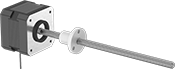
    Image of Product. Front orientation. Stepper Motors. Stepper Motors with Linear Actuation, External Lead Screw.
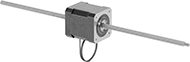
    Image of Product. Front orientation. Stepper Motors. Stepper Motors with Linear Actuation, Pass-Through Lead Screw.

    External Lead Screw

    Pass-Through Lead Screw

    Instead of a shaft, these stepper motors have a lead screw that converts rotational motion to linear motion. Moving in increments smaller than the thickness of a sheet of paper, they're ideal for applications that require fine motion control, such as positioning electrical components on a circuit board. They move in equal steps and hold their position when stationary, so they do not require encoders, sensors, or other position feedback devices. The lead screw is built into the motor, so there are fewer points of failure than systems that use a shaft coupling to connect the lead screw. All are bipolar hybrid stepper motors, which deliver greater torque, precision, and efficiency than other types of stepper motors.
    All motors require a controller and drive (not included).
    External Lead Screw—External lead screw stepper motors work similar to a traditional linear motion system; attach the load to the flanged nut, which travels back and forth along the lead screw.
    Pass-Through Lead Screw—Pass-through lead screw stepper motors give you the most design versatility because there are two ways to move your load: on the motor body or on the ends of the lead screw. The motor moves when the lead screw is fixed or the lead screw moves when the motor body is fixed.
    Travel Distance per Full Step—Travel distance per full step determines the control you have over the motor’s positioning. The smaller the measurement, the finer positioning control you have, but the more steps it will take to go the same distance.
    Dynamic Load Capacity—Dynamic load capacity is the maximum load a motor can move. If you increase the speed, the dynamic load capacity decreases. Click on a part number and select "Product Detail" to view the load-speed chart and confirm the motor will work for your application.
    Full Step Increment—Full step increment is the rotation of the shaft from one position to the next. A smaller full step increment means the rotor has more teeth, producing smoother and more precise motion. 1.8° is considered standard.
    Overall
    Temp.
    Range, ° F
    Travel Distance
    per Full Step
    Travel
    Lg.
    Dynamic
    Load Cap., lb.
    Max. Speed,
    in/sec
    Max. Current
    per Phase, amp
    Full Step
    Increment
    Stepper Motor
    Polarity
    No. of Wire
    Leads
    Lg.
    Wd.
    Ht.
    Lead Screw
    Lg.
    Thread
    Size
    Min.
    Max.
    Each
    External Lead Screw
     
    NEMA 14 Frame Size
    0.00024"5.2"500.31.21.8°Bipolar47.4"1.4"1.4"6"7/32"-483513000000000000000
    0.00024"11.2"500.31.21.8°Bipolar413.4"1.4"1.4"12"7/32"-48351300000000000000
     
    Pass-Through Lead Screw
     
    NEMA 14 Frame Size
    0.00024"4.5"500.31.21.8°Bipolar46.3"1.4"1.4"6"7/32"-48351300000000000000
    0.00024"10.5"500.31.21.8°Bipolar412.3"1.4"1.4"12"7/32"-48351300000000000000
     
    back to top