We will reply to your message within an hour.
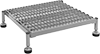
Step up to assembly areas, conveyor lines, and other workstations for a better working height. These platforms have legs you can turn to raise and lower them.
A vinyl foam mat cushions your feet and reduces fatigue when you’re standing on these platforms for long periods. Made of steel, they’re durable enough to last on shop floors or assembly lines.
Maintain equal spacing when adjusting the overall height of these platforms. The distance between the floor and the first step is always the same between steps to meet OSHA requirements.
Equipped with four casters, these platforms are easy to move between work areas. When you stand on these platforms, the spring-loaded casters automatically retract for a stable surface.
Tip these platforms onto their casters to roll them wherever you need them—they give you a step up to your work and a large surface to stand on.
Reduce strain from standing on work platforms for long periods—these platforms have vinyl foam padding for cushioning. Spring-loaded casters make them easy to move between work areas, then retract when you step on the platform to keep you steady while working.
Install these platforms for easy access to elevated areas.
Transform your forklift into an elevated work platform.
With foldable rails, these platforms can be collapsed to the size of a pallet for easy storage when not in use. Attach them to your forklift for an enclosed, elevated work platform.
Customize the height of these platforms with a simple turn of the crank. Ideal for shared workstations, they can be raised or lowered to your optimal working height in seconds from a standing position.
Roll these platforms into place to access the tops of machinery, trucks, or tanks. They provide a stable surface to reach elevated or hard-to-access areas during maintenance.
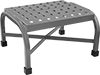
Get a secure and stable step up with these standard step stools.
Grip the handrail of these stools to keep steady. Rubber-coated steps prevent slipping.
With spring-loaded casters, these step stools are easy to move between work areas.
Fold for easy transport and storage.
Grab the handrail for stability. These stools fold for easy transport and storage.
Safely climb truck tires for inspections and maintenance under the hood or to access cargo. They are compatible with a variety of vehicles, from standard work trucks to semi-trucks.
Flip these steps down when you need them and fold them up when you don't.
Good for use as ladder rungs, cut these steps to size with a metal-cutting saw and weld them in place.
Add a hand- or foothold for easier access to your vehicle or equipment.
Get a leg up. Weld or bolt these steps—originally designed to hang underneath trucks—to any flat horizontal surface.
A leg up when you need it, out of the way when you don’t—these ladders slide in and out of their mounting bracket for easy access. Originally designed for trucks, weld or bolt them underneath any surface.
Posts at the top of these ladders give you something to grab when you climb up and descend.
Ladders can be connected to create the height you need.
Mount these ladders to the wall for access to mezzanines, roofs, and other elevated areas.
Ladder and cage come unassembled for mounting flexibility and lower freight costs.
A cage is welded to these ladders for quick installation. The cage helps you feel secure on tall ladders—it surrounds the ladder to help reduce the risk of falls.
Ladders have serrated rungs for slip resistance and four smooth rungs at the top for hand grips.
Step up safety—attach these covers to the rungs of your wall and tank ladders to help prevent slips and falls.
Often used on loading docks, these ladders mount to the top of a wall or ledge.
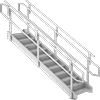
Mount these stairs to an elevated landing for easy access.
Tilt these stairs sideways to roll them between work areas.
These stairs have offset steps that allow for a comfortable and safe forward descent. Set at a steeper angle than our standard stairs, they require less floor space.
Also known as ship's ladders, these stairs have a 75° climbing angle to fit in pits, trenches, wells, and other tight spaces.
Pull these stairs out to reach a storage or work area, then fold them flat against the wall when you’re done.
Tilt these ladders to roll them on their wheels. When you set them upright again, the wheels lift off the floor to keep them stationary while in use.
While in use, wheels retract and the cup shoes rest directly on the floor to prevent movement.
Grip the handrail for stability. While in use, wheels retract and the cup shoes rest directly on the floor to prevent movement.
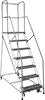
Move these standard rolling platform ladders easily between your work areas.
Ladders are shipped unassembled to save on freight costs.
A 50° incline is more gradual than standard ladders, so it's easier to climb and descend.
Extra bracing in the base and back makes these ladders tough enough to handle harsh environments.
An extra pair of casters in the center allows these ladders to turn easily in narrow aisles and tight spaces.
Picking and putting away material just got easier. Ladders have three shelves with raised edges that each hold 70 lbs.
Move freely as you work—these ladders have a more spacious platform than standard platform ladders.
With a work platform that extends beyond the base, these rolling ladders allow you to access hard-to-reach areas, such as the top of large tanks and heavy machinery. Also known as cantilever ladders.
Get close to your work even when pipes or other objects are in the way. With no horizontal braces, these ladders can straddle obstructions.
Not only can you climb on either side of these ladders, two people can use the oversized platform simultaneously.
With a 1,000 lb. capacity and storage supports on the base, these ladders can store tools and supplies as well as support personnel.
Release the chain across the back of this platform so you can walk through to unload and load trailers.
Fold these ladders for easy transport and compact storage.
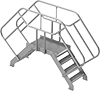
Use these standard crossover bridges to walk over conveyors, machines, and pipes.
Set at a steeper angle than our other crossover bridges, these bridges require less floor space.
Move these bridges as you update your facility layout. Unlike other crossover bridges, they do not need to be bolted to the floor. Use them to walk over pipes and conveyors.
Take the safest, shortest route over pipes and other obstacles near the ground.
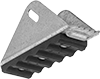
Replace worn out shoes on step ladders.
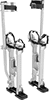
Often used to reach overhead lights, pipe, and electrical wiring, these stilts give you mobility at step ladder height.
Hooks along the top hold these general purpose ladders in place.
Replace worn out shoes on straight and extension ladders.
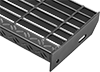
Choose these stair treads for greater durability than metal plank grating stair treads.
The most economical stair treads we offer.
Use plank grating for platforms, stair treads, ramps, and decks.
An integral toeboard keeps tools and parts from falling off this plank grating and meets OSHA 29 CFR 1910.23 for elevated walkways.
Able to support heavier loads than plank grating, bar grating is good for trenches, mezzanines, walkways, work platforms, and floors.
Narrow openings give this grating a higher load bearing surface than our standard metal bar grating and reduce the chance of something falling through.
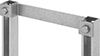
Mount between two strut channels to create a handhold.
Run cable and tubing in the tightest spaces with channel that is one-quarter the height and one-half the width of regular strut channel.
Slide the strut channel into the tube for telescoping length adjustments.
Half the height and the same width as regular strut channel, this low-profile strut channel fits into tight spots and is compatible with many of the same brackets.
Up to two times the height of regular strut channel, this high-profile channel is stronger than regular strut channel.
For compatibility with quick-connect clamps to secure pipe and conduit without screws and tools, this strut channel has narrow slotted holes.
This welded, one-piece strut channel combines two strut channels side-to-side.
This welded, one-piece strut channel combines two strut channels back-to-back.
Serrated grooves grip the lip of the channel.
Connect two channels to create a stacked channel.
Keep a rod securely centered against the strut channel.
Also known as insert nuts, these convert slotted holes to threaded round holes and keep them centered in the channel.
Push these nuts into place rather than threading them onto a fastener.
Quickly attach these nuts by twisting them closed at any point along a threaded rod.
A spring plus serrated grooves that grip the lip of the channel provide a more secure hold than standard strut channel nuts.
Insert these nuts into the long open side of strut channel and twist to secure. A built-in washer enables one-handed installation.
A tab fits tightly against the lip of the channel to keep these nuts from slipping.
In addition to serrated grooves for gripping the lip of the channel, these nuts have wings for easy positioning.
There's no need for additional fasteners with these nuts—they combine a strut channel nut with a spring and a threaded stud.
Keep hardware centered in the strut channel slot.
Add hardware to strut channel without having to hold the washer in place or reach inside the channel.
Use with hex nuts to connect threaded rod.
Notches on these washers grip the channel to keep them in place.
Mount these brackets to strut channel to add stair treads. They’re also known as stringers.
Designed to wrap around the sides of strut channel, these brackets provide a stronger hold than other strut channel brackets.
Attach strut channel at any point on a threaded rod without taking apart your assembly.
Push these brackets into strut channel and tighten the included cam screws for a partially concealed connection.
These brackets have narrow slots compatible with quick-connect clamps for securing pipe and conduit on the channel side of struts without screws or tools.
Position two strut channels at a 30° to 90° angle, then tighten the bolt to secure.
Create a four-sided raceway for cable, or give a more finished look to strut channel structures.
Smoothly move lightweight curtains overhead along strut channel.
Slip these hangers onto the lip of top-opening strut channel to attach chain, wire rope, pipe, and threaded rod.
Securely fasten strut channel to the floor.
Provide a stable, nonmarring base for strut channel legs.
Mount strut channel away from walls.
Mount a length of strut channel between the ends of a beam to run cable and conduit along the beam without drilling.
For quick mounting of components, these hangers snap into strut channels for a strong hold and easy repositioning.
Brackets mount on the outside of strut channel to allow trolley movement.
Roll components along strut channel hanging overhead.
Support and protect conduit by mounting it to strut channel.
Support the corners of strut channel structures.
Mount to your strut channel to support rail, tube, or pipe.
Cover rough ends of strut channel.
A tab on the end of these shelf brackets fits inside the strut channel for extra stability.
Mount electrical components along your strut channel to bring power to new locations.
Hold two pieces of strut channel together so they can smoothly open or close.
Lower a ladder so a teammate can climb to safety after a fall.