We will reply to your message within an hour.
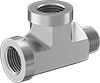
Use these corrosion-resistant fittings in a low-pressure pipe line.
These fittings are made to tighter tolerances than other stainless steel pipe fittings. They are also known as instrumentation fittings.
Use these fittings in extreme-pressure conditions up to 15,000 psi.
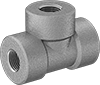
Use these heavy duty, corrosion-resistant fittings in high-pressure flow applications.
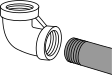
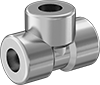
Socket-connect fittings are easier to weld than butt-weld fittings because the fitting doesn't need to align perfectly to the pipe. Slip the pipe into the socket and weld.
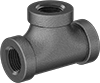
Use these fittings for low-pressure applications in noncorrosive environments.
The galvanized finish on these fittings provides fair corrosion resistance. Fittings are for use in low-pressure applications.
These fittings are strong enough to handle extreme pressures, yet small enough to fit into cramped spaces.
Made to tighter tolerances than other steel pipe fittings, these are also known as instrumentation fittings.
These fittings can stand up to high-pressure applications. Use them in noncorrosive environments.
A galvanized finish gives these fittings better corrosion resistance than our plain steel high-pressure fittings. Also known as Pressure Class 3000 fittings.
Socket-connect fittings are easier to weld than butt-weld fittings because the fitting doesn't need to align perfectly to the pipe. Slide the pipe into the socket and weld.
These brass fittings have the strength to handle high-pressure applications.
Not only do these brass fittings have the strength to handle high-pressure applications, the male threads have a sealant applied for extra protection against leaks.
Use these heavy-duty brass fittings for high-pressure drinking water applications.
The plating on these brass fittings creates a shiny finish and provides extra protection in corrosive environments. Fittings have the strength to handle high-pressure applications.
When space in your pipe line is limited, choose these miniature fittings that are one inch or less in length.
Use these fittings in low-pressure flow applications. They have good corrosion resistance.
Used in low-pressure pipe lines, these brass fittings have a plating that makes them shiny and improves corrosion resistance.
Also known as instrumentation fittings, these have the most precise threads and the tightest tolerances of all the brass pipe fittings we offer.
Extreme pressures are no problem for these heavy-duty brass fittings.
In addition to being lightweight, these aluminum fittings offer good corrosion resistance. Use them in low-pressure flow applications.
Designed for medium-pressure applications, these fittings have better strength than our low-pressure aluminum pipe fittings.
Connect these fittings to Schedule 40 plastic pipe—they are the industry standard for residential and commercial low-pressure plumbing and water supply applications. They are plastic for good corrosion resistance.
Extreme temperatures are no problem for these fittings—they’re made of PTFE, so they can withstand a wider temperature range than any of our other plastic pipe fittings for chemicals. They are commonly used in high-purity chemical flow processes, such as semiconductor and clean room applications.
Not only do these PFA fittings have the chemical resistance to handle acid and salt water, they also have better crack resistance than other plastic pipe fittings for chemicals. They are commonly used in high-purity chemical flow processes, such as semiconductor and clean room applications.
Made of corrosion-resistant plastic, these fittings won’t deteriorate when used in oil applications. They have high strength and impact resistance.
Made of PVDF, also known as Kynar, these fittings stand up to the harsh chemicals used to clean food processing lines. Unlike other plastic fittings, such as nylon and acetal fittings, they’ll resist degrading when exposed to strong alkali and highly acidic solutions.
Made of either nylon or acetal, these fittings resist corrosion, so they won't deteriorate in food processing applications. They won’t transfer tastes or odors to your food or beverages.
Made of nickel-plated brass, these tube fittings resist corrosion better than plain brass fittings. The male threaded ends connect to NPT, NPTF, BSPP, BSPT, and other universal threads, so you don’t have to bother matching exact thread types.
Often used in outdoor, damp, and washdown environments, these 316 stainless steel fittings will not corrode from water, salt, or chemicals. The male threaded ends mate with NPT, NPTF, BSPT, BSPP, and other universal threads, so you won’t have to worry about matching exact threads when you’re on the job.
Made of brass, these fittings have good corrosion resistance.
Made of nickel-plated brass, these fittings have better corrosion resistance than unplated brass fittings.
Make lightweight connections without the hassle of matching the exact thread type—these fittings connect to NPT, NPTF, BSPP, BSPT, and other universal threads.
These fittings won’t absorb moisture, so they’re good for water and high-humidity air applications.
The threads on these fittings mate with NPT, NPTF, BSPT, and BSPP threads.
Connect high-pressure brake lines with fittings that won’t crack in frigid temperatures. Often used on commercial trucks and trailers, these fittings meet Department of Transportation FMVSS 571 safety standards.
Connect air brake lines with fittings that won’t crack in sub-zero temperatures. They meet Department of Transportation FMVSS 571 safety standards, so they’re often used in commercial trucks and trailers.
An all-metal body and built-in tube support or dual seals allow these fittings to handle the highest pressure ratings of all our push-to-connect tube fittings.
Designed for use in welding applications, these fittings are flame retardant.
Withstanding up to 300° F, these fittings have the highest temperature rating of all our brass push-to-connect tube fittings for air and water.
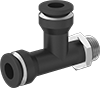
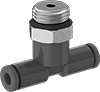
Made of EPDM, the gasket on these fittings stands up to the hot water found in heat exchangers and cooling systems. These fittings have stainless steel pipe threads, which are more durable than the plastic pipe threads found on other push-to-connect tube fittings.
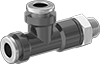
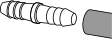
Barbs grip onto tubing.
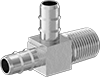
Minimize leaks in your line—these fittings have a single barb that creates a smooth clamping surface for extra-tight connections.
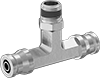
Made of brass, these fittings resist corrosion from water and are more durable than plastic and aluminum fittings.
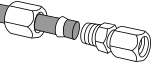
A single sleeve (ferrule) compresses the tubing as you tighten the nut on these fittings, creating a strong seal. They are brass for good corrosion resistance.
A built-in tube support slips inside the tubing to prevent collapsing and provides a sturdy connection for an extra-tight seal.
These fittings include a nut with a built-in sleeve (ferrule), so there’s no need to remove the nut for assembly.
Made of acetal, these compression fittings are lighter in weight than metal compression fittings and won’t absorb moisture when used in wet environments.
Lighter in weight than their metal counterparts, these compression fittings are polypropylene.
Fittings withstand temperatures up to 220° F.
A smooth interior reduces friction and prevents product buildup, ensuring an unrestricted flow.
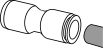
Also known as instant fittings, these connect to tubing with a push, and an internal gripping ring and O-ring hold the tubing tight. Use in applications up to 150 psi.
Connect hot food and beverage lines with just a push. Also known as instant fittings, they have an internal gripping ring and an O-ring that hold tight to tubing.
Made of brass, these fittings withstand frequent washdowns in food-processing applications. They also adhere to NSF/ANSI safety standards, so they’re safe to use with food, beverages, and dairy.
Made of PVDF (also known as Kynar), these fittings have excellent strength and can handle temperatures as high as 240° F or 270° F.
These plastic compression fittings meet NSF/ANSI Standard 51 for food contact.
Fittings can withstand temperatures up to 200° F.
These fittings keep their strength in moist environments and meet NSF/ANSI 61 for drinking water. Also known as instant fittings.
Fittings have a barb that grips onto tubing. Use in applications up to 120 psi.
Also known as instant fittings, these chemical-resistant plastic fittings connect to tubing with a push. An internal gripping ring holds the tubing tight.
Fittings have a sleeve that bites into tubing as you tighten the nut to form a seal in applications up to 120 psi. Also known as flareless fittings.
Fittings have a barb that grips onto tubing. Use in applications up to 150 psi.
Also known as instant fittings, they connect to tubing with a push, and an internal gripping ring and O-ring hold the tubing tight. Use in applications up to 140 psi.
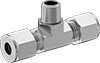
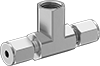
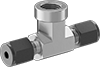
Use these fittings at pressures up to 9,700 psi. Also known as instrumentation fittings, they are made to tight tolerances for use in high-precision applications. They are compatible with Swagelok®, Let-Lok, and Parker A-Lok fittings.
For applications that require an extra level of cleanliness, these fittings are individually bagged to prevent contamination.
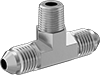
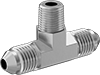
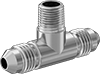
Also known as JIC (Joint Industrial Council) fittings, these provide a tight metal-to-metal seal on stainless steel tubing that is flared to 37°.
Individually bagged to prevent contamination, these fittings are suitable for applications that require a high level of cleanliness.
The threads on the tube end of these fittings are Class 3A or 3B and adhere to tighter tolerances than other 37° flared fittings.
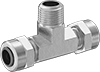
A single sleeve (ferrule) bites into tubing as you tighten the nut, creating a strong seal. The nut and sleeve are included.
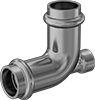
Crimp these fittings to copper tubing with a crimping tool for a leak-tight connection that doesn’t require heat or soldering. They are comparable to Viega ProPress fittings.
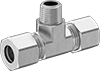
A nut with two sleeves (ferrules) gives these fittings extra gripping power. The sleeves bite into tubing as you tighten the nut, creating a strong seal.
No sleeve is required to assemble these fittings, which makes for a faster, more convenient installation compared to 37° flared fittings. They are also known as refrigeration and SAE fittings.
Create a strong connection without heating, flaring, or soldering.
With a nickel-plated finish, these compression fittings resist corrosion better than plain brass fittings.
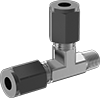
Also known as instrumentation fittings, these are made to tighter tolerances than standard compression fittings. They are compatible with Parker CPI fittings.
These fittings have two sleeves for extra gripping power. They bite into steel tubing as you tighten the nut to form a strong seal.
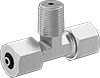
A single sleeve (ferrule) bites into tubing as you tighten the nut, creating a strong seal.
Made of polypropylene, these fittings are lighter in weight than metal barbed hose fittings.
Designed for coolant applications up to 200 psi, these fittings have a standard barbed end that slides into hose and secures with a clamp.