We will reply to your message within an hour.
The interior and exterior are polished to a high-luster finish to resist particle buildup and allow for easy cleaning.
This tubing has a seamless construction with no weld bead for unrestricted flow and is stronger than welded tubing.
When your application does not require a smooth interior, this tubing is an economical choice.
A titanium additive gives this tubing excellent strength and superior corrosion resistance. It meets MIL-T-8808.
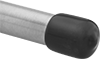
This tubing comes cleaned and capped to prevent moisture and dirt from contaminating the inside.
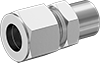
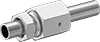
Use these fittings at pressures up to 9,700 psi. Also known as instrumentation fittings, they are made to tight tolerances for use in high-precision applications. They are compatible with Swagelok®, Let-Lok, and Parker A-Lok fittings.
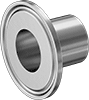
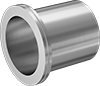
The smooth finish inside these stainless steel quick-clamp fittings makes it easy to remove product residue.
Also known as I-line fittings, these fittings have a male adapter that interlocks with a female adapter for more support than standard quick-clamp fittings.
Polished to a 20 Ra finish, these fittings have an extra-smooth interior that prevents product buildup and inhibits bacteria growth.
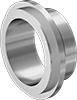
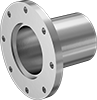
Also known as KF, QF, and NW fittings, these fittings are for high-vacuum applications, such as vacuum coating and heat treating, leak testing, and analyzing gases.
Fittings are polished to a32 Ra and under finish on the interior.
Polished to at least a 15 Ra finish on the inside, these fittings have an ultra-smooth interior surface that helps prevent contamination. They are also known as ultra-high-purity fittings.
Originally used on satellites, rocket propulsion systems, and even Mars rovers, these fittings will handle your most challenging industrial environments. They're designed to withstand high vibration and ultra-high vacuum without generating particles that could disrupt your operation.
An alternative to bolt-together fittings, these fittings handle larger tube OD sizes than quick-clamp fittings. Also known as ISO-K high-vacuum fittings, the clamps have claws that grab hold of fittings with flanged ends.
Create access points in ultra-high-vacuum lines or chambers by bolting two same-size flanges together with a copper gasket between them. The flanges’ sharp edges dig into the copper gasket and form an extremely tight seal, which means they handle higher vacuum pressures than other high-vacuum fittings with rubber gaskets.
For high-vacuum systems with tube sizes too large for quick-clamp (KF) fittings, choose these bolt-together fittings.
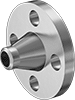
Butt-weld fittings allow for a smooth, flush connection that provides maximum flow.
For use in high-vacuum systems, these fittings use a metal reinforced O-ring to create an airtight seal. Also known as KF, QF, and NW fittings, they’re used for high-vacuum applications such as vacuum coating and heat treating, leak testing, and analyzing gases.
Typically used with thin-wall stainless steel unthreaded pipe fittings.
Choose these fittings when you want the same high-quality found in our low-pressure pipe fittings, but need more strength to handle higher pressures.
Use these heavy duty, corrosion-resistant fittings in high-pressure flow applications.
Typically used with thick-wall and high-pressure stainless steel unthreaded pipe fittings.
Bolt two same-size flanges together with a gasket to create an access point within a pipe line.
Typically used with extreme-pressure stainless steel unthreaded pipe fittings.
Also known as Schedule 10 fittings, these are thin, lightweight, and corrosion resistant.
Socket-connect fittings are easier to weld than butt-weld fittings because the fitting doesn't need to align perfectly to the pipe. Slip the pipe into the socket and weld.
Typically used with standard-wall and low-pressure stainless steel unthreaded pipe fittings.
Use these heavy duty forged flanges for high-pressure applications.
Unlike other stainless steel fittings, these are made in the U.S.A. for superior quality. As another marker of quality, they come with a certificate with a traceable lot number and test report that guarantees material composition.
Use these corrosion-resistant fittings in a low-pressure pipe line.
Typically used with low-pressure stainless steel threaded pipe fittings.
Titanium has similar strength to steel, but is approximately 40% lighter. It has better corrosion resistance than most stainless steel alloys and can handle corrosive substances, such as salt water and acids.
Also known as Schedule 40 fittings, these have thicker walls than our thin-wall aluminum unthreaded pipe fittings.
In addition to being lightweight, these aluminum fittings offer good corrosion resistance. Use them in low-pressure flow applications.
Typically used with standard-wall aluminum unthreaded pipe fittings.
Typically used with thin-wall aluminum unthreaded pipe fittings.
Thick walls give these Schedule 80 fittings excellent strength.
Also known as Pressure Class 3000 fittings, these have the highest pressure rating of all the aluminum pipe fittings we offer.
Use these unthreaded flanges in low-pressure applications. Also known as Pressure Class 125 flanges.
Typically used with thick-wall aluminum unthreaded pipe fittings.
These joints weld to unthreaded pipe or another butt-weld fitting for a leak-resistant permanent connection.
Typically used with standard-wall and low-pressure iron and steel unthreaded pipe fittings. Also known as Schedule 40.
With thicker, stronger walls than our standard-wall butt-weld pipe fittings, these fittings stand up to your high strength applications.
Socket-connect fittings are easier to weld than butt-weld fittings because the fitting doesn't need to align perfectly to the pipe. Slide the pipe into the socket and weld.
Typically used with extreme-pressure iron and steel unthreaded pipe fittings. Pipe is also known as Schedule XXH .
Typically used with thick-wall and high-pressure iron and steel unthreaded pipe fittings. Also known as Schedule 80.
Even in temperatures as low as -46°, these A350 LF2 steel flanges won’t become brittle, so they absorb impact better than other low-pressure steel flanges.
Bolt two flanges of the same size together with a gasket to create an access point in a pipe line.
For excellent strength in extreme-pressure applications, choose these heavy duty Pressure Class 1500 flanges.
Forged for extra strength, these heavy duty unthreaded flanges can withstand high-pressure applications.
A galvanized finish gives these fittings better corrosion resistance than our plain steel high-pressure fittings. Also known as Pressure Class 3000 fittings.
Typically used with medium-pressure iron and steel threaded pipe fittings. Also known as Schedule 80.
These fittings can stand up to high-pressure applications. Use them in noncorrosive environments.
The strongest steel fittings we offer, these can withstand extreme-pressure applications.
Typically used with extreme-pressure iron and steel threaded pipe fittings. Also known as Schedule XXH.
Also known as Schedule 40, this steel pipe is designed for low-pressure applications.
Also known as Pressure Class 200 pipe.
This steel pipe has grooved ends that connect to fittings with a clamp (sold separately) for an easy way to install piping systems.
Typically used with low-pressure brass and bronze threaded pipe fittings.
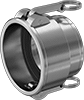
Couplings are metal, which has better durability than plastic cam-and-groove hose couplings. They consist of a plug and a socket that connect and disconnect quickly. Use them if you need frequent access to a line. To connect, insert the plug into the socket and push the levers down.
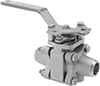
Weld these valves to unthreaded metal pipe for a permanent, flush connection that permits smooth flow through a line. Use with water, oil, inert gas, and steam.
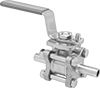
Weld these valves to unthreaded metal pipe for a permanent, flush connection that permits smooth flow through a line. They have polished internal surfaces for easy cleaning in food and beverage systems.