


Filter by
Maximum Holding Torque


Mounting Position
Direction of Operation


RoHS

U.S.–Mexico–Canada Agreement (USMCA) Qualifying
DFARS Specialty Metals
REACH
Export Control Classification Number (ECCN)
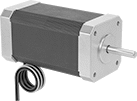
Clean Room Stepper Motors
Motors
 |
 |  |
Maximum Holding Torque—Holding torque is the force needed to move the shaft out of position when it is stationary. When the shaft is in motion, torque generally decreases as speed increases. Use a torque-speed curve to confirm which motor will work for your application. Click on a part number and select “Product Detail” to view the curve for a motor.
Full Step Increment—Full step increment is the rotation of the shaft from one position to the next. A smaller full step increment means the rotor has more teeth, producing smoother and more precise motion. 1.8° is considered standard.
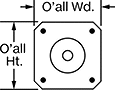
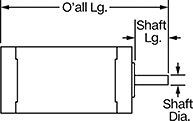
Overall | Shaft | Temp. Range, ° F | ||||||||||||||||||
|---|---|---|---|---|---|---|---|---|---|---|---|---|---|---|---|---|---|---|---|---|
Max. Holding Torque, in·ozf | Max. Rotation Speed, rpm | Max. Current per Phase, amp | Full Step Increment | Stepper Motor Polarity | No. of Wire Leads | Lg. | Wd. | Ht. | Dia., mm | Lg., mm | Type | No. of Shafts | Vacuum Rating, Torr | Min. | Max. | Clean Room Std. | Each | |||
Square Body | ||||||||||||||||||||
NEMA 11 Frame Size | ||||||||||||||||||||
| 10 | 3,250 | 0.67 | 1.8° | Bipolar | 4 | 2.1" | 1.1" | 1.1" | 5 | 18 | Solid | 1 | 1× 10^-7 | 0 | 120 | ISO Class 1 | 4799N11 | 000000000 | ||
| 19.5 | 1,550 | 0.67 | 1.8° | Bipolar | 4 | 2.8" | 1.1" | 1.1" | 5 | 18 | Solid | 1 | 1× 10^-7 | 0 | 120 | ISO Class 1 | 4799N12 | 00000000 | ||
NEMA 17 Frame Size | ||||||||||||||||||||
| 85.4 | 850 | 1.05 | 1.8° | Bipolar | 4 | 2.9" | 1.7" | 1.7" | 5 | 22 | Solid | 1 | 1× 10^-7 | 0 | 120 | ISO Class 1 | 4799N13 | 00000000 | ||
| 115.1 | 1,150 | 2 | 1.8° | Bipolar | 4 | 3.3" | 1.7" | 1.7" | 5 | 22 | Solid | 1 | 1× 10^-7 | 0 | 120 | ISO Class 1 | 4799N14 | 00000000 | ||
NEMA 23 Frame Size | ||||||||||||||||||||
| 181 | 1,300 | 2.8 | 1.8° | Bipolar | 4 | 3.1" | 2.3" | 2.3" | 6 | 21 | D-Profile | 1 | 1× 10^-7 | 0 | 120 | ISO Class 1 | 4799N15 | 00000000 | ||
| 237 | 2,000 | 4 | 1.8° | Bipolar | 4 | 4" | 2.3" | 2.3" | 6 | 21 | D-Profile | 1 | 1× 10^-7 | 0 | 120 | ISO Class 1 | 4799N16 | 00000000 | ||
