We will reply to your message within an hour.
More

Protect loads with this high-strength webbing that stretches to minimize shock to a load.
A tight weave gives this webbing better abrasion and slip resistance than standard nylon webbing.
Polypropylene is lightweight and economical.
Sunlight and salt water are no match for this webbing that also resists chemicals and abrasion.
Able to resist stretching, polyester holds loads tightly.
Cotton is nonabrasive and soft enough to allow buckles to grip tightly.
A nylon core makes this webbing stronger than standard cotton webbing.

This webbing resists abrasion caused by sharp corners and edges.
This slip-resistant webbing remains flexible, even in low temperatures, and is easy to clean.
Often used in temperatures up to 500° F without burning or melting. This webbing is also soft to the touch.
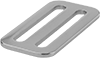
The slotted bar on these buckles allows you to attach an eye easily.
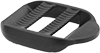
Permanently sew webbing onto these buckles.
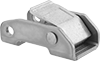
Attach webbing to these buckles without sewing.
These buckles have a bar that grips webbing tightly without sewing.
For use in tie down applications, this webbing has eyes that won't scratch or damage surfaces.
Press the button to retract the webbing for easy storage.
Use this webbing in tie down and towing applications. It absorbs shock and will not scratch or damage the contact surface.
The track fitting attaches to snap-in load-securing track, also known as E-track.
These slides are rated for heavy duty applications.

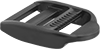
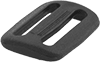
Add a slide to webbing to make adjustable straps.
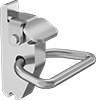
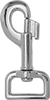
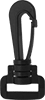
Permanently sew webbing onto these hooks.
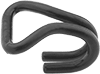
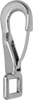
Use the split in the hook to slide a loop on and off these fittings.
Attach tips to webbing to prevent frayed ends and make it easier to thread.
Use couplings to connect straps or convert end fittings from male to female.
These guides have a flat slot that accepts webbing and prevents it from twisting.
These bags snap into track to create easy storage.
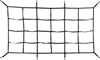
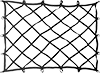
Contain and organize bulky and oddly shaped loads with these nets.
Quickly increase and release tension over loads: lift the cam on the buckle, pull the webbing through, and release the cam to hold webbing in place.
These straps have a ratchet buckle that tightens incrementally for maximum tension.
Set the amount of tension on these straps to prevent damage from overtightening. They have a ratchet buckle that tightens incrementally.
The ring pivots to secure loads in various directions.
Use these plates where full lengths of track won't fit to create one anchor point.
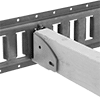
Use these brackets to mount wooden 2×4 beam for economical load bracing.
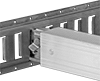
These aluminum beams provide lightweight decking and bracing.
Snap these hooks into track to hang equipment or attach straps.
Use these short lengths to tether material or with a coupling to add extra length to a ratchet strap.
Contain and organize bulky and oddly-shaped loads with these nets.
Sew webbing onto these plates for a permanent anchor point or run webbing through to use them as guides.
Also known as footman's loops, use these guides to prevent webbing from twisting, or as anchor points in tie-down applications.
No need for drilling or welding—these guides mount with adhesive.
Protect items from theft and tampering; these tie downs have a combination lock on each end.
Pull rope through the automatic-locking buckle to tension; press the lever to release.
Each end of these straps has a hook and a movable ring—use them separately or together to create a soft loop in a choker configuration.
These tie downs meet D.O.T., California Highway Patrol, and CVSA requirements.
Bolt these tie downs directly to a surface or mount them with a hook, bracket, or cargo track fitting.
A polyurethane strap on one end stretches and contracts to maintain even tension when loads shift.
Position the ratchet buckle anywhere along the webbing to access the buckle more easily.

Use these seatbelt-style straps to secure loads with a click.
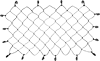
Hold heavy loads in place with these strong nets that have thicker webbing than light duty cargo nets.
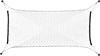
Fold these nets in half to cradle items.
Use these nets as a barrier or stretch them over light loads in vans and small transport vehicles.
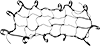
These elastic nets stretch out and hook into place to bind loads.
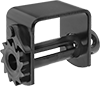
Pair these winches with straps to secure loads for transit.
Also known as lashing straps, use these to tightly secure material.
The hook on these straps quickly connects to the buckle—no need to spend time threading the end through the buckle.
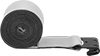
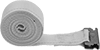
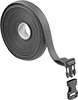
Cut rolls to length and add the no-sew buckle.
Hold bundles tightly with these cinching straps that conform to the shape of the material.
Cut rolls to length and add the no-sew buckles. These straps stretch to hold bundles tight.
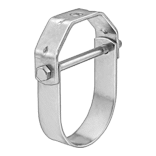
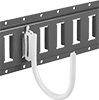
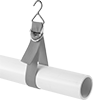
A versatile solution for temporary hanging of pipe and tubing at work sites as well as anywhere welding and fastening are not possible. Feed material through the strap, then use the D-rings to adjust the hanging height.
The flat side allows you to connect webbing and strapping, so they lay flat and resist bunching.
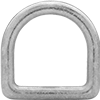
Hang, pull, and secure loads. These rings are good for general non-lifting applications.
Also known as Type 3 slings, the eyes lie in a flat position for easy removal from beneath loads.
Slings are reinforced for additional abrasion resistance.
Slings have plastic-coated fibers woven into the edges for added abrasion resistance.
Also known as Type 5 and endless slings, these slings last longer than other web slings with eyes because they can be rotated to change the load-bearing point.
Also known as Type 4 slings, the eyes are turned 90° so they can form a choker configuration more easily than with flat-eye slings.
Also known as cargo slings, these wide slings provide extra stability and balance when lifting bulky loads.
Securely hook these slings to a load that has lifting eyes.
Designed for use in the choker configuration, the end fittings keep these slings correctly positioned during use.
These two-leg slings stack steel drums vertically and horizontally.
Also known as cotton duck and canvas.
Attach these rings to any harness to keep excess lanyard webbing out of the way.
This barrier tape has a long-lasting woven construction.
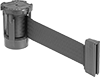
Replace cassettes in retractable belt barriers.
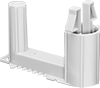
Provide an end point for your belt barrier.
No need for mounting hardware—these barriers have a magnetic housing and belt end to attach to metal surfaces.
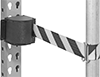
Attach to upright rack shelving to block off aisles.
Provide an end point for a belt barrier.
To make a complete unit, team one or more belt barriers with a wall receptacle or receiver post.
Add a strap or replace one that has worn out.