McMaster-Carr logo
    Filter by
    Actuator Style
    System of Measurement
    Switch Starting Position
    Industrial Info Compare
    Actuator Material
    Electrical Connection Type
    Number of Circuits Controlled
    Number of Terminals
    Number of Mounting Holes
    Switch Designation
    Industrial Info Compare
    U.S.–Mexico–Canada Agreement (USMCA) Qualifying
    Export Control Classification Number (ECCN)
    Industrial Info Snippet
    DFARS Specialty Metals
    Enter e-mail addresses in the fields below
    Message
    Cancel
    Comments
    E-mail address (if you would like a response)
    35 Products

    Limit Switches

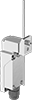
    Image of Attribute. Style F. Front orientation. Contains Annotated. Limit Switches. Limit Switches, Rod Actuator, Style F.
    Image of Attribute. Style H. Front orientation. Contains Annotated. Limit Switches. Limit Switches, Wobble Stick Actuator, Style H.

    Style F

    Style H

    When a moving object contacts the actuator on these switches, they open or close a circuit. They have the rapid-closing action of a snap-acting switch, but with a larger actuator. This makes them a good choice for use with large objects—for instance, a box on a conveyor runs into the switch, stopping the conveyor.
    Rod Actuator—Switches with a rod actuator use a rod extending out of the body to actuate, so they’ll activate even if an object is far away.
    Wobble Stick Actuator—Switches with a wobble stick actuator have an arm that rotates 360°, so you don’t need to align it in a specific direction. Since the actuator is flexible, it won’t snap if pushed backward. That makes these switches a great choice for systems that get jammed often.
    Style F—Styles E and F let you adjust the actuator’s height to align it with your target.
    NEMA 13 Enclosure Rating—Switches rated NEMA 13 are protected against dirt and oil/coolant spraying.
    IP67 Enclosure Rating—Switches rated IP67 are protected against dust and temporary submersion.
    Housing
    Style
    No. of Circuits
    Controlled
    Switch Starting
    Position
    Switch
    Action
    Switch
    Designation
    Switching Current @ Voltage
    Max. Voltage
    Actuation Torque,
    in·ozf
    Operating
    Temp. Range, ° F
    Actuator Ht.
    For Max.
    Cable OD
    No. of
    Terminals
    Lg.
    Ht.
    Dp.
    Housing
    Material
    Conduit
    Trade Size
    Enclosure Rating
    Each
    Rod Actuator
     
    Screw-Terminal Wire Connection
    F11 Off or 1 On
    Momentary
    SPDT
    0.5 amp @ 380V AC, 0.05 amp @ 220V DC380V AC
    220V DC
    -4 to 1581.5" to 5"0.25"41.1"2.5"1"ZincNEMA 13, IP67
    7988K3000000
    F11 Off or 1 On
    Momentary
    SPDT
    10 amp @ 240V AC, 10 amp @ 24V DC600V AC
    250V DC
    10 to 2500.5" to 4.3"41.9"4.5"1.8"Zinc1/2
    NEMA 6P, NEMA 13, IP66, IP67
    65785K15000000
    F11 Off or 1 On
    Momentary
    SPDT
    10 amp @ 300V AC, 6 amp @ 24V DC300V AC
    250V DC
    50.614 to 1761.4" to 5.9"41.6"2.7"1.6"Aluminum1/2
    IP67
    7076K24000000
    F22 Off or 2 On
    Momentary
    DPDT
    5 amp @ 240V AC, 10 amp @ 24V DC600V AC
    250V DC
    10 to 2500.5" to 11.8"81.9"4.5"1.8"Zinc1/2
    NEMA 6P, NEMA 13, IP66, IP67
    65785K76000000
     
    Wobble Stick Actuator
     
    Screw-Terminal Wire Connection
    H11 Off or 1 On
    Momentary
    SPDT
    0.5 amp @ 380V AC, 0.05 amp @ 220V DC380V AC
    220V DC
    -4 to 1583.8"0.25"41.1"2.5"1"ZincNEMA 13, IP67
    7988K400000
    H11 Off or 1 On
    Momentary
    SPDT
    10 amp @ 240V AC, 10 amp @ 24V DC600V AC
    250V DC
    10 to 2004.5"41.9"4.5"1.8"Zinc1/2
    NEMA 6P, NEMA 13, IP66, IP67
    65785K12000000
    H11 Off or 1 On
    Momentary
    SPDT
    10 amp @ 300V AC, 6 amp @ 24V DC300V AC
    250V DC
    14 to 1765.3"41.6"2.7"1.6"Aluminum1/2
    IP67
    7076K25000000
    H22 Off or 2 On
    Momentary
    DPDT
    5 amp @ 240V AC, 10 amp @ 24V DC600V AC
    250V DC
    10 to 2004.5"81.9"4.5"1.8"Zinc1/2
    NEMA 6P, NEMA 13, IP66, IP67
    65785K77000000
     

    Washdown Limit Switches

    Image of Attribute. Style E. Front orientation. Contains Annotated. Limit Switches. Washdown Limit Switches, Rod Actuator, Style E.
    Image of Attribute. Style F. Front orientation. Contains Annotated. Limit Switches. Washdown Limit Switches, Wobble Stick Actuator, Style F.
    Image of Attribute. Style G. Front orientation. Contains Annotated. Limit Switches. Washdown Limit Switches, Wobble Stick Actuator, Style G.

    Style E

    Style F

    Style G

    Rated NEMA 3S and IP69K, these switches can handle washdowns with high pressures and temperatures. They’re also protected from oil/coolant spraying, precipitation, and temporary submersion. When an object in motion contacts the actuator, it sends a signal to open or close a circuit. These switches have the rapid-closing action of a snap-acting switch, but with a larger actuator. This makes them a good choice for use with large objects—for instance, a box on a conveyor runs into the switch, stopping the conveyor.
    Rod Actuator—Switches with a rod actuator use a rod extending out of the body to actuate, so they’ll activate even if an object is far away.
    Wobble Stick Actuator—Switches with a wobble stick actuator have an arm that rotates 360°, so you don’t need to align it in a specific direction. Since the actuator is flexible, it won’t snap if pushed backward. That makes these switches a great choice for systems that get jammed often.
    Styles E and F—Styles D, E, and F let you adjust the actuator’s height to align it with your target.
    Housing
    Style
    No. of Circuits
    Controlled
    Switch Starting
    Position
    Switch
    Action
    Switch
    Designation
    Switching Current @ Voltage
    Max. Voltage
    Actuation
    Torque
    Operating
    Temp. Range, ° F
    Actuator
    Ht.
    No. of Wire
    Leads
    Cable Lead
    Lg., ft.
    Lg.
    Ht.
    Dp.
    Housing
    Material
    Enclosure Rating
    Each
    Rod Actuator
     
    Wire Lead Connection
    E11 Off or 1 On
    Momentary
    SPDT
    10 amp @ 240V AC, 1 amp @ 250V DC240V AC
    250V DC
    0.92 in·ozf10 to 2000" to 5.5"581.5"4.6"1.6"ZincNEMA 3S, NEMA 6P, NEMA 13, IP67, IP69K
    7926K1550000000
    E22 Off or 2 On
    Momentary
    DPDT
    10 amp @ 240V AC, 1 amp @ 250V DC240V AC
    250V DC
    0.92 in·ozf10 to 2000" to 5.5"581.5"4.6"1.6"ZincNEMA 3S, NEMA 6P, NEMA 13, IP67, IP69K
    7926K156000000
     
    Wobble Stick Actuator
     
    Wire Lead Connection
    F11 Off or 1 On
    Momentary
    SPDT
    10 amp @ 240V AC, 1 amp @ 250V DC240V AC
    250V DC
    Not Rated10 to 2000" to 2.25"581.5"4.6"1.6"ZincNEMA 3S, NEMA 6P, NEMA 13, IP67, IP69K
    7926K157000000
    F22 Off or 2 On
    Momentary
    DPDT
    10 amp @ 240V AC, 1 amp @ 250V DC240V AC
    250V DC
    Not Rated10 to 2000" to 5"581.5"4.6"1.6"ZincNEMA 3S, NEMA 6P, NEMA 13, IP67, IP69K
    7926K158000000
    G11 Off or 1 On
    Momentary
    SPDT
    10 amp @ 240V AC, 1 amp @ 125V DC600V AC
    250V DC
    32 in·ozf14 to 22113.6"581.5"3.1"1.6"ZincNEMA 3S, NEMA 6P, NEMA 13, IP67, IP69K
    7926K32000000
     

    Build-Your-Own Limit Switches

    Image of Product. Style J. Front orientation. Limit Switches. Build-Your-Own Limit Switches, Rod Actuator, Style J.
    Image of Product. Style K. Front orientation. Limit Switches. Build-Your-Own Limit Switches, Wobble Stick Actuator, Style K.
    Image of Product. Style L. Front orientation. Limit Switches. Build-Your-Own Limit Switches, Wobble Stick Actuator, Style L.

    Style

    J

    Style

    K

    Style

    L

    Combine an actuator and a switch to assemble the exact limit switch you need. These switches have the rapid-closing action of a snap-acting switch, but have a larger actuator for large objects. When an object in motion comes into contact with the actuator, it sends a signal to open or close a circuit. They’re often used for conveyor systems and elevators. Each actuator style is compatible with all housing styles and vice versa.
    Actuators
    Image of Product. Style J. Front orientation. Limit Switches. Build-Your-Own Limit Switches, Rod Actuator, Style J.
    Image of Product. Style K. Front orientation. Limit Switches. Build-Your-Own Limit Switches, Wobble Stick Actuator, Style K.

    Style

    J

    Style

    K

    Image of Product. Style L. Front orientation. Limit Switches. Build-Your-Own Limit Switches, Wobble Stick Actuator, Style L.

    Style

    L

    Rod Actuator—Rod actuators open or close circuits when material pushes against the rod. The rod extends from the body of the actuator, so these switches are ideal when objects actuating the switch are further away.
    Wobble Stick Actuator—Wobble stick actuators open or close circuits when an object hits the flexible arm. The arm has a 360° range of motion, so it can be actuated from any direction. This means that if there’s a jam, these switches are less likely to break than switches that are aligned to a specific direction.
    Adapters—An adapter is required to mount styles F, G, H, and J to a switch body.
    Switches
    Adapters
    Style
    Actuator
    Material
    Actuator
    Ht.
    Each
    Each
    Rod Actuator
    JAluminum
    7.9"7976N180000007976N15000000
     
    Wobble Stick Actuator
    KPlastic5.6"7976N2100000———0
    LMetal7.9"7976N2600000———0
     

    Hazardous Location Limit Switches

    Image of Product. Front orientation. Contains Annotated. Limit Switches. Hazardous Location Limit Switches, Wobble Stick Actuator.

    Wobble Stick

    Actuator

    Safely open or close a circuit near ignitable gases and dust—the housing on these switches seals in anything that could ignite flammable material. You'll know they're safe because they're NEC Class I, Divisions 1, 2 Groups B, C, and D; and Class II, Divisions 1, 2 Groups E, F, and G certified for hazardous locations. These switches send a signal to your circuit when an object hits the actuator—for instance, a box on a conveyor runs into the switch, stopping the conveyor. They open and close circuits as fast as snap-acting switches, but they have a bigger actuator for large objects.
    Wobble Stick Actuator—Switches with a wobble stick actuator have an arm that rotates 360°, so you don’t need to align it in a specific direction. The actuator won’t snap if pushed backward, such as if there’s a jam in your system.
    Housing
    No. of Circuits
    Controlled
    Switch Starting
    Position
    Switch
    Action
    Switch
    Designation
    Switching Current @ Voltage
    Max. Voltage
    Actuation Torque,
    in·ozf
    Operating
    Temp. Range, ° F
    Actuator
    Ht.
    No. of
    Terminals
    Lg.
    Ht.
    Dp.
    Housing
    Material
    Conduit
    Trade Size
    Enclosure Rating
    Each
    Wobble Stick Actuator
     
    Screw-Terminal Wire Connection
    11 Off or 1 On
    Momentary
    SPDT
    10 amp @ 600V AC, 2.5 amp @ 600V DC600V AC
    600V DC
    480 to 1856.2"42.7"4.1"2.1"Aluminum1/2
    NEMA 6P, NEMA 7, NEMA 9, NEMA 13
    7794K150000000
     

    Compact Safety Limit Switches

    Image of Attribute. Style F. Front orientation. Contains Annotated. Limit Switches. Compact Safety Limit Switches, Rod Actuator, Style F.
    Image of Attribute. Style G. Front orientation. Contains Annotated. Limit Switches. Compact Safety Limit Switches, Wobble Stick Actuator, Style G.

    Style F

    Style G

    Shorter and thinner than other safety limit switches, these are sized to fit tight spaces. They protect machinery and ensure the safety of personnel. Positive-force contacts open the circuit when actuated, even if a spring fails or the contacts stick. They send a signal to your circuit when an object hits the actuator—for instance, a box on a conveyor runs into the switch, stopping the conveyor. They open and close circuits as fast as snap-acting switches, but they have a bigger actuator for large objects. All are NEMA and IP rated for protection from washdowns.
    Rod Actuator—Switches with a rod actuator have a large actuation area with a rod extending out of the actuator’s body. They’re best where the object actuating the switch is far away.
    Wobble Stick Actuator—Switches with a wobble stick actuator have an arm that rotates 360°, so you don’t need to align it in a specific direction. The actuator won’t snap if pushed backward, such as if there’s a jam in your system.
    Style F—Styles E and F have an actuator that allows you to adjust its height, making it easier to align the switch with the target during installation.
    NEMA 13 Enclosure Rating and IP67 Enclosure Rating—NEMA 13 and IP67 rated switches are protected from oil/coolant spraying and temporary submersion.
    Housing
    Style
    No. of Circuits
    Controlled
    Switch Starting
    Position
    Switch
    Action
    Switch
    Designation
    Switching Current @ Voltage
    Max. Voltage
    Actuation Torque,
    in·ozf
    Operating Temp.
    Range, ° F
    Actuator
    Ht.
    No. of
    Terminals
    Lg.
    Ht.
    Dp.
    Housing
    Material
    Conduit
    Trade Size
    Enclosure Rating
    Each
    Rod Actuator
     
    Screw-Terminal Wire Connection
    F11 Off or 1 On
    Momentary
    SPDT
    10 amp @ 600V AC, 10 amp @ 250V DC600V AC
    250V DC
    17.6-40 to 1850.6" to 5.8"41.2"2.4"1.2"Plastic1/2
    NEMA 4, NEMA 13, IP66, IP67
    65745K18000000
     
    Wobble Stick Actuator
     
    Screw-Terminal Wire Connection
    G11 Off or 1 On
    Momentary
    SPDT
    3 amp @ 240V AC, 0.27 amp @ 250V DC240V AC
    250V DC
    -40 to 1854.9"41.2"2.4"1.2"Plastic1/2
    NEMA 4X, NEMA 13, IP66, IP67
    6352K205000000
     

    Safety Limit Switches

    Image of Attribute. Style F. Front orientation. Contains Annotated. Limit Switches. Safety Limit Switches, Rod Actuator, Style F.
    Image of Attribute. Style G. Front orientation. Contains Annotated. Limit Switches. Safety Limit Switches, Wobble Stick Actuator, Style G.

    Style F

    Style G

    Protect machinery and ensure the safety of personnel—these switches have positive-force contacts that will open the circuit when actuated even if a spring fails or the contacts stick. When an object in motion comes into contact with the actuator, it sends a signal to open or close a circuit. These switches have the rapid-closing action of a snap-acting switch, but with a larger actuator. This makes them a good choice for use with large objects—for instance, a box on a conveyor runs into the switch, stopping the conveyor.
    Rod Actuator—Switches with a rod actuator use a rod extending out of the body to actuate, so they’ll activate even if an object is far away.
    Wobble Stick Actuator—Switches with a wobble stick actuator have an arm that rotates 360°, so you don’t need to align it in a specific direction. Since the actuator is flexible, it won’t snap if pushed backward. That makes these switches a great choice for systems that get jammed often.
    Style F—Styles D, E, and F have an actuator that allows you to adjust its height, making it easier to align switch with the target during installation.
    Plastic Actuator—Switches with a plastic actuator limit wear and tear on passing objects better than switches with a steel actuator.
    Steel Actuator—Switches with a steel actuator are more durable than switches with a plastic actuator. They also handle higher loads.
    Housing
    Conduit
    Style
    No. of Circuits
    Controlled
    Switch Starting
    Position
    Switch
    Action
    Switch
    Designation
    Actuator
    Material
    Switching Current @ Voltage
    Max. Voltage
    Actuation Torque,
    in·ozf
    Operating Temp.
    Range, ° F
    Actuator
    Ht.
    No. of
    Terminals
    Lg.
    Ht.
    Dp.
    Housing
    Material
    Trade
    Size
    Thread
    Size
    Enclosure Rating
    Each
    Rod Actuator
     
    Screw-Terminal Wire Connection
    F11 Off or 1 On
    Momentary
    SPDT
    Steel3 amp @ 240V AC, 1.5 amp @ 24V DC240V AC
    24V DC
    24.8-22 to 1650.5" to 8"41.7"2.9"1.6"PlasticM20
    NEMA 4X, IP66, IP67
    65745K460000000
     
    Wobble Stick Actuator
     
    Screw-Terminal Wire Connection
    G11 Off or 1 On
    Momentary
    SPDT
    Plastic10 amp @ 600V AC, 10 amp @ 250V DC600V AC
    250V DC
    -13 to 1855.7"51.7"3.2"1.7"Zinc1/2
    NEMA 4, NEMA 13, IP67
    6352K102000000
    G11 Off or 1 On
    Momentary
    SPDT
    Steel10 amp @ 600V AC, 10 amp @ 250V DC600V AC
    250V DC
    -13 to 1855.3"51.7"3.2"1.7"Zinc1/2
    NEMA 4, NEMA 13, IP67
    6352K103000000
     

    Low-Profile Limit Switches

    Image of Attribute. Style G. Front orientation. Contains Annotated. Limit Switches. Low-Profile Limit Switches, Wobble Stick Actuator, Style G.

    Style G

    Stack these slim switches together, or fit them into tight spaces. They're rated IP67 for protection from temporary submersion. When an object in motion comes into contact with the actuator, it sends a signal to open or close a circuit. These switches have the rapid-closing action of a snap-acting switch, but have a larger actuator for large objects. They’re often used on conveyor systems and elevators.
    Wobble Stick Actuator—Wobble stick actuators open or close circuits when an object hits the flexible arm. The arm has a 360° range of motion, so it can be actuated from any direction. This means that if there’s a jam, these switches are less likely to break than switches that are aligned to a specific direction.
    4-Pole M12 Connection—Switches with a 4-pole M12 plug connect to cords with a socket (sold separately), allowing you to quickly connect and disconnect the switch.
    Switches
    Cords
    Housing
    Style
    No. of Circuits
    Controlled
    Switch Starting
    Position
    Switch
    Action
    Switch
    Designation
    Switching Current @ Voltage
    Max. Voltage
    Operating
    Temp. Range, ° F
    Actuator
    Ht.
    No. of Wire
    Leads
    Cable Lead
    Lg., ft.
    Lg.
    Ht.
    Dp.
    Housing
    Material
    Enclosure
    Rating
    Each
    Each
    Wobble Stick Actuator
     
    Wire Lead Connection
    G11 Off or 1 On
    Momentary
    SPDT
    5 amp @ 250V AC, 4 amp @ 30V DC250V AC
    250V DC
    14 to 1583.6"49.51.6"1.9"0.6"AluminumIP67
    7628K760000000———0
     
    4-Pole M12 Connection
    G11 Off or 1 On
    Momentary
    SPDT
    1 amp @ 125V AC125V AC14 to 1583.6"1.6"2.2"0.6"AluminumIP67
    7628K440000007628K99000000
     

    Enclosed Washdown Snap-Acting Switches

    Image of Attribute. Style D. Front orientation. Contains Annotated. Snap-Acting Switches. Enclosed Washdown Snap-Acting Switches, Side Mount, Wobble Stick Actuator Style, Style D.
    Image of Attribute. Style J. Front orientation. Contains Annotated. Snap-Acting Switches. Enclosed Washdown Snap-Acting Switches, Bottom Mount, Wobble Stick Actuator Style, Style J.

    Style D

    Style J

    Rated NEMA 4 and IP66, these enclosed switches have a sealed actuator for protection from washdowns. They open and close circuits quickly to minimize arcing and prevent contacts from sticking.
    Housing
    Style
    No. of Circuits
    Controlled
    Switch Starting
    Position
    Switch
    Action
    Switch
    Designation
    Switching Current
    @ Voltage
    Max. Voltage
    hp @ Switching
    Voltage
    Operating Temp.
    Range, ° F
    Actuator
    Ht.
    Wire
    Connection
    No. of
    Terminals
    Lg.
    Ht.
    Dp.
    Conduit
    Trade Size
    Each
    Side Mount
     
    Wobble Stick Actuator Style
    D11 Off or 1 On
    Momentary
    SPDT
    15 amp @ 250V AC
    0.5 amp @ 125V DC
    600V AC
    250V DC
    1/4 hp @ 250V AC-25 to 1605.1"Screw Terminal33.04"1.75"1"1/2
    7778K670000000
     
    Bottom Mount
     
    Wobble Stick Actuator Style
    J11 Off or 1 On
    Momentary
    SPDT
    15 amp @ 250V AC
    0.5 amp @ 125V DC
    600V AC
    250V DC
    1/4 hp @ 250V AC-25 to 1605.1"Screw Terminal33.04"1.75"1"1/2
    7778K27000000
     

    Single-Action Mechanically Operated Air Directional Control Valves

    Image of Product. Front orientation. Directional Control Valves. Single-Action Mechanically Operated Air Directional Control Valves , Style M.

    Style M

    A simple automation solution that requires no programming, these valves are activated when an object, such as a box rolling on a conveyor, pushes the actuator. Also known as 3-way and 3/2 valves, they create one action, such as extending a cylinder. Valves direct airflow from the inlet to your equipment and exhaust return airflow to create motion. Return actuation is by spring, so they go back to their starting position as soon as the actuator is released. In the off position, they exhaust air pressure from the system, allowing equipment to reset so the action can be repeated.
    Threaded Female Inlet x Threaded Female Outlet
    Image of Product. Front orientation. Directional Control Valves. Single-Action Mechanically Operated Air Directional Control Valves , Style M.

    Style M

    2-Direction Actuation—Valves with a two-direction actuator are activated by objects from both sides.
    Valve Position—Fail-closed valves block airflow until actuated. Valves that are both fail closed and fail open can be installed to block airflow, or allow air to flow until actuated.
    Flow Coefficient (Cv)—Flow coefficient (Cv) is a measurement that indicates how much airflow can pass through a valve. When selecting between valves with the same port size, choose the valve with the higher flow coefficient to ensure it provides enough airflow to operate your system.
    Overall,
    mm
    Style
    Actuation
    Force, lbf
    No. of Flow
    Ports
    Inlet
    Size
    Outlet
    Size
    Exhaust
    Connection
    Max. Flow Rate
    @ 100 psi, scfm
    Flow Coefficient
    (Cv)
    Pressure Range,
    psi
    Vacuum
    Rating
    Lg.
    Wd.
    Ht.
    For Panel
    Cutout Dia., mm
    Mounting Fasteners
    Included
    Each
    2-Direction Actuation
     
    Fail Closed
    M1.5731/8 BSPP1/8 BSPPThreaded4.230.1253 to 120Not Rated361822019No6464K920000000
     

    Snap-Acting Switches

    Image of Attribute. Style J. Top orientation. Contains Annotated. Snap-Acting Switches. Snap-Acting Switches, Wobble Stick Actuator Style, Style J.

    Style J

    Open and close circuits in a snap. These switches actuate quickly to minimize arcing and prevent contacts from sticking. They’re often used to indicate that an appliance or enclosure door is open. You can also use them inside limit, pressure, and temperature switches.
    Wobble Stick Actuator Style—Switches with a wobble stick actuator have a flexible arm that can actuate from any direction.
    Housing
    Style
    No. of Circuits
    Controlled
    Switch Starting
    Position
    Switch
    Action
    Switch
    Designation
    Switching Current
    @ Voltage
    Max. Voltage
    hp @ Switching
    Voltage
    Operating Temp.
    Range, ° F
    Actuator
    Ht.
    No. of
    Terminals
    Lg.
    Ht.
    Dp.
    Each
    Wobble Stick Actuator Style
     
    Wire Lead Connection
    J11 Off
    Momentary
    SPST-NO
    15 amp @ 250V AC
    0.5 amp @ 125V DC
    480V AC
    250V DC
    1/4 hp @ 250V AC-67 to 1852.93"21.94"1.38"0.69"7090K213000000
    J11 On
    Momentary
    SPST-NC
    15 amp @ 250V AC
    0.5 amp @ 125V DC
    480V AC
    250V DC
    1/4 hp @ 250V AC-67 to 1853.93"21.94"1.38"0.69"7090K20600000
     

    Two-Speed Two-Action Mechanically Operated Air Directional Control Valves

    Image of Product. Front orientation. Directional Control Valves. Two-Speed Two-Action Mechanically Operated Air Directional Control Valves, Style K.

    Style K

    Often used to extend and then retract a cylinder at different speeds, these valves create two actions and have two exhaust ports, which allows you to control the speed of each action by attaching a flow control valve to each exhaust port. A simple automation solution that requires no programming, they activate when an object, such as a box rolling on a conveyor, pushes the actuator. They direct airflow from the inlet to your equipment and exhaust return airflow to create motion. Return actuation is by spring, so they go back to their original position as soon the actuator is released. Also known as 4-way and 5/2 valves.
    2-Direction Actuation—Valves with a two-direction actuator are activated by objects from both sides.
    NPTF Inlet Thread—NPTF (Dryseal) threads are compatible with NPT threads.
    Flow Coefficient (Cv)—Flow coefficient (Cv) indicates how much airflow can pass through a valve.
    Overall
    For Panel
    Cutout
    Style
    Actuation
    Force, lbf
    No. of Flow
    Ports
    Inlet
    Size
    Outlet
    Size
    Exhaust
    Connection
    Max. Flow Rate
    @ 100 psi, scfm
    Flow Coefficient
    (Cv)
    Pressure Range,
    psi
    Vacuum
    Rating
    Lg.
    Wd.
    Ht.
    Mount Type
    Wd.
    Lg.
    Mounting Fasteners
    Included
    Mounting
    Hole Dia.
    Each
    Threaded Female Inlet x Threaded Female Outlet
     
    2-Direction Actuation—Spring Return
    K0.351/8 NPTF1/8 NPTFThreaded140.2425 to 125Not Rated6 1/4"3/4"3 7/8"Panel, Screw In3/4"1 1/4"No0.19"61345K140000000
     

    Wireless Self-Powered Limit Switches

    Image of Attribute. Style E. Front orientation. Contains Annotated. Limit Switches. Wireless Self-Powered Limit Switches, Rod Actuator, Style E.

    Style E

    Install these limit switches where changing a battery or routing wires might be difficult—they power themselves when a moving object contacts the actuator. Place them up to 330 ft. away from the receiver (sold separately). These switches have the rapid-closing action of a snap-acting switch, but with a larger actuator.
    Rod Actuator—Rod actuators open or close circuits when material pushes against the rod. The rod extends from the body of the actuator, so these switches are ideal when objects actuating the switch are further away.
    Housing
    Style
    No. of Circuits
    Controlled
    Max. Transmission
    Distance, ft.
    Transmission
    Freq., MHz
    Switch
    Action
    Actuator
    Material
    Operating Temp.
    Range, ° F
    Actuator
    Ht.
    Lg.
    Ht.
    Dp.
    Housing
    Material
    Certification
    Specs. Met
    Each
    Rod Actuator
    E13302,405Momentary
    Plastic-13 to 1313"1.2"2.5"0.6"PlasticCE Marked
    IEC 60947-5, EN 60947-57786N180000000
     
    Accessories for Limit Switches
    back to top