

Mounting Location Mounting Location |
|---|
 |  |
| Lower Robot Arm | Upper Robot Arm |
Manufacturer Manufacturer | Show |
|---|
|
Manufacturer Manufacturer | Hide |
|---|
|
Manufacturer Model Number Manufacturer Model Number |
|---|
|
Manufacturer Series Manufacturer Series |
|---|
|
DFARS (Defense Acquisition Regulations Supplement) DFARS (Defense AcquisitionRegulations Supplement)  |
|---|
Electrical Connection Type Electrical Connection Type |
|---|
|
Environment Environment |
|---|
|
Environmental Rating Environmental Rating |
|---|
Material Material |
|---|
|
Maximum Temperature Maximum Temperature |
|---|
|
Minimum Temperature Minimum Temperature |
|---|
|
Mount Type Mount Type |
|---|
|
Robot Cell Component Robot Cell Component | Show |
|---|
|
Robot Cell Component Robot Cell Component | Hide |
|---|
|
Safety Padding Component Safety Padding Component |
|---|
 | Padding |
Safety Padding Type Safety Padding Type |
|---|
|
Sensor Type Sensor Type |
|---|
|
Specifications Met Specifications Met |
|---|
|
Contact-Sensing Robot Safety Padding
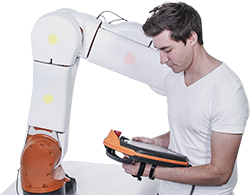
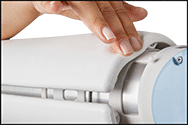
Cover robot arms and tools with this padding to help prevent injuries in areas where people are working nearby. When the padding is touched, pressure sensors signal your machine to stop moving, halting it within nine milliseconds. If a collision takes place, the soft polyurethane foam will lessen the impact. With this padding installed, you can operate robots closer to people and at higher speeds than with other safety equipment, such as machine guards. You can also combine it with other equipment to create multi-step safety systems.
Each pad has LEDs that change color to indicate their status. When the lights are blue, the padding is fully operational. Pads that sense a pressure change turn red and the surrounding pads turn yellow, clearly showing the impact area. They're powered by internal micropumps, so you don't need an outside compressed air source. The double circuit design makes sure that if one circuit fails, the other will continue to function.
All components meet international design standards for safety. Using this padding helps you meet ISO/TS 15066 standards for safe interactions between humans and robots. Before running robots, you should carry out a safety risk assessment as described in ANSI/RIA R15.06 to ensure a safe environment for those working near the robot.
 For technical drawings and 3-D models, click on a part number.
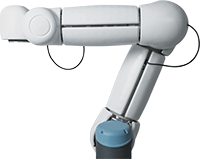
Select custom-fit padding to match your robot arm, tool, or machine vision camera. Designed to fit specific models, it hugs the shape of your component for a clean look with no pinch points. These padding kits include a controller, enough pads to cover your part, and connection cables to link them together.
| For Robot Arm Manufacturer (Series/Model No.) | Sensor Response Time, ms | Mounting Fasteners Included | Temp. Range, °F | Environmental Rating | Includes | Specifications Met | Each | |
Polyurethane Foam | ||||||||
|---|---|---|---|---|---|---|---|---|
For Lower and Upper Robot Arms | ||||||||
| DENSO (VS 087) | 9 | Yes | 40° to 100° | IP50 | One Controller-to-Padding Cable (5 m Lg), One Padding-to-Padding Cable (300 mm Lg), One Padding-to-Padding Cable (500 mm Lg), Safety Padding Controller, Two Padding-to-Padding Cables (400 mm Lg) | ISO/TS 15066, ISO 13849-1 PLe, IEC 62061, TUV Rheinland Certified, C-TUV Rheinland Certified, UL 94 V-2, CE Marked | 00000000 | 0000000000 |