
We will reply to your message in the morning.
From cookware to chemical-processing equipment, 304 stainless steel is a good all-around choice for a wide range of applications.
When compared to standard 304 stainless steel, this material can be machined faster with less wear on cutting tools. It's also called Prodec and Project 70+.
This material has tighter tolerances than standard 304 stainless steel.
Polished to either a brushed or mirror-like finish, this material is often used to fabricate decorative enclosures and industrial workstations.
Widely used for fabricating fittings and fasteners, 303 stainless steel machines quickly without sticking to cutting tools.
This material has tighter tolerances than standard 303 stainless steel.
Offering outstanding resistance to surface wear and corrosion, Nitronic 60 stainless steel is often used for shafts, fasteners, and valves.
Hardened for improved strength and wear resistance, these rods are precision ground to a strict diameter tolerance. Use them for turning applications in your lathe.
This material is hardened for improved strength and wear resistance.
Each piece is precision ground to offer tighter tolerances than standard 17-4 PH stainless steel.
Also known as Project 70+, this material machines faster with less wear on cutting tools than standard 17-4 PH stainless steel.
With a higher chromium content than 15-5 PH stainless steel, this high-strength 17-4 PH offers better corrosion resistance. It is also known as 630 stainless steel.
Offering outstanding strength, 15-5 PH stainless steel is often used for gears and shafts.
Widely used to fabricate fasteners and engine components, A286 will maintain its strength as temperatures rise.
13-8 PH stainless steel can be hardened at lower temperatures than other heat-treatable types of stainless steel. It is widely used for fittings, pins, and lock washers.
The addition of molybdenum gives 316 stainless steel excellent corrosion resistance. Use it in a variety of marine and chemical-processing applications.
This material is precision ground to offer tighter tolerances than standard 316 stainless steel.
This material machines faster with less wear on cutting tools than standard 316 stainless steel. It's also called Prodec and Project 70+.
These rods have been passivated for enhanced corrosion resistance.
Stronger and more corrosion resistant than 316 stainless steel, Nitronic 50 is especially well-suited for use as shafts and fixtures in marine environments.
A high nickel content allows Alloy 20 stainless steel to stand up to harsh chemicals in caustic environments. It's also known as Carpenter 20.
One of the most machinable types of stainless steel available, 416 contains sulfur for fast machining without clogging cutting tools. It's used for gears, screws, and shafts.
Hardened for superior wear resistance, these rods are precision ground to a tight diameter tolerance so they’re ready for turning in a lathe.
Precision ground to a tight diameter tolerance, these rods are all set for turning applications in a lathe.
Suitable for making molds, 420 stainless steel is a hard, wear-resistant material that can be finely polished to a very smooth surface.
Often used for fasteners and valves, 410 stainless steel withstands wear caused by abrasion.
With a diameter that’s held to a close tolerance, this material is hardened for increased wear and abrasion resistance.
Ready for turning in your lathe, these rods are precision ground to a tight tolerance.
One of the hardest types of stainless steel after heat treating, 440C offers excellent wear and abrasion resistance. It's often used for bearings, valves, and knife blades.
The titanium content of 321 stainless steel preserves corrosion resistance around weld points.
309/310 stainless steel has high levels of chromium and nickel to provide good corrosion resistance at elevated temperatures. It's often used in heat exchangers and furnaces.
Able to withstand temperatures up to 2100° F, 330 stainless steel is widely used as components for industrial furnaces, gas turbines, and boilers. It resists cracking when exposed to heating and cooling cycles.
The most widely used aluminum, 6061 is fabricated into everything from pipe fittings and containers to automotive and aerospace parts. It is strong and corrosion resistant, plus it's easy to machine and weld.
These rods and discs are precision ground to offer tighter tolerances than standard 6061 rods and discs.
Choose between rods that are polished to a brushed finish or a mirror-like finish.
An anodized coating forms a bond with the aluminum surface to improve wear and corrosion resistance.
The matte plating on these rods, sometimes called industrial chrome and hard chrome, creates a slippery surface that minimizes galling and prevents parts from seizing.
More corrosion resistant and easier to form than multipurpose 6061 aluminum, 6063 is primarily used for exterior railings, decorative trim, and door frames.
Originally developed for aircraft frames, uses for 7075 aluminum now include keys, gears, and other high-stress parts. It is often used as a replacement for 2024 aluminum because it’s stronger and provides similar performance in all other aspects.
Ready for turning in a lathe, these rods are precision ground and held to a strict straightness tolerance.
While 2024 aluminum was initially designed for structural components in aircraft, it's now widely used when a high strength-to-weight ratio is needed, such as for gears, shafts, and fasteners. It offers similar performance to 7075 aluminum, but it’s not as strong.
These rods are precision ground and held to a strict straightness tolerance, so they’re ready for turning in a lathe.
2011 has the best machinability of all the aluminum alloys. It is the most selected aluminum for screws, tube fittings, hose parts, and other items that require extensive machining.
Precision ground and held to a strict straightness tolerance, these rods are ready for turning in a lathe.
Also known as mild steel, low-carbon steel is easy to machine, form, and weld. It's widely fabricated into parts that don’t require high strength.
These rods are precision ground and held to a strict straightness tolerance, so they're ready for turning in a lathe.
These rods are zinc galvanized for good corrosion resistance.
The matte plating on these rods increases corrosion resistance and wear resistance.
Often called Stressproof, these rods are stress-relieved to minimize warping during machining.
These rods are precision ground and held to a strict straightness tolerance, so they're all set for turning applications in your lathe.
Also known as Fatigueproof, these rods have enhanced strength and resistance to breaking from repeated impact compared to High-Strength Easy-to-Machine 1144 Carbon Steel Rods.
The lead additive acts as a lubricant, which allows 12L14 carbon steel to withstand very fast machining. It's used to fabricate a wide variety of machine parts.
A lead-free alternative to 12L14, 1215 carbon steel contains the same amount of sulfur and phosphorus for excellent machinability. It is often used for shaft couplings, studs, and pins.
Precision ground and held to a strict tightness tolerance, these rods are ready for turning in a lathe.
1117 carbon steel responds to surface-hardening heat treatment better than other easy-to-machine carbon steels. Use it to fabricate shaft couplings, studs, pins, and universal joints.
Stronger than low-carbon steel with equally good machinability, 1045 carbon steel is widely used for bolts, studs, and shafts.
These rods are hardened for increased abrasion and impact resistance. Also known as chrome-moly steel, 4140 alloy steel resists fracturing from repeated stress.
The chrome plating on these rods increases corrosion resistance.
Ready for turning in your lathe, these rods are precision ground and held to a strict straightness tolerance.
Often called ETD-150, these rods are made from a modified version of 4140 alloy steel and have been drawn at high temperatures for excellent strength.
Also known as chrome-moly steel, this versatile 4140 alloy steel is used for a wide range of parts, such as gears, axles, shafts, collets, and die holders. It resists fracturing from repeated stress.
4130 alloy steel has a low carbon content that provides good weldability. It's often used for gears, fasteners, and structural applications.
Use for power transmission and structural applications that involve extreme impact, heat, and wear.
A modified version of 4340 alloy steel, 300M is used in applications that require high yield strength, such as torsion bars and drive shafts.
Also known as chrome steel, 52100 is an extremely hard and wear-resistant material. It’s used for parts such as bearings, bushings, and punches.
The addition of lead gives 41L40 the best machinability of all the alloy steel we offer.
While the low carbon content makes 8620 alloy steel easy-to-weld, it's the nickel, chromium, and molybdenum content that provides wear resistance.
Often used for gears, shafts, and ball screws, 4150 alloy steel resists wear from friction and abrasion.
Offering excellent resistance to cracking from impact and compression, C300 alloy steel is often used for dies and tooling. It is also known as maraging steel and VascoMax.
With the highest lead content of all the brass alloys, 360 offers the best machinability. Often called free-machining and free-cutting brass, it stands up to high-speed drilling, milling, and tapping operations with minimal wear on your tools. It’s commonly used for gears, pinions, and lock components.
The diameter of these rods is held to a ±0.0002" tolerance.
353 brass is more formable than 385 brass while maintaining good machinability. Commonly called engraver’s brass, it’s well suited for fabrication processes such as knurling and threading. Use it to make nuts, gears, drawer pulls, and hinges.
Often called architectural bronze, 385 brass is easy to machine and has excellent formability when heated. It is typically used for handrails, ornamental trim, and hardware, such as hinges and lock bodies.
A lead-free alternative to 485 brass, 464 brass offers good weldability, strength, and wear resistance. It’s widely used for marine hardware, pump and propeller shafts, and rivets.
Also known as high-leaded naval brass, 485 brass contains lead for good machinability. It is commonly used for marine hardware, valve stems, and screw machine products.
Offering high electrical conductivity and formability, 110 copper is 99.9% pure. Also known as ETP copper, it's often used in electrical applications, such as for bus bars and wire connectors, as well as for flashing, gaskets, and rivets.
With 99.99% copper content, 101 copper has higher purity than 110 copper, resulting in superior electrical conductivity. It's commonly called OFE and OFHC copper. Use it in electrical applications, such as for coaxial cables and terminal lugs.
A thin layer of titanium is bonded to these copper rods for long life and dimensional stability in corrosive environments.
Also called tellurium copper, 145 copper contains tellurium, which makes it more machinable than all other copper while maintaining good corrosion resistance and high electrical conductivity. It’s often used for transformer and circuit-breaker terminals, welding torch tips, and fasteners.
182 copper is stronger, harder, and more wear resistant than 110 copper. Also known as RWMA Class 2 chromium copper, it's commonly used in resistance welding, for circuit-breaker parts, and for molds to make plastic parts.
These 17510 beryllium copper rods are not only conductive, but also non-sparking and non-magnetic, making them suitable for mines, oil rigs, and navigational tools.
Even though they have similar performance properties to beryllium copper, these copper rods don't require special machining techniques.
From fasteners to ferrules to fittings—machine these rods into parts that stand up to salt water. Made of copper nickel, also called cupro nickel, they resist rusting better than stainless steel.
With the addition of lead, this beryllium copper alloy forms small chips that won’t clog machines when it’s drilled or cut, so it is ideal for automated production lines.
Diameter is oversized to allow for finishing.
These rods are precision ground for a tight diameter tolerance of ±0.0005".
Powdered bronze is pressed and then impregnated with SAE 30 oil to make this material self-lubricating.
An excellent alternative to oil-filled bronze, graphite-filled bronze provides dry lubrication in temperatures as high as 700° F.
Known for its ability to resist stress cracking and fatigue, 544 bronze also offers good formability and excellent machinability. It's commonly called phosphor bronze.
954 bronze contains a minimum of 10% aluminum for strength and weldability. It is also known as aluminum bronze. It's widely used for bearings, bushings, valve bodies, and worm gears.
An easier-to-machine alternative to 932 bronze, 936 also has better corrosion resistance. It's also called modified SAE 64.
The addition of nickel gives 630 bronze high strength. It is also called aluminum-nickel-bronze.
A low-lead alternative to 316 bronze, 642 bronze is just as machinable with higher strength. It is also called aluminum-silicon-bronze.
Commonly called silicon-bronze, 655 bronze contains more silicon than other bronze alloys, making it suitable for all types of welding.
Also known as leaded commercial bronze, 316 contains lead for good machinability.
Because 510 bronze is very strong and formable, it is the best choice for applications involving repetitive motion, such as springs and bellows.
Precision ground and held to a strict straightness tolerance, these rods are ready for turning in your lathe.
An oversized diameter allows for finishing to your exact requirements.
Hardened for increased abrasion and impact resistance, these rods are precision ground with a tight diameter tolerance.
Ready for turning in a lathe, these rods are precision ground to a tight diameter tolerance.
Hardened for increased abrasion and impact resistance, these precision-ground rods have a tight diameter tolerance and are ready for turning in your lathe.
The diameter on these rods is precision ground while the straightness is held to a strict tolerance, so they're ready for turning in a lathe.
These rods, also known as drill blanks, have an undersized diameter for machining your own jobbers'-length drill bits.
Also known as reamer blanks, these rods are hardened for increased abrasion and impact resistance.
Ready for turning in a lathe, these precision-ground rods have a tight diameter tolerance and are held to a strict straightness tolerance.
Also known as cobalt steel, this M42 tool steel maintains its hardness in high-speed cutting applications that generate intense heat. Use it to make tools for cutting extremely hard materials.
Made from powdered metal, M4 tool steel has a consistent microstructure that gives it outstanding resistance to wear and abrasion. It is comparable to CPM Rex M4.
All set for turning in your lathe, these precision-ground rods are held to a strict straightness tolerance.
An oversized diameter on these rods allows for finishing to your exact requirements.
Furnished hardened, P20 tool steel is strong and easy to machine. It has the wear resistance and highly polishable surface needed to fabricate long-lasting molds and dies.
Ground and held to strict diameter and straightness tolerances, these rods are ready to be turned in a lathe.
Resistant to wear, abrasion, and chipping, A11 is a hard material that is often made into punches and stamping tools.
200 nickel rods are over 98% pure, so they offer corrosion resistance along with good formability, weldability, and electrical conductivity. They're often used in food-processing equipment and chemical shipping drums.
A blend of nickel, chromium, and molybdenum gives these 625 nickel rods the strength, weldability, and corrosion resistance necessary for use in expansion joints, exhaust systems, and marine components. They are comparable to Inconel 625 and Haynes 625.
Often used for cryogenic tanks and fasteners, these 718 nickel rods will maintain their high strength in temperatures from -300° to 1200° F, even after long-term exposure. They are comparable to Inconel 718.
Because Invar 36 holds its size and shape when temperatures rise, these nickel-iron alloy rods are the go-to material when dimensional stability is required. They are commonly used when precision is a priority, such as for scientific instruments and optical devices.
These nickel-iron-cobalt alloy rods expand at the same rate as glass when heated. They offer better machinability than Invar 36 and are often used anywhere a dependable glass-to-metal seal is required, such as in diodes and microwave tubes.
C-276 nickel has excellent corrosion resistance against chemicals, including nitric acid, sulfuric acid, and hydrochloric acid.
Containing titanium and aluminum for added hardness, K500 nickel has double the yield strength of 400 nickel, with the same excellent corrosion resistance.
Even in temperatures up to 2000° F, Alloy X nickel rods offer good strength and weldability, along with excellent oxidation resistance. They're often used for components in gas turbine engines and furnaces. This material is equivalent to Inconel HX and Hastelloy X.
From marine hardware to chemical-processing equipment, 400 nickel rods are widely used for their strength, weldability, and formability. Comparable to Monel, this nickel-copper alloy will stand up to highly corrosive environments, such as those involving salt water, sulfuric acid, and alkalies.
This Alloy 22 nickel resists highly corrosive environments better than other nickel alloys such as 625 and C-276.
Ultra dense for use as electrodes, furnace support pillars, and screws and bolts, these chemically pure tungsten rods withstand greater heat than other high-temperature metal, such as molybdenum.
Use these rods for electrodes in the electrical-discharge machining of dense material, such as tungsten carbide—they’re 75% tungsten for wear and arc-erosion resistance and 25% copper for electrical and thermal conductivity. They’re also known as Elkonite rods.
This tungsten alloy is strong, corrosion resistant, and extremely dense. It’s dense enough to use as a lead alternative to shield from radiation, a vibration dampener in small spaces for equipment such as helicopter blades, and as crankshaft weights.
This high-density tungsten alloy is thermally conductive, so it dissipates heat quickly without deforming at high temperatures.
Also known as chatter-free tungsten, this material is used for boring bars and grinding tools that dampen noise and vibration while machining.
Grade 5 is the strongest of all the titanium alloys thanks to its higher aluminum and vanadium content. It offers a versatile mix of good corrosion resistance, weldability, and formability. It's often used for turbine blades, fasteners, and spacer rings.
Because Grade 2 titanium is 99% pure, it is more corrosion resistant than Grades 5 and 9 but not as strong. It has good formability and weldability. Common uses include chemical processing equipment, heat exchangers, and marine hardware.
These titanium rods are the strongest of the commercially pure titanium alloys, Grades 1 through 4, and resist corrosion better than Grade 5 titanium. However, they’re not as strong as Grade 5, and they won’t bend or form as easily as lower grades.
Purer than Grade 5 titanium, these long-lasting rods resist fracturing from use even when cracked.
These molybdenum rods conduct both heat and electricity, and they won’t deform at high temperatures.
Containing zirconium and titanium for additional strength in extreme temperatures, these rods are commonly used in vacuum furnaces and other high-stress environments.
Delrin® acetal resin, also known as acetal homopolymer, is stronger and stiffer than acetal copolymer.
The addition of PTFE provides a more slippery, wear-resistant surface than standard Delrin® acetal resin. It’s commonly fabricated into pump components, gears, and bearings.
A glass-fiber filler gives this material increased rigidity over standard Delrin® acetal resin. Use it to machine manifolds, impellers, and other parts that require rigidity.
An economical alternative to Delrin® acetal resin, this acetal copolymer offers similar wear resistance.
This material prevents the buildup of static charges.
A silicone additive gives this material a self-lubricating surface that reduces friction and extends the life of your parts.
Also known as nylon 6/6, this general purpose material is often used for bearings, gears, valve seats, and other high-wear parts.
Because this 6/12 material absorbs less water than standard nylon 6/6, it holds its shape better. It’s often machined into hose fittings and valve components.
Designed for extreme wear resistance, this Kevlar-filled nylon 6/6 material lasts up to 20 times longer than unfilled nylon. Also known as Hydlar Z, it is often used for parts that are continuously exposed to wear and abrasion, such as wear strips and bushings.
This nylon 6/6 material is modified with MDS for a self-lubricating surface that’s more slippery than standard nylon. It's often used in high-friction applications, such as gears and bearings.
In addition to a low-friction surface that prevents sticking and binding, this tough material is impact and wear resistant to handle the scuffs, scrapes, and strikes that other plastics can’t.
This material suppresses static charges to prevent dust from building up.
Because PVC resists many acids and alkalies, it’s widely used for tanks and in chemical-processing applications. Also known as PVC Type 1.
CPVC is just as chemical resistant as standard PVC Type 1 and can handle hotter temperatures up to 200° F.
Offering greater impact resistance than standard PVC Type 1 with similar chemical resistance, this PVC Type 2 is widely used for parts that are subject to shock.
Because ABS maintains its toughness even after thermoforming, it’s often made into storage cases, tote trays, equipment housings, and protective gear.
Polycarbonate maintains good impact resistance across a wide temperature range. It's comparable to Lexan, Hyzod, Tuffak, and Makrolon.
The addition of glass fibers to this polycarbonate increases tensile strength for use in structural applications.
Practically nonabsorbent, HDPE won't swell when exposed to moisture. It is denser and more rigid than LDPE, plus it's more chemical resistant.
When moisture-resistant polyester is combined with PTFE, the result is this self-lubricating material. It’s also called Hydex and PBT.
These black polyester rods protect from UV rays better than off-white polyester. Strong and semi-rigid, they won't swell in moist environments, so they're often made into valves, pump components, and spacers.
Polyester resists swelling in wet environments.
Because this polypropylene resists swelling when exposed to water, it’s often fabricated into containers and parts for laboratory equipment.
Known for its electrical insulating properties, this polystyrene is often used for cable connectors, electrical housings, and in microwave applications. It is also known as Rexolite.
Often fabricated into signs, packaging, and light duty housings, polystyrene is easy to thermoform.
One of the softest and most flexible plastics we offer, LDPE is more formable than HDPE.
Use Noryl PPO for electrical insulating applications where moisture is a concern. It remains dimensionally stable over time, even when temperatures fluctuate.
Not only does PEEK provide superior wear resistance in repetitive processes, it is also resists wear caused by abrasion. PEEK can be used as a lightweight substitute for metal parts in chemical-processing applications.
A glass filler is added to this this PEEK material to offer increased durability over standard PEEK in high-stress structural applications.
Carbon enhances the stiffness of this material, while the addition of PTFE ensures a slippery surface.
Known for its naturally slippery surface, PTFE surpasses most plastics when it comes to chemical resistance and performance in extreme temperatures.
Also called reprocessed and mechanical-grade PTFE, this material is an economical alternative to standard PTFE.
Manufactured from Rulon PTFE, a PTFE that's modified with filler material for a super-slippery, impact-resistant surface that resists wear.
This glass-filled PTFE is more rigid than standard PTFE for increased durability in high-stress applications.
Vespel® polyimide offers excellent strength, even at extreme temperatures.
Often used as gaskets and bearings, this slippery-surface material absorbs virtually no moisture. PCTFE is equivalent to Kel-F and Neoflon.
Often used for circuit-breaker housings, manifolds, and semiconductor components, Ultem PEI offers excellent electrical-insulating properties.
Among the strongest plastic materials we offer, Torlon PAI has a slippery surface that resists wear. Use it to make high-friction compressor parts, bearings, and seals.
Use these Torlon 4203 rods instead of standard Torlon PAI to create parts that not only withstand extreme temperatures, but also are electrical insulators.
Stronger and more rigid than Torlon 4301 and 4203 because they’re filled with glass, these Torlon 5030 rods are also electrical insulators like Torlon 4203.
Stronger than PTFE, PVDF offers good chemical resistance. Comparable to Kynar and Solef, it’s widely used for pump parts, tank liners, and seals.
Offering excellent resistance to shock, PPSU is frequently fabricated into vehicle parts and machine components that are subject to vibration. It withstands higher temperatures than polysulfone and can handle repeated autoclaving cycles.
Just as chemical resistant as PTFE, yet FEP offers greater impact strength. Use it to make valve components and gaskets.
When excellent chemical resistance is combined with an ability to hold tight tolerances, the result is PPS—a material that’s widely machined into parts for chemical-processing applications. It is comparable to Techtron and Ryton.
Use PFA in place of PTFE and FEP for durability in repetitive processes, such as pump parts. It is chemical resistant across a wide temperature range.
Widely used to make parts that require autoclaving, polysulfone is a hard, rigid material that’s easy to machine and thermoform. It maintains its physical properties when heated, even when exposed to steam.
This extruded acrylic offers similar performance as cast acrylic at a lower cost.
Cast acrylic is easier to machine than extruded acrylic. It's comparable to Lucite and Plexiglas® Acrylic.
At only half the weight of glass, polycarbonate maintains excellent impact resistance across a wide temperature range. It's comparable to Lexan, Hyzod, Tuffak, and Makrolon.
Because PVC resists acids and alkalies, it is often used in tanks and chemical-processing applications where visibility is essential.
PETG can be formed into complex shapes without sacrificing durability.
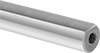
Combine these general purpose shafts with a linear bearing and shaft support to create a basic linear motion system.
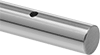
Internal threads allow you to mount these shafts onto threaded studs and fasteners, no shaft supports needed.
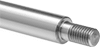
Mount these externally threaded shafts into tapped holes rather than using a shaft support, or attach a hex nut, shaft collar, or other threaded accessory.
With 2" of each end softened, it's easier to machine a custom end for mounting. The rest of the shaft is case-hardened, which increases hardness and wear resistance on the surface of the shaft while allowing the center to remain soft for absorbing stresses caused by shifting loads.
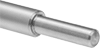
A shoulder near the end of the shaft allows for easy positioning of housings, shaft supports, and collars.
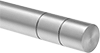
Clip retaining rings into the grooves to separate and position collars, supports, and housings.
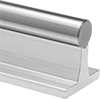
Replace worn shafts in two-piece support-rail shaft systems, or mate with a support rail to create your own. The tapped mounting holes match those on our Support Rails.
These shafts include a support rail for a stable setup that eliminates bending and prevents linear bearings from rotating.
Use these general purpose shafts with bearings, sprockets, and gears to transmit rotary motion.
Eight times straighter than standard rotary shafts, these tight-tolerance shafts minimize vibrations and reduce wear to bearings and other components. They also have diameter tolerances that are twice as tight as standard rotary shafts.
Combine with a machine key to transmit torque to gears, sprockets, and other power transmission components.
In addition to diameter tolerances that are twice as tight as standard keyed shafts, these shafts include a traceable lot number and test report. Use them with machine keys to transmit torque to gears, sprockets, and other power transmission components.
These shafts have keyways only on the ends, leaving a plain shaft in the center. Use the keyways with machine keys to transmit torque to gears, sprockets, and other keyed components. Use the middle of the shaft with bearings and other round-bore components.
A flat surface area allows set screws to dig into the shaft for securely mounting gears, sprockets, and bearings.
Connect these internally threaded shafts directly to threaded components, or use a fastener to secure. They have a flat surface area that allows set screws to dig into the shaft for securely mounting gears, sprockets, and bearings.
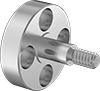
Mount the flange to a machine or wall to support idler sprockets and pulleys in tensioning applications. They include washers and a nut to position your component and hold it in place.
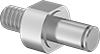
Thread these shafts into a tapped hole to support idler sprockets and pulleys in tensioning applications. They have a retaining-ring groove, retaining ring, and spacers to position your component and hold it in place.
Connect these internally threaded shafts directly to threaded components, or use a fastener to secure.
Attach threaded accessories, such as mixer propellers and fan blades, to the end of these shafts.
Clip retaining rings into the grooves to separate and position gears, sprockets, and bearings.
A shoulder near the end of the shaft provides a stop for gears, sprockets, and bearings.
A good all-around choice, Garolite G-10/FR4 is strong, machinable, and electrically insulating. It meets UL 94 V-0 for flame retardance.
Using nothing more than standard high-speed steel tooling, Garolite LE can be machined into intricate parts.
Offering higher strength and better heat resistance than Garolite G-10/FR4, Garolite G-11 is suitable for continuous use in elevated temperatures.
Frequently called electrical-grade Garolite, this Garolite G-9 is strong, electrically insulating, and arc resistant in dry environments.
Choose these Garolite G-7 rods for their high heat tolerance—they withstand temperatures up to 425° F. While not as strong as Garolite G-9, they offer better arc resistance in dry environments.
Stronger than Garolite CE with better electrical-insulating properties, Garolite XX is often fabricated into low-cost electrical components.
Use Garolite G-10 in place of Garolite G-10/FR4 for applications that are sensitive to halogen, such as in nuclear plants. It's strong, machinable, and electrically insulating.
Garolite CE is often fabricated into parts where high strength is not required.
An alternative to wood in structural applications, FRP fiberglass is strong and lightweight.
Offering excellent arc and track resistance, this GPO3 fiberglass is often used for electrical applications in humid environments.
Reinforce structures with these rods—they weigh less than aluminum while remaining strong and almost as rigid.
Hard fiber is the easiest composite to machine, making it good for creating custom parts. Also known as vulcanized fiber.
Often used to create prototype components, these ceramic rods and discs come semi-fired so they can be machined using conventional metalworking tools.
Over 99% pure, these rods have the strength of silicon carbide throughout, so they resist deforming under heavy loads at high temperatures (known as creep). They’re often used as supports in kilns.
Machine these rods into nozzles for acids, pins or supports for kilns, and other parts that require extreme hardness when exposed to quick temperature changes and chemicals. This nitride-bonded silicon carbide is better at transferring heat than most ceramics and expands without cracking when temperatures fluctuate.
Create bushings and other parts that will be exposed to abrasion, harsh chemicals, high heat, and rubbing with these rods. Sintering strengthens the bonds within silicon carbide, leaving it two times stronger than other versions of silicon carbide.
As fracture resistant and durable as metal, this temperature-resistant zirconia ceramic has been fired to obtain a high hardness and can be used in high-wear applications.
Turn and drill intricate components such as heat sinks, fixture parts, and other electronics parts where thermal stability is important.
Used in prototypes, insulators, and machine tooling, these mullite ceramic rods won’t deform or crack when exposed to extreme temperature changes, high heat, or stress.
Also known as Macor, these glass-mica ceramic rods withstand temperatures up to 1470° F.
Machine complicated shapes and precision parts from these glass-mica ceramic bars in a fraction of the time it would take using other types of fired ceramic.
Able to withstand temperatures up to 2100° F, this quartz glass is useful in high-temperature applications that also require optical clarity, such as high-intensity lighting, fiber-optic production, and optical lens systems.
Also called Pyrex and Schott glass, these glass rods and discs resist clouding and pitting and are highly chemical and heat resistant.
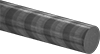
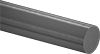
Oak is a heavy wood with high wear resistance. Its surface is rougher than birch and maple.
Birch is softer than maple and oak and has a smooth surface.
Maple is heavy and wear resistant like oak but with a smoother surface.
One end of these shafts is machined to fit into the mixer; the other is machined to fit into an attachment like a propeller.
Designed for use with mixing blades, these shafts are left-hand threaded for counterclockwise motion.
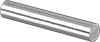
Also known as sacrificial anodes, these rods and pads protect tanks, water heaters, and heat exchangers from rusting by attracting corrosion that would otherwise damage equipment.
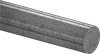
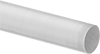
These neoprene foam cords stand up to water, sunlight, and oxidation, plus they resist swelling when they come into contact with oil.
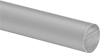
An economical alternative to neoprene foam, these Santoprene foam cords stand up to water, sunlight, and oxidation but lack oil resistance.
Made of EPDM, this foam has the best resistance to water, sunlight, and oxidation of all the foam we offer.
These silicone foam cords meet NSF/ANSI 51 for food equipment materials. Use them to seal and cushion narrow spaces in food service equipment.
Seal and cushion narrow spaces in hot environments with these silicone foam cords.
Connect an electrical system to a ground.
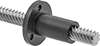
Multiple thread channels (also known as thread starts) create faster linear travel than lead screws with a single thread start.
Found in hand-powered clamps, vises, grates, doors, and work tables, lead screws and nuts have broad, square threads that are well suited for quick assembly, high clamping forces, and lifting and lowering heavy objects.
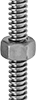
Also known as single-start and self-locking lead screws and nuts, these have a single thread that runs the length of the screw. The nut travels only when the screw turns, so your system won't unexpectedly move when the lead screw is at rest.
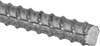
Reduce the chance your concrete will crack from expansion and contraction and other tensile stresses.
These electrodes cut as well as gouge aluminum, copper, stainless steel, and steel.