We will reply to your message within two hours.
Comparable to Grade 8 steel, these threaded rods have a tensile strength of 150,000 psi, making them about 25% stronger than medium-strength steel rods.
These Grade B7 threaded rods meet the pressure and temperature requirements of ASTM A193 and are often used to secure pressure tanks, valves, and flanges.
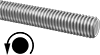
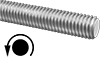
Tighten these threaded rods by turning them to the left; once fastened, they resist loosening from counterclockwise motion.
Grade B16 threaded rods maintain their strength at higher temperatures than Grade B7 threaded rods. They meet the pressure and temperature requirements of ASTM A193 and are often used to secure pressure tanks, valves, and flanges.
About half the strength of medium-strength steel threaded rods, use these for light duty hanging, mounting, and fastening.
Tighten these threaded rods by turning them to the left; once fastened, they resist loosening from counterclockwise motion. About half the strength of medium-strength steel threaded rods, use them for light duty hanging, mounting, and fastening.
18-8 stainless steel threaded rods have good chemical resistance.
Grade B8 threaded rods meet the pressure and temperature requirements of ASTM A193 and are often used to secure pressure tanks, valves, and flanges. They have good chemical resistance.
Stronger and more wear resistant than 18-8 stainless steel, these threaded rods are mildly chemical resistant. They meet the pressure and temperature requirements of ASTM A193 and are often used to secure pressure tanks, valves, and flanges.
More corrosion resistant than 18-8 and 410 stainless steel threaded rods, these 316 stainless steel rods have excellent resistance to chemicals and salt water.
These hardened 316 stainless steel threaded rods are 40% stronger than standard Grade B8M threaded rods. They meet the pressure and temperature requirements of ASTM A193 and are often used to secure pressure tanks, valves, and flanges.
Grade B8M threaded rods meet the pressure and temperature requirements of ASTM A193 and are often used to secure pressure tanks, valves, and flanges.
The most corrosion resistant stainless steel threaded rods we offer, these Alloy 20 stainless steel threaded rods contain nickel to withstand exposure to sulfuric, phosphoric, and nitric acids.
Fiberglass threaded rods are stronger than nylon threaded rods. They resist acids, solvents, salt water, and oil.
Made from nylon 6/6, these threaded rods resist oil, grease, and solvents. They’re nonconductive, making them good for use around sensitive electrical components.
PVC threaded rods resist acids, alkalies, salt solutions, and alcohol.
These acetal threaded rods won't absorb moisture like nylon and fiberglass rods, so they're good for use in wet environments. They resist alcohol, gasoline, and solvents.
PTFE threaded rods withstand temperatures up to 250° F and resist oil, grease, detergents, and most mineral acids. They're the lowest friction plastic threaded rods we offer, so they thread on smoothly.
Unlike metal rods, these threaded rods will not warp at extreme temperatures, making them ideal for heat treating and furnace fixtures.
One-third the weight of steel, aluminum threaded rods resist corrosion in wet environments.
More corrosion resistant than 400 nickel threaded rods, these C276 nickel rods are often used in marine environments and chemical-processing plants.
Commonly used in valves, pumps, and shafts, these 400 nickel threaded rods resist salt water and caustic chemicals.
Brass threaded rods are corrosion resistant in wet environments, electrically conductive, and nonmagnetic.
Bronze threaded rods are stronger and more resistant to salt water than brass rods.
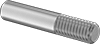
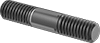
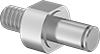
Screw these studs into a tapped hole and use them as a pivot point, hinge, shaft, or locator pin.
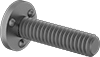
Pass these studs through a hole and weld them in place.
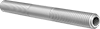
A hollow center allows these studs to be used as an axle, a vent, or a passageway for wiring.
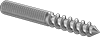
18-8 stainless steel studs have good chemical resistance and may be mildly magnetic. Also known as hanger bolts, use them to hang, mount, and fasten parts to wood structures.
These studs are also known as hanger bolts—use them to hang, mount, and fasten parts to wood structures.
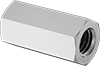
About half the strength of medium-strength steel coupling nuts, these nuts are for light duty fastening applications.
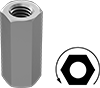
The left-hand threads on these coupling nuts resists loosening from counterclockwise vibration. Use in light duty applications.
Made from Grade 8 steel, these nuts are about 25% stronger than medium-strength steel coupling nuts. Furnished in inch thread sizes.
Made from Grade 5 steel, these inch-sized coupling nuts are suitable for most applications.
Comparable in strength to Grade 9 bolts, these coupling nuts are about 20% stronger than high-strength steel coupling nuts. Available in inch thread sizes.
More corrosion resistant than 18-8 stainless steel coupling nuts, these nuts have excellent resistance to chemicals and salt water.
These coupling nuts have good chemical resistance.
One-third the weight of steel, aluminum coupling nuts resist corrosion in wet environments.
Brass coupling nuts are corrosion resistant in wet environments and electrically conductive.
Stainless steel coupling nuts have excellent corrosion resistance in most environments.
Known for their strength, steel coupling nuts are available with a corrosion-resistant finish.
A smooth rounded body provides a finished look.
Use the sight hole to check for proper thread engagement.
Connect two differently sized male-threaded parts, such as threaded rods, and tighten with a standard wrench.
Often called sleeve nuts, these thread adapters fasten parts with right-hand threads to parts with left-hand threads.
Adapt threaded rods from inch to metric. These adapters connect two male-threaded fasteners, so you can change the gender of a mating part or increase or decrease its thread size. The hex-shaped body fits into the head of a standard wrench.
Mount these externally threaded shafts into tapped holes rather than using a shaft support, or attach a hex nut, shaft collar, or other threaded accessory.
Internal threads allow you to mount these shafts onto threaded studs and fasteners, no shaft supports needed.
A shoulder near the end of the shaft allows for easy positioning of housings, shaft supports, and collars.
Clip retaining rings into the grooves to separate and position collars, supports, and housings.
Attach threaded accessories, such as mixer propellers and fan blades, to the end of these shafts.
Connect these internally threaded shafts directly to threaded components, or use a fastener to secure.
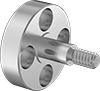
Mount the flange to a machine or wall to support idler sprockets and pulleys in tensioning applications. They include washers and a nut to position your component and hold it in place.
Thread these shafts into a tapped hole to support idler sprockets and pulleys in tensioning applications. They have a retaining-ring groove, retaining ring, and spacers to position your component and hold it in place.
Combine with a machine key to transmit torque to gears, sprockets, and other power transmission components.
A flat surface area allows set screws to dig into the shaft for securely mounting gears, sprockets, and bearings.
A shoulder near the end of the shaft provides a stop for gears, sprockets, and bearings.
Clip retaining rings into the grooves to separate and position gears, sprockets, and bearings.
Designed for use with right-hand, internally threaded rod ends, these rods have right-hand threads on both ends. Use them for remote valve operators, throttle controllers, shifting mechanisms, and virtually any push/pull assembly.
Protect electrical systems from lightning strikes on structures up to seventy-five feet tall.
Secure setup clamps and fixtures to your machine table, or assemble heavy machines, such as engine mounts.
Also known as tap-end and fixture studs, these rods have friction-fit threads on one end to resist loosening and standard threads on the other side for attaching a nut.