

Component Component |
|---|
 | Gear |
Gear Pitch Gear Pitch |
|---|
Bore Type Bore Type |
|---|
 |  |
| Machinable | Round |
System of Measurement System of Measurement |
|---|
|

Pressure Angle Pressure Angle |
|---|
|
For Shaft Diameter For Shaft Diameter | Show |
|---|
|
For Shaft Diameter For Shaft Diameter | Hide |
|---|


Material Material |
|---|
|
Gear Type Gear Type |
|---|
| Spur |

For Maximum Shaft Diameter For Maximum Shaft Diameter |
|---|
|


DFARS (Defense Acquisition Regulations Supplement) DFARS (Defense AcquisitionRegulations Supplement) |
|---|
REACH (Registration, Evaluation, Authorization and Restriction of Chemicals) REACH (Registration,Evaluation, Authorization and Restriction of Chemicals) |
|---|
|
RoHS (Restriction of Hazardous Substances) RoHS (Restriction ofHazardous Substances) |
|---|
|
Teeth Heat Treatment Teeth Heat Treatment |
|---|
|

About Gears
More
Metal Gears and Gear Racks—14 1/2° Pressure Angle
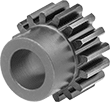
A former industry standard, 14½° pressure angle gears are often found on older machinery. Made of carbon steel, they have high strength and are better than plastic gears and gear racks for high-load, high-speed, and heavy duty applications.
Combine gears with different numbers of teeth to change speed and torque in your assembly. Combine a gear and rack to convert rotary motion into linear motion.
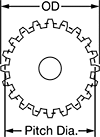
For components to mesh correctly, they must have the same pressure angle and pitch.
Gears with machinable bore have a large hub diameter so you can machine them to fit your shaft.
Gears with teeth that are not hardened can be hardened to fit your application. Hardening a gear's teeth increases its wear resistance.
 For technical drawings and 3-D models, click on a part number.