


Clear All
Number of Teeth Number of Teeth | Show |
|---|
|
Number of Teeth Number of Teeth | Hide |
|---|
Component Component |
|---|
 | Gear |
System of Measurement System of Measurement |
|---|
|
Module Module |
|---|

Gear Type Gear Type |
|---|
 | Spur |
Material Material |
|---|
|
Pressure Angle Pressure Angle |
|---|
|
Bore Type Bore Type |
|---|
| Round |
Gear Pitch Diameter Gear Pitch Diameter |
|---|

|


Color Color |
|---|
 | Blue |
DFARS (Defense Acquisition Regulations Supplement) DFARS (Defense AcquisitionRegulations Supplement) |
|---|
Fabrication Fabrication |
|---|
|


REACH (Registration, Evaluation, Authorization and Restriction of Chemicals) REACH (Registration,Evaluation, Authorization and Restriction of Chemicals) |
|---|
|
RoHS (Restriction of Hazardous Substances) RoHS (Restriction ofHazardous Substances) |
|---|
|
About Gears
More
Plastic Gears and Gear Racks—20° Pressure Angle
The current industry standard, these 20° pressure angle gears have thicker, stronger teeth than 14½° pressure angle gears. Made of plastic, they run quieter than metal gears and have good corrosion and chemical resistance. They’re also known as spur gears.
Combine gears with different numbers of teeth to change speed and torque in your assembly. Combine a gear and rack to convert rotary motion into linear motion.
For components to mesh correctly, they must have the same pressure angle and pitch/module.
Nylon gears can be operated without lubrication, so they’re commonly used in food-processing machines.
 For technical drawings and 3-D models, click on a part number.
Metric Gears

Round Bore
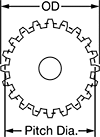
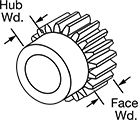
Hub | |||||||||||||
|---|---|---|---|---|---|---|---|---|---|---|---|---|---|
| Module | Number of Teeth | Gear Pitch Dia., mm | OD, mm | Face Wd., mm | Overall Wd., mm | For Shaft Dia., mm | Material | Fabrication | Color | Dia., mm | Wd., mm | Each | |
Round Bore | |||||||||||||
| 1 | 75 | 75 | 77 | 10 | 20 | 10 | Nylon Plastic | Machined | Blue | 40 | 10 | 00000000 | 000000 |