
We will reply to your message in the morning.
Use these corrosion-resistant fittings in a low-pressure pipe line.
The male threads on these fittings have a sealant applied for extra leak protection.
Use these heavy duty, corrosion-resistant fittings in high-pressure flow applications.
Use these fittings in extreme-pressure conditions up to 15,000 psi.
These fittings are made to tighter tolerances than other stainless steel pipe fittings. They are also known as instrumentation fittings.
Choose these fittings when you want the same high-quality found in our low-pressure pipe fittings, but need more strength to handle higher pressures.
When space is at a premium choose these compact fittings.
Socket-connect fittings are easier to weld than butt-weld fittings because the fitting doesn't need to align perfectly to the pipe. Slip the pipe into the socket and weld.
18-8 stainless steel spacers have good corrosion resistance.
These spacers have excellent corrosion resistance and are passivated for enhanced protection.
Choose the OD, ID, length, and material and we will accommodate your unique spacer needs.
The 45° end fits against an angled surface to create a flat surface for connection.
Choose these standoffs for their adherence to NAS 1831 specifications.
These standoffs are made to NAS specifications.
Mount components onto food processing lines, walls, and sanitary equipment while leaving space to clean in between.
These standoffs are designed to fit in the limited space of compact electronics such as laptops and hand-held devices.
Also known as captive spacers, the splines on these bite into a panel for a permanent hold.
Once the end is clinched in place, panels with keyholes easily slide on and off these supports.
With the end clinched in place, the prongs allow you to quickly snap a panel on and off these supports.
Precisely align, level, and adjust spacing on fasteners and shafts with these shims.
Be prepared with ring shims in a variety of thicknesses. These shims fit around fasteners and shafts to precisely align, level, and adjust spacing.
Also known as machinery bushings, these shims have an oversized OD to create a larger bearing surface for reduced wear between moving parts.
For a snug fit around a shaft, the ID of these shims is held to a tighter tolerance than other round shims.
These shims are made of layers of metal bonded with adhesive. Remove layers with a utility knife until you get the thickness you need.
Adjust spacing between bearings and other components on shafts. These shims are sized to fit the outer rim of a bearing.
Also called tolerance rings, these rings are for use in stamped, molded, or worn housings to form a tight hold on the bearings.
Slide these shims under the screw head to shorten the shoulder length.
Spin these shims onto screw threads to extend the shoulder length.
Use these round shims as they are, or punch out the middle to create the ID you need.
Precisely shaped to fit snugly on keyed shafts, these shims align, level, and space components. Because of their tight fit, they also help components rotate in unison with the shaft.
Place these shims under sharpened dies to restore their original height and extend their life.
Level dies, plates, presses, and other machine tools—this shim tape conforms to curves and uneven surfaces.
Be prepared with slotted shims in a variety of thicknesses. The slot lets you insert, remove, and adjust the shims without disassembling your machinery.
The slot lets you insert, remove, and adjust the shims without disassembling your machinery.
Align cabinets, doors, and windows with these shims. The horseshoe design fits around screws.
Send us a drawing, and we'll cut your custom shim.
Send us a drawing, and we'll cut your custom shim. Shims are made of layers of metal bonded with adhesive; remove layers with a utility knife until you get the thickness you need.
Connect male- and female-threaded parts of different thread types and sizes, while allowing air, liquids, wire, or other thin materials to pass through.
The through hole allows you to connect float rods to float valves.
Join two female-threaded parts of various thread types and sizes, while allowing air, liquids, wire, or other thin materials to pass through.
Reinforce holes in soft material to keep them from collapsing around screws.
Flat and oval head screws sit flush within these washers for a neat, finished appearance.
Made of Nitronic 60 stainless steel, these inserts prevent the screw from binding or sticking without any coating or lubricant that could contaminate particle-free environments.
A dry film keeps the screw from sticking or binding in these inserts during installation.
Eliminating the need for primer, these inserts are coated to resist corrosion when installed in different materials.
A distorted thread grips the screw to resist loosening.
Inserts come with a through-hole tap and installation tool.
Assortments include various sizes of helical inserts and a tap, a drill bit, and an installation tool for each thread size.
Without a prong to break off and retrieve, these inserts are often used where debris could cause damage.
Kits include helical inserts, a tap, and an installation tool.
These kits have short-, normal-, and long-reach inserts, an installation tool, and a tap.
Made of 18-8 stainless steel, these inserts have good corrosion resistance.
These inserts are made to stringent military specifications.
Forming the strongest hold of any of our threaded inserts, these inserts have a distorted internal thread to lock screws into place and keys that drive into surrounding material to prevent slipping and rotating.
These inserts come with an installation tool. Drive the keys into the surrounding material for a more secure hold than thread-locking inserts.
Made of 18-8 stainless steel, these inserts have better corrosion resistance than black-phosphate steel.
These inserts are the most corrosion-resistant thread-locking inserts we offer.
These assortments include various sizes of thread-locking inserts.
These 18-8 stainless steel inserts have better corrosion resistance than brass inserts and may be mildly magnetic.
These 18-8 stainless steel inserts have better corrosion resistance than aluminum inserts and may be mildly magnetic.
The tapered shape makes it easier to guide these inserts into a hole during installation. Use a drill bit to create a straight hole, then taper the top half.
Install these inserts into plastic parts to create a secure base for fasteners.
These 18-8 stainless steel inserts have excellent resistance to chemicals and may be mildly magnetic.
The most corrosion resistant tee nut inserts we offer, these inserts stand up to chemicals and salt water.
These 18-8 stainless steel tee nut inserts have better corrosion resistance than zinc-plated steel tee nut inserts.
Press these inserts into a drilled hole and the flexible metal teeth anchor them in the material. Use them with carbon fiber, fiberglass, and garolite.
Weld these nuts to stainless steel surfaces.
Create threads in hard-to-work areas—where you can’t reach the back of a workpiece, or material is too thin to be tapped.
Stainless steel nuts have excellent corrosion resistance in most environments.
The most corrosion resistant twist-resistant rivet nuts we offer, these stand up to chemicals.
The most corrosion resistant low-profile rivet nuts we offer, these stand up to chemicals.
These 18-8 stainless steel anchors have good chemical resistance.
More corrosion resistant than 18-8 stainless steel anchors, these 316 stainless steel anchors have excellent resistance to chemicals and salt water.
These 316 stainless steel anchors have excellent resistance to chemicals and salt water.
For narrow holes and small cavities where toggle anchors won't fit.
Because they usually do not require lubrication, linear sleeve bearings outperform linear ball bearings in dirty environments.
Ridges on the inside of these bearings wipe away dust and debris as the bearing travels on a shaft.
Thinner than standard linear sleeve bearings, these bearings fit where clearance is a concern.
A ceramic liner makes high speeds as well as rapid acceleration and deceleration possible.
Made of FDA-listed materials for use in food applications, these bearings also have excellent chemical and corrosion resistance.
Use these ultra-thin sleeve bearings in high-speed applications where clearance is a concern.
These fiberglass bearings are lightweight, nonmagnetic, and won’t conduct electricity.
Use ball bearings in debris-free environments and when speed is a necessity. They operate with less friction than sleeve bearings, so you can run them at higher speeds.
Engineered for simultaneous linear and rotary motion, these bearings are used with round end-supported shafts.
The choice for low-friction motion in high-temperature environments.
Designed to handle heavy loads, these bearings have higher load capacities than comparable standard linear ball bearings.
Sleeve bearings outperform ball bearings in dirty environments. Use them for low speed applications.
These bearings have a ceramic liner to help them achieve high speeds as well as rapid acceleration and deceleration.
Ball bearings create less friction than sleeve bearings, so they require less force to operate.
Designed to handle heavy loads, these bearings have higher load capacities than comparable standard linear ball bearings for support rail shafts.
Grooved on the inside, these bearings rotate with your spline shaft as they move loads up and down its length.
The flanged housing makes these bearings a good solution for vertical linear motion applications.
The shell, housing, and balls of these bearings are stainless steel for excellent corrosion resistance.
The Frelon liner on these bearings allows them to stand up to a wider range of chemicals than other flange-mounted linear sleeve bearings.
A ceramic coating makes high speeds as well as rapid acceleration and deceleration possible.
Choose ball bearings for debris-free environments and when speed is a necessity. They operate with less friction than sleeve bearings, so you can run them at higher speeds.
Outdoor as well as mild chemical environments are no problem for these bearings. They have stainless steel balls for corrosion resistance.
Designed to handle heavy loads, these bearings have the highest load capacities of any mounted linear ball bearings we offer.
Use the adjustment screw in the housing to tighten or loosen the snugness (also known as preload) of the bearing to your shaft.
Virtually maintenance free, these bearings have slippery, chemical-resistant liners that don't require added lubrication.
With two bearings mounted in one housing, these sleeve bearings can handle heavier loads than standard mounted linear sleeve bearings.
Float bearings on air for precise, frictionless movement. Unlike traditional bearings that can wear your shaft down, these bearings are suspended using pressurized air for linear and rotary motion.
Mount these bearings on a support rail shaft for applications requiring maximum rigidity.
Designed to handle heavy loads, these bearings have higher load capacities than comparable standard mounted linear ball bearings for support rail shafts.
With two bearings mounted in one housing, these sleeve bearings withstand heavy loads. Use them on round support rail shafts for applications that require maximum rigidity.
With two bearings mounted in a single housing, these bearings have higher load capacities than standard ones. A ceramic liner helps them achieve high speeds as well as rapid acceleration and deceleration.
With a flexible layer of rubber sandwiched between an oil-embedded bronze bearing and rigid metal shell, these bearings reduce wear and machinery noise.
A metal shell adds strength.
Use these UHMW bearings in wet, corrosive environments.
These bushings are made of stainless steel, which provides excellent corrosion resistance.
Keep these shaft collars in place by tightening their set screw into the shaft.
These metal collars are stronger than plastic shaft collars.
Internal ball bearings allow you to slide a collar onto your shaft in one direction and then automatically lock the collar in place in the opposite direction.
Formed to offset the weight of the clamping screw, these collars won't wobble or vibrate when shafts are spinning—even at high speeds.
Wider than standard shaft collars with twice the number of clamping screws, these ensure a better grip for greater holding power.
A threaded lever lets you tighten these collars with more torque than other quick-release styles, ensuring that they stay put on your shaft.
Customize the bore of these collars to precisely fit your shaft.
With larger screws than those found on standard clamping collars, these provide a stronger grip on your shaft without using additional screws.
Use a wrench to rotate your drive shaft without marring or gouging the shaft.
Make quick adjustments to these shaft collars with a lever on the side.
Although these collars fit inch-sized shafts, they have a metric OD and width for use with metric equipment.
Tighten the set screw to bite into an unhardened shaft for a secure hold.
Offering the benefits of a two-piece collar in a one-piece design, these collars swing open for positioning then close anywhere on your shaft.
Three tapped counterbored holes and three through-holes provide mounting flexibility.
Two tapped holes on the face of these collars allow you to fasten them to gears, pulleys, and sprockets.
Secure items to either side of these collars—each half has a flat end with a tapped hole
Mount these collars flush against each other or attach components to either side—the round body has flattened ends with tapped holes.
With a nylon insert that grips your threaded shaft or spindle without damaging its threads, these locknuts—also called shaft nuts—hold bearings, bushings, gears, and pulleys prone to vibration tightly in place.
To install, thread these one-piece collars onto the end of your shaft.
Install these collars anywhere on a shaft without removing components or having access to the ends of the shaft.
To install, slide these one-piece collars onto the end of your shaft.
Slide these one-piece collars onto the end of your shaft to create an end-stop for linear components.
Install these two-piece collars square shafts.
These threaded handles take the place of a set screw, allowing you to move set screw shaft collars without additional tools—useful for when the collar serves as a stroke limiter or mounting clamp.
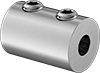
Set screws bite into your shaft to hold these couplings in place.
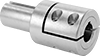
When one of your shafts is undersized from wear, oversized from coatings, or uncommonly sized, machine one end of these couplings to fit. They clamp around your shafts for a secure hold that won’t cause damage.
Designed to grip evenly around your shaft, clamping couplings provide more holding power than set screw couplings without marring the shaft.
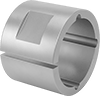
Machine the pilot hole in these couplings to whatever size you need. Often used for shafts that are undersized from wear or oversized from coatings. These couplings are two-piece, so you can remove and reinstall them without moving your shafts.
Install and remove these shaft couplings without disconnecting the shafts, motors, and other attached components—they’re made in two pieces so you don’t need to slide them onto shaft ends. They’re also useful when you have limited access to the ends of the shafts.
Access one shaft without disconnecting the other. These rigid couplings have a solid bottom that connects the shafts and two top pieces that clamp the shafts independently.
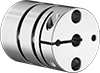
Able to handle high twisting forces as well as misalignment, these couplings are good for high-performance servomotor applications.
The thick split spider on these couplings takes on twice as much torque as standard split spiders, while a set screw holds the hubs in place on your shaft. Also known as jaw couplings, use them to connect motors to pumps, mixers, and other high-torque equipment.
Each hub includes a set screw (unless noted), which bites into your shaft to hold the coupling in place.
Safely connect slightly misaligned shafts near food lines—the spider on these couplings contains metal, so it’ll trigger a metal detector if a piece frays off and contaminates your batch.
One side is unfinished for milling custom pulleys, threaded hubs, sprockets, collars, knobs, sensor targets, or just about anything imaginable; the other side is a one-piece clamping coupling for mounting whatever you’ve created to your shaft.
Often used with V-groove wheels or track roller carriages, these off-center bushings create precise mounting clearance.
The tapered barrel on these bushings is split on both sides, allowing them to contract more tightly around the shaft than quick-disconnect and taper-lock bushings.
The screw connections on these bushings easily mate to compatible quick-disconnect sprockets and pulleys.
Also known as Trantorque bushings, these tighten with a twist of the collar nut—no screws needed.
With a diameter that’s held to a close tolerance, this material is hardened for increased wear and abrasion resistance.
A slippery PTFE liner reduces wear and eliminates the need for lubrication.
Stronger than plastic models, these stainless steel swivel joints are also more corrosion resistant than steel joints.
Thread these one-piece collars onto an Acme lead screw.
Mount these two-piece collars anywhere on an Acme lead screw without removing components.
Also known as single-start ball screws and nuts, these have a single thread that runs the length of the screw. They operate with more torque than fast-travel ball screws and nuts.
Multiple thread channels (also known as thread starts) create faster linear travel than ball screws with a single thread start.
Made of tightly layered stainless steel mesh, these mounts withstand temperatures up to 500° F.
Install these mounts with a socket head cap screw—the counterbored hole ensures the screw sits flush with or below the top of the mount.
Isolate vibration and noise from oscillating equipment like fans and tumblers that create horizontal (shear) force.
A rolled rim provides added grip while the elongated neck and teeth on the washer, also known as a spur washer, add reinforcement and reduce rotation so you can use these grommets in thick materials such as canvas. Press the grommets into a hole you've already cut. They strengthen and prevent holes from fraying in tarps, covers, and curtains. They also provide a way to run rope and cable through your material.
Press these grommets into a hole you've already cut. They strengthen and prevent holes from fraying in tarps, covers, and curtains. They also provide a way to run rope and cable through your material.
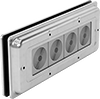
Eliminate clutter on desktops, countertops, benchtops, and other work surfaces by organizing wire, cable, and cords.
These grips are the most corrosion resistant of any of our submersible metal cord grips.
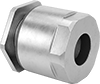
Securely connect cable in sanitary environments such as food plants with these watertight cord grips.
Able to stand up to rust better than steel grips, these 300 series stainless steel grips secure electrical cables in corrosive environments.
These stainless steel grips offer the most protection from wet, corrosive environments of any of our metal wet-location cord grips. They are rated IP67 for protection from temporary water submersion.
The mesh offers a secure hold in applications where cable is pulled or in motion. It reduces stress on the cable and prevents kinking for longer cable life.
Stainless steel construction offers the most corrosion-resistance of any of our multi-diameter wet-location cord grips.
FDA compliant for direct food contact, these cord grips have a multi-piece design to wrap around cables in sanitary environments without removing connectors or rewiring.
Peel away layers of rubber inserts to fit around cord grips, even when you don't know the exact diameter.
Modify these cord grips to get the right fit for your cord even when you don't know the exact diameter.
Replace worn and damaged bearings or press-fit bearings into tubing or pipe to create a roller.