
We will reply to your message in the morning.
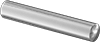
Use these metal dowel pins as pivots, hinges, shafts, jigs, and fixtures to locate or hold parts.
Slip these pins in and out during maintenance or prototyping—they’re undersized to make alignment easier.
Cut this 12" stock to the length you need.
Oversized to fit worn and enlarged holes, these pins work well as repair and replacement parts.
To remove these pins, thread a screw or tool into the tapped hole, then pull them out.
The flat side of these pins relieves trapped air, making them easier to insert in and remove from blind holes. To remove, thread a screw or tool into the tapped hole, then pull the pin out.
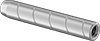
A spiral groove cut into these pins relieves trapped air but stays in 360° contact with the hole for a secure fit that's easy to insert in and remove from blind holes. To remove, thread a screw or tool into the tapped hole, then pull the pin out.
Grooves run the full length of these pins for a firm hold that won't spin. Use them in place of standard dowel, spring, and taper pins to fasten parts. Also known as type A pins.
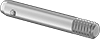
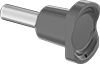
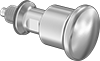
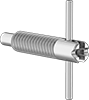
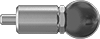
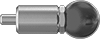
Add a knob or handle to the threaded shank. A spring-loaded, nonlocking retaining ball pops out when the pin is pushed through a hole, and retracts when the pin is pulled out.
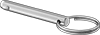
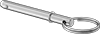
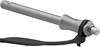
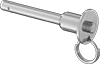
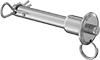
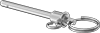
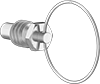
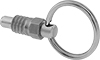
The smooth ring handle on these pins won't catch on parts. A spring-loaded, nonlocking retaining ball pops out when the pin is pushed through a hole, and retracts when the pin is pulled out.
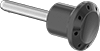
A high-profile knob is easy to grip, but fits in small spaces. A spring-loaded, nonlocking retaining ball pops out when the pin is pushed through a hole, and retracts when the pin is pulled out.
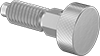
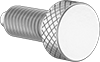
These pins have a low-profile head, so they won't get knocked out of place. A spring-loaded, nonlocking retaining ball pops out when the pin is pushed through a hole, and retracts when the pin is pulled out.
The smooth ring handle on these pins won't catch on parts. The shoulder keeps a portion of the pin outside the hole and makes them easy to grab.
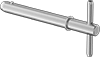
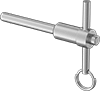
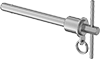
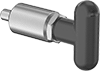
A T-handle makes these pins easy to grip. The shoulder keeps a portion of the pin outside the hole and makes them easy to grab.
Two spring-loaded balls give these pins more holding power than quick-release pins with only one retaining ball. The balls pop out when the pin is pushed into a hole, and retract when the pin is pulled out.
For a more secure hold than standard quick-release pins, these pins lock in place until you push the button to release the spring-loaded retaining balls.
Use these pins for visibility or to color-code processes. For a more secure hold than standard quick-release pins, they lock in place until you push the button to release the spring-loaded retaining balls.
The extra height and smaller width of the grip make the button more accessible in tight spaces. For a more secure hold than standard quick-release pins, these pins lock in place until you push the button to release the spring-loaded retaining balls.
For the tightest spaces, these narrow-grip pins have the smallest heads of any of our locking quick-release pins. They lock in place until you push the button to release the spring-loaded retaining balls.
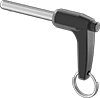
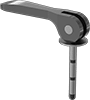
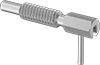
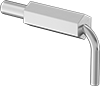
When there isn't enough room for a T-handle, an L-handle saves space but is still easy to grip. For a more secure hold than standard quick-release pins, these pins lock in place until you push the button to release the spring-loaded retaining balls.
A recessed button prevents accidental pin removal. These all-stainless steel pins stand up to corrosive environments. They lock in place until you push the button to release the spring-loaded retaining balls.
A T-handle makes these pins easy to grip. Made entirely of stainless steel, they stand up to corrosive enviroments. Pins lock in place until you push the button to release the spring-loaded retaining balls.
Four spring-loaded retaining balls provide extra holding power. Made entirely of stainless steel, these pins stand up to corrosive enviroments. They lock in place until you push the button to release the spring-loaded retaining balls.
The extra height and smaller width of the grip make the button more accessible in tight spaces. Made entirely of stainless steel, they stand up to corrosive enviroments. Pins lock in place until you push the button to release the spring-loaded retaining balls.
The shaft on these pins retracts into the head to hold thin sheets of material together. Pins lock in place until you push the button to release the spring-loaded retaining balls.
To insert and remove these pins, press the button, then flip the lever to release the spring-loaded retaining balls. Two-step locking prevents accidental removal.
These pins lock in place until you push the button to release the spring-loaded retaining balls, and can also be secured with a cotter pin for longer-term holding. Two-step locking prevents accidental removal.
Also known as double-acting pins, these pins lock in place until you push or pull the handle to release the spring-loaded retaining balls. The T-handle is easy to grip.
Also known as double-acting pins, these pins lock in place until you push the button or pull the ring to release the spring-loaded retaining balls. The smooth ring handle won't catch on parts.
Flip the handle 180° to expand and contract the shaft for a tight, vibration-resistant fit.
A strong magnet in the head holds these pins in place on steel and other ferrous metals. Use them for light duty applications and blind holes.
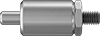
Threads on these pins stick out for easy removal from blind holes. Tighten the hex nut to draw the pin out.
To remove these pins, hit the small end with a punch to drive the pin out.
Pass these pins through a mounting hole and weld the head to the surface.
Weld these pins directly to a surface —no mounting hole required.
Spring force holds pieces of telescoping tubing together. Also known as snap buttons and tubing buttons.
Press these catches into a hole.
Weld these catches in place for a strong permanent hold.
Quickly align, join, or hold machine components in place in food, pharmaceutical, and other sanitary environments. Pulling the plunger knob and twisting it 90° will lock the nose into its retracted position.
Lock the nose into the retracted position by pulling the knob and rotating it 90°.
Retract the nose by pulling the knob.
Use the lanyard as a tether to secure the spring plunger to machinery and prevent accidental drops.
Install by hand or with a hex key in low-clearance applications.
Lock the nose into the retracted position by pulling the ring and rotating it 90°.
The ring allows you to attach these spring plungers to a lanyard.
Thread onto machinery or attach a knob or handle to the threaded spindle.
Lock the nose into the retracted position by pulling the handle and rotating it 90°.
A T-handle makes these spring plungers easy to grip.
A quarter turn of the handle locks these plungers in the retracted position. The T-handle is easy to grip.
A quarter turn of the handle locks these plungers in the retracted position. The smooth ball handle is easy to grip and won't catch on other parts.
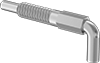
An L-handle takes up less space than a T-handle.
A smooth ball handle is easy to grip and won't catch on other parts.
Add a knob or handle to the threaded shank.
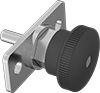
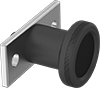
Two holes in the plate allow these plungers to be mounted to a flat surface.
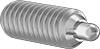
Install these spring plungers with a screwdriver—they're slotted on one or both ends.
An O-ring in the flange creates a tight seal.
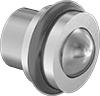
Designed with a flange to keep the plunger from being pushed through a hole when the ball is depressed.
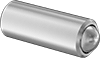
The flangeless design allows these spring plungers to mount flush with a surface.
Install with a hex key for more torque than slotted ball-nose spring plungers.
A flange keeps the plunger from being pushed through a hole when the ball is depressed.
Install with a driver.
Install with a hex key for more torque than slotted long-nose spring plungers.
Slotted on both ends for installation with a screwdriver.
Mount ball-nose and long-nose spring plungers to fixture surfaces.
Dowel pins are commonly used as pivots, hinges, shafts, jigs, and fixtures to locate or hold parts. They're slightly oversized for a tight fit.
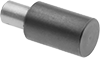
Support and position workpieces and fixtures from the bottom or side. These buttons press into a drilled hole for permanent installation.
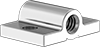
Mount through the counterbored hole with a socket head cap screw to support and position workpieces and fixtures from the bottom or side.
Support rounded or irregularly shaped workpieces from the bottom or side with minimal contact.
As the face of these plungers is pushed in, the internal spring applies outward pressure to hold a workpiece in position against stops and rails.