
We will reply to your message within 30 minutes.
From cookware to chemical-processing equipment, 304 stainless steel is a good all-around choice for a wide range of applications.
This material has tighter tolerances than standard 304 stainless steel.
When compared to standard 304 stainless steel, this material can be machined faster with less wear on cutting tools. It's also called Prodec and Project 70+.
Polished to either a brushed or mirror-like finish, this material is often used to fabricate decorative enclosures and industrial workstations.
Bend this wire and it will stay put. It’s frequently used as tying wire and locking wire.
The textured surface hides fingerprints and dents. This material is widely used in decorative applications, such as partitions and handrails.
Widely used for fabricating fittings and fasteners, 303 stainless steel machines quickly without sticking to cutting tools.
This material has tighter tolerances than standard 303 stainless steel.
Offering outstanding resistance to surface wear and corrosion, Nitronic 60 stainless steel is often used for shafts, fasteners, and valves.
Hardened for improved strength and wear resistance, these rods are precision ground to a strict diameter tolerance. Use them for turning applications in your lathe.
Each piece is precision ground to offer tighter tolerances than standard 17-4 PH stainless steel.
With a higher chromium content than 15-5 PH stainless steel, this high-strength 17-4 PH offers better corrosion resistance. It is also known as 630 stainless steel.
This material is hardened for improved strength and wear resistance.
Also known as Project 70+, this material machines faster with less wear on cutting tools than standard 17-4 PH stainless steel.
Offering outstanding strength, 15-5 PH stainless steel is often used for gears and shafts.
Widely used to fabricate fasteners and engine components, A286 will maintain its strength as temperatures rise.
13-8 PH stainless steel can be hardened at lower temperatures than other heat-treatable types of stainless steel. It is widely used for fittings, pins, and lock washers.
The addition of molybdenum gives 316 stainless steel excellent corrosion resistance. Use it in a variety of marine and chemical-processing applications.
This material is precision ground to offer tighter tolerances than standard 316 stainless steel.
This material machines faster with less wear on cutting tools than standard 316 stainless steel. It's also called Prodec and Project 70+.
These rods have been passivated for enhanced corrosion resistance.
A high nickel content allows Alloy 20 stainless steel to stand up to harsh chemicals in caustic environments. It's also known as Carpenter 20.
Stronger and more corrosion resistant than 316 stainless steel, Nitronic 50 is especially well-suited for use as shafts and fixtures in marine environments.
2205 stainless steel resists cracking even when faced with a combination of tensile stress, corrosive chemicals, and heat. Also known as duplex stainless steel, it has twice the strength of 316 stainless steel. Use it for high-pressure applications in caustic environments.
One of the most machinable types of stainless steel available, 416 contains sulfur for fast machining without clogging cutting tools. It's used for gears, screws, and shafts.
Hardened for superior wear resistance, these rods are precision ground to a tight diameter tolerance so they’re ready for turning in a lathe.
Precision ground to a tight diameter tolerance, these rods are all set for turning applications in a lathe.
Often used for fasteners and valves, 410 stainless steel withstands wear caused by abrasion.
With a diameter that’s held to a close tolerance, this material is hardened for increased wear and abrasion resistance.
Ready for turning in your lathe, these rods are precision ground to a tight tolerance.
One of the hardest types of stainless steel after heat treating, 440C offers excellent wear and abrasion resistance. It's often used for bearings, valves, and knife blades.
Suitable for making molds, 420 stainless steel is a hard, wear-resistant material that can be finely polished to a very smooth surface.
309/310 stainless steel has high levels of chromium and nickel to provide good corrosion resistance at elevated temperatures. It's often used in heat exchangers and furnaces.
The titanium content of 321 stainless steel preserves corrosion resistance around weld points.
Able to withstand temperatures up to 2100° F, 330 stainless steel is widely used as components for industrial furnaces, gas turbines, and boilers. It resists cracking when exposed to heating and cooling cycles.
Use these general purpose shafts with bearings, sprockets, and gears to transmit rotary motion.
Combine with a machine key to transmit torque to gears, sprockets, and other power transmission components.
These shafts have keyways only on the ends, leaving a plain shaft in the center. Use the keyways with machine keys to transmit torque to gears, sprockets, and other keyed components. Use the middle of the shaft with bearings and other round-bore components.
Connect these internally threaded shafts directly to threaded components, or use a fastener to secure.
Attach threaded accessories, such as mixer propellers and fan blades, to the end of these shafts.
A flat surface area allows set screws to dig into the shaft for securely mounting gears, sprockets, and bearings.
Clip retaining rings into the grooves to separate and position gears, sprockets, and bearings.
A shoulder near the end of the shaft provides a stop for gears, sprockets, and bearings.
Combine these general purpose shafts with a linear bearing and shaft support to create a basic linear motion system.
Internal threads allow you to mount these shafts onto threaded studs and fasteners, no shaft supports needed.
Mount these externally threaded shafts into tapped holes rather than using a shaft support, or attach a hex nut, shaft collar, or other threaded accessory.
Replace worn shafts in two-piece support-rail shaft systems, or mate with a support rail to create your own. The tapped mounting holes match those on our Support Rails.
These shafts include a support rail for a stable setup that eliminates bending and prevents linear bearings from rotating.
18-8 stainless steel threaded rods have good chemical resistance.
Available in metric sizes, these 18-8 stainless steel threaded rods have good chemical resistance.
Tighten these threaded rods by turning them to the left; once fastened, they resist loosening from counterclockwise motion.
Grade B8 threaded rods meet the pressure and temperature requirements of ASTM A193 and are often used to secure pressure tanks, valves, and flanges. They have good chemical resistance.
Stronger and more wear resistant than 18-8 stainless steel, these threaded rods are mildly chemical resistant. They meet the pressure and temperature requirements of ASTM A193 and are often used to secure pressure tanks, valves, and flanges.
More corrosion resistant than 18-8 and 410 stainless steel threaded rods, these 316 stainless steel rods have excellent resistance to chemicals and salt water.
These metric 316 stainless steel threaded rods are more corrosion resistant than 18-8 and 410 stainless steel threaded rods and have excellent resistance to chemicals and salt water.
Grade B8M threaded rods meet the pressure and temperature requirements of ASTM A193 and are often used to secure pressure tanks, valves, and flanges.
These hardened 316 stainless steel threaded rods are 40% stronger than standard Grade B8M threaded rods. They meet the pressure and temperature requirements of ASTM A193 and are often used to secure pressure tanks, valves, and flanges.
The most corrosion resistant stainless steel threaded rods we offer, these Alloy 20 stainless steel threaded rods contain nickel to withstand exposure to sulfuric, phosphoric, and nitric acids.
Screw these studs into a tapped hole and use them as a pivot point, hinge, shaft, or locator pin.
Also known as hood pins, these studs have a cotter pin lodged through a drilled hole in the unthreaded portion for light duty holding, such as securing access panels and locking other fasteners.
These metric 316 stainless steel studs have excellent resistance to chemicals and salt water. Also known as hanger bolts, use them to hang, mount, and fasten parts to wood structures.
18-8 stainless steel studs have good chemical resistance and may be mildly magnetic. Also known as hanger bolts, use them to hang, mount, and fasten parts to wood structures.
Turn these studs with a hex key for ease of installation.
18-8 stainless steel studs have good chemical resistance.
316 stainless steel studs have excellent resistance to chemicals and salt water.
A hollow center allows these studs to be used as an axle, a vent, or a passageway for wiring.
These studs have good chemical resistance. Weld them to stainless steel surfaces.
These coupling nuts have good chemical resistance.
These metric coupling nuts have good chemical resistance.
More corrosion resistant than 18-8 stainless steel coupling nuts, these nuts have excellent resistance to chemicals and salt water.
More corrosion resistant than 18-8 stainless steel coupling nuts, these metric nuts have excellent resistance to chemicals and salt water.
Stainless steel coupling nuts have excellent corrosion resistance in most environments.
A smooth rounded body provides a finished look.
Often called sleeve nuts, these thread adapters fasten parts with right-hand threads to parts with left-hand threads.
Connect two differently sized male-threaded parts, such as threaded rods, and tighten with a standard wrench.
Increase or decrease metric thread size from one male-threaded part to another. Commonly used to connect two differently sized threaded rods, they have a hex-shaped body, so you can tighten them with a standard wrench.
Adapt threaded rods from inch to metric. These adapters connect two male-threaded fasteners, so you can change the gender of a mating part or increase or decrease its thread size. The hex-shaped body fits into the head of a standard wrench.
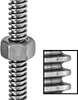
Found in hand-powered clamps, vises, grates, doors, and work tables, lead screws and nuts have broad, square threads that are well suited for quick assembly, high clamping forces, and lifting and lowering heavy objects.
Also known as single-start and self-locking lead screws and nuts, these have a single thread that runs the length of the screw. The nut travels only when the screw turns, so your system won't unexpectedly move when the lead screw is at rest.
Multiple thread channels (also known as thread starts) create faster linear travel than lead screws with a single thread start.
Thread these one-piece collars onto an Acme lead screw.
Mount these two-piece collars anywhere on an Acme lead screw without removing components.
Multiple thread channels (also known as thread starts) create faster linear travel than ball screws with a single thread start.
Also known as single-start ball screws and nuts, these have a single thread that runs the length of the screw. They operate with more torque than fast-travel ball screws and nuts.
Designed for use with right-hand, internally threaded rod ends, these rods have right-hand threads on both ends. Use them for remote valve operators, throttle controllers, shifting mechanisms, and virtually any push/pull assembly.
Designed for use with right-hand, externally threaded rod ends, these rods have right-hand threads on both ends. Use them for remote valve operators, throttle controllers, shifting mechanisms, and virtually any push/pull assembly.
Similar to turnbuckles, these rods have right-hand threads on one end and left-hand threads on the other so you can make a linkage that adjusts for tension. Add right- and left-hand threaded rod ends to build your linkages.
Similar to turnbuckles, these rods have right-hand threads on one end and left-hand threads on the other so you can make a linkage that adjusts for tension.
Made of stainless steel, these internally threaded rod ends provide excellent corrosion resistance.
Made of stainless steel, these externally threaded rod ends provide excellent corrosion resistance.
A carbon fiber-reinforced insert or PTFE liner reduces wear, handles shock loads, and eliminates the need for lubrication.
Made of cadmium-plated steel, these externally threaded rod ends generally handle higher loads than stainless steel, aluminum, and nylon rod ends.
Made of cadmium-plated steel, these internally threaded rod ends generally handle higher loads than stainless steel, aluminum, and nylon rod ends.
Along with internal threads, these rod ends have a double row of precision ball bearings that allows high speeds and smooth operation.
Decrease the ID of your rod end to allow approximately 60° of misalignment.
These rod end bolts are good for wet and corrosive environments—for maximum mounting flexibility, cut the fully threaded shaft to whatever length you need.
Pivot and hinge components in wet and corrosive environments with these stainless steel or brass rod end bolts.
Made of stainless steel, these rod end bolts are more corrosion resistant than steel rod end bolts.
Made of stainless steel, these rod end bolts are stronger and more corrosion resistant than our standard flat-shoulder rod end bolts.
A slippery PTFE liner reduces wear and eliminates the need for lubrication.
Stronger than plastic models, these stainless steel swivel joints are also more corrosion resistant than steel joints.
Made of zinc-plated steel or stainless steel, these clevis rod ends offer more corrosion resistance than standard steel clevis rod ends.
Made of stainless steel for excellent corrosion resistance, these nuts make pivoting and hinge movements where misalignment is not a concern.
Made of stainless steel, these ball joint linkages offer more corrosion resistance than steel and zinc ball joint linkages.
Made of stainless steel, these ball joint linkages offer more corrosion resistance than steel ball joint linkages.
Make welds quickly with these fast-melting rods.
Made of 85% pure nickel, these electrodes join cast iron to itself, and to mild steel and stainless steel.
Increase the wear resistance of your base metal, or restore a worn-down surface with these electrodes.
The flat tip creates a larger weld and can be used when appearance is less important.
The pointed tip is best for tight areas or for a small weld.
Use these cadmium-free alloys with most metals in general purpose applications.
No need to add flux—these alloys have it built in.
Use these alloys with most metals in general purpose applications.
These alloys create stronger bonds than standard brazing alloys.
These cadmium-free alloys create stronger bonds than standard brazing alloys.
When melted, these alloys form a thin liquid that easily flows into smaller gaps than standard gap-filling brazing alloys.
These alloys melt into thicker liquid than standard brazing alloys, which allows them to fill larger gaps.
Use these alloys for 300 series stainless steel.
One end of these shafts is machined to fit into the mixer; the other is machined to fit into an attachment like a propeller.
These shafts have one threaded end to fit threaded propellers and one machined end to fit mixer shaft couplings.
Designed for use with mixing blades, these shafts are left-hand threaded for counterclockwise motion.
Connect float valve bodies and floats with these rods.
Typically used with low-pressure stainless steel threaded pipe fittings.
Typically used with medium- to high-pressure stainless steel threaded pipe fittings.
Typically used with standard-wall and low-pressure stainless steel unthreaded pipe fittings.
Typically used with thin-wall stainless steel unthreaded pipe fittings.
Typically used with thick-wall and high-pressure stainless steel unthreaded pipe fittings.
Typically used with extreme-pressure stainless steel unthreaded pipe fittings.
Secure setup clamps and fixtures to your machine table, or assemble heavy machines, such as engine mounts.
Also known as tap-end and fixture studs, these rods have friction-fit threads on one end to resist loosening and standard threads on the other side for attaching a nut.
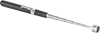
Pick up screws, nuts, and other small steel objects.
Often used to pick up steel sheets, the magnet holds material until you press the lever to disengage it.
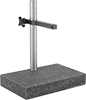
Mount one of these rods between the plunger and contact point to extend the reach of your indicator.
Keep coolant systems free of small particles, such as chip filings and metal dust.
Replace individual rods in an existing filter or create a custom filter.
The guide rods direct flow to the magnetic rods. They’re helpful in removing dry particles from fine powder and low-flow applications.
These filters are designed without guide rods to prevent wet and sticky material from blocking flow.
Easy to keep clean thanks to their design, these filters pull metal and magnetic particles out of food and sanitary material as it passes through gravity hoppers, chutes, and other parts of your process line.
Pull the rods from their sleeve to release particles stuck to the filter.
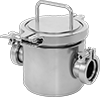
Draw metal shavings and other contaminants out of your sanitary liquid line with these strainers.
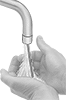
For tap water with the tap of your hand, thread these stainless steel rods onto your faucet spout. Water flows when the rod is pushed and stops when it's released.
Made from stainless steel for excellent corrosion resistance in damp environments.
Made of 316 stainless steel, this framing has excellent resistance to chemicals and salt water.