We will reply to your message within two hours.
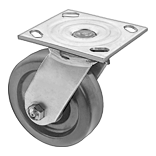
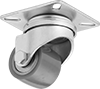
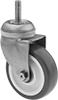
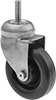
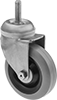
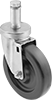
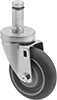
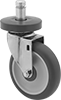
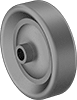
With a 304 stainless steel frame for good corrosion resistance, these casters are an economical alternative to washdown casters. Wheels range from soft rubber that absorbs shock and sound while providing good traction on rough surfaces, to hard, impact-resistant rubber that rolls easily on smooth surfaces.
Polyurethane wheels combine the abrasion resistance of plastic with the shock- and sound-absorbing qualities of rubber. They can be used on smooth or rough floors and in areas with debris. Their 304 stainless steel frame is corrosion resistant.
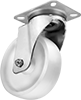
The lightweight wheels on these casters provide impact resistance on smooth surfaces. They are the most economical wheel option. Their 304 stainless steel frame is corrosion resistant.
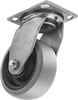
The most durable plastic wheel, the nylon wheels on these casters are impact and wear resistant. They work well on smooth surfaces. Their 304 stainless steel frame is corrosion resistant.
Our most corrosion-resistant casters have a 316 stainless steel frame and stainless steel wheel bearings that stand up to frequent washdowns. Their soft rubber wheels absorb shock and provide good traction on rough surfaces.
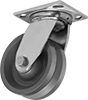
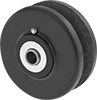
The wheels of these casters have a 90° V-groove and a flat tread to move your equipment on angle-iron track as well as the floor. Polyurethane wheels combine the abrasion resistance of plastic with the shock- and sound-absorbing qualities of rubber. Their 304 stainless steel frame is corrosion resistant.
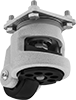
Stable and easy to turn, these casters have the lowest mount heights in their capacity range.
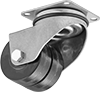
These casters have some of the lowest mount heights in their capacity range.
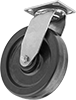
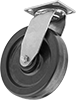
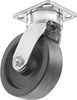
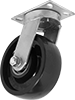
A stainless steel frame and rust-resistant bearings make these casters good options for food-service equipment that's frequently washed down. The phenolic wheels are nonmarking and roll best on smooth surfaces.
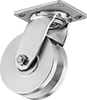
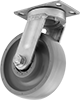
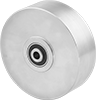
The wheels of these casters have a 90° V-groove and a flat tread to move your equipment on angle-iron track as well as the floor. The 303 stainless steel wheels are suitable for steam-cleaning applications.
A stainless steel frame and rust resistant bearings gives these casters good corrosion resistance. Their polyurethane wheels combine the abrasion resistance of plastic with the shock- and sound-absorbing qualities of rubber. Use them on smooth or rough floors and in areas with debris.
Able to withstand temperatures up to 350° F, these casters also have a 304 stainless steel frame for corrosion resistance. Their glass-filled nylon wheels are impact and wear resistant.
Precision steel ball bearings result in smoother rolling than other high-capacity corrosion-resistant casters. They have a stainless steel frame for good corrosion resistance. Their polyurethane wheels combine the abrasion resistance of plastic with the shock- and sound-absorbing qualities of rubber.
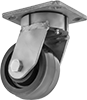
The wheels on these casters are made of a special rubber that is impact and chemical resistant and absorbs shock for smooth rolling over rough surfaces. They have a stainless steel frame and sealed bearings for corrosion resistance.
Polyurethane wheels combine the abrasion resistance of plastic with the shock- and sound-absorbing qualities of rubber. They have a stainless steel frame and sealed bearings for corrosion resistance.
Polyurethane wheels combine the abrasion resistance of plastic with the shock- and sound-absorbing qualities of rubber. Use them on smooth or rough floors and in areas with debris. Their 304 stainless steel frame is corrosion resistant.
The soft rubber wheels are quiet, shock absorbing, and provide good traction on rough surfaces. Their 304 stainless steel frame is corrosion resistant.
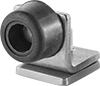
Designed for sanitary environments such as food plants, use these casters to move machinery, carts, furniture, and other equipment while compensating for uneven floors.
Also known as universal casters, press-fit these casters into standard 1" OD wire shelving posts.
Easily replace casters on InterMetro carts and shelving—friction holds them in place in the 1" OD posts.
Made of 303 stainless steel, these wheels are the best choice for washdown applications such as food-processing areas.
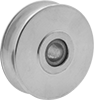
These wheels have a 90° V-groove and a flat tread to move your equipment on angle-iron track as well as the floor.
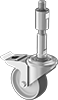
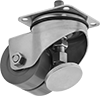
Use screws or bolts to attach the mounting plate on these casters to a flat surface. Adjust the leveling pad to keep your equipment stationary and compensate for uneven floors.
The dual-wheel design provides better load distribution and easier turning than leveling plate casters. Adjust the leveling pad to keep your equipment stationary and compensate for uneven floors.
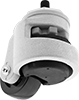
Install these casters into a threaded hole. Adjust the leveling pad to keep your equipment stationary and compensate for uneven floors.
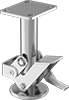
Floor locks bolt or weld to the underside of your equipment and have a spring-loaded base with a nonskid floor pad to keep equipment stationary.
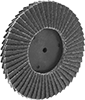
With more flaps than standard discs, these last 30-40% longer.
These discs have a harder abrasive than standard flap sanding discs.

The flaps have an abrasive to remove material and a lubricant that minimizes heat to reduce discoloration of the work surface.
The backing plate on these discs can be sheared away as the abrasive flaps wear down, allowing you to use more of the disc rather than replacing with a new one.
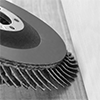
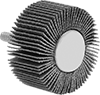
Set at an angle and widely spaced, the flaps reach into corners.
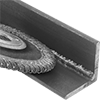
The flaps wrap around the outer edge of these discs to sand welds at right angles.
Used for stripping, these discs eliminate discoloration from heat buildup.
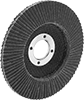
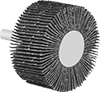
Fit these discs over your tool’s arbor to sand stainless steel and hard metals.
The premium abrasive stays sharp longer.
A coating prevents dust and debris from building up on the abrasive surface.

The premium abrasive stays sharp longer. Holes in the disc let you see the surface you’re sanding.
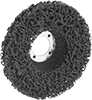
Used for heavy cleaning and stripping, these discs have an abrasive-embedded nylon mesh construction that gives you more control over sanding pressure.
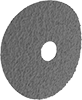
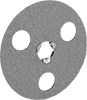
The cushioned construction gives you more control over sanding pressure, creating finer and more consistent finishes.
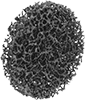
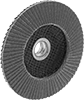
The threaded stud allows faster wheel changes but requires the use of an adapter in your tool.
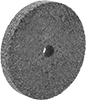
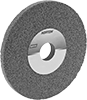
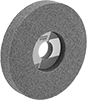
Use these wheels for light grinding, deburring, and sharpening.
Designed to stand up to heavy use, these wheels remove more material than our general purpose grinding wheels.
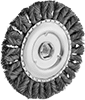
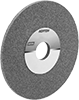
Use these wheels for precision grinding on surface, cylindrical, and tool and cutter grinders. They are also known as Type 1 wheels and straight wheels.
A more durable abrasive allows these wheels to remove more material and last longer than Norton General Purpose Grinding Wheels. They are also known as Type 1 wheels and straight wheels.
The porous bond leaves more space between abrasive grains so heavy amounts of chips and coolant easily flow through.
The special shapes of these wheels provide more clearance than typical straight wheels.
Use these wheels for heavy material removal in one spot or along a weld seam. They are also known as Type 1 wheels and snagging wheels.
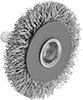
Wheels remove more material than other grinding wheels with cotton laminate.
A combination of cotton laminate and aluminum oxide abrasive creates a smoother surface than other grinding wheels with similar grits.
A blend of cotton laminate and aluminum oxide creates a smoother surface than other grinding wheels with similar grits. Wheels are also known as Type 27 wheels and raised-hub wheels.
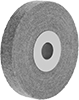
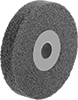
Multiple layers of nylon mesh embedded with abrasive provide a cushioned grind. Also known as unitized discs or wheels.
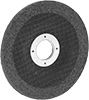
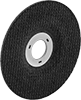
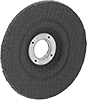
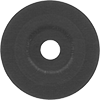
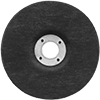
Wheels are a blend of aluminum oxide and zirconia alumina, which removes more material and lasts three times as long as our General Purpose Grinding Wheels. They are also known as Type 27 wheels, raised-hub wheels, and grinding discs.
A blend of ceramic alumina and zirconia alumina removes material at a 50% faster rate than our Long-Life Grinding Wheels. Wheels are also known as Type 27 wheels, raised-hub wheels, and grinding discs.
The absence of iron, sulfur, and chlorine in these wheels means they won’t corrode or discolor stainless steel. They are also known as INOX wheels, Type 27 wheels, raised-hub wheels, and grinding discs.
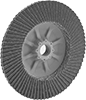
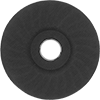
The flexible backing on these wheels conforms to curved and rough surfaces.
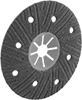
Heat-dissipating holes reduce material buildup and extend the life of the wheel. Wheels have a semiflexible backing that conforms to curved and rough surfaces.
The saucer shape lets you hold these wheels at shallower angles than Type 27 wheels, so they’re more comfortable to handle. They are also known as Type 28 wheels and raised-hub wheels.
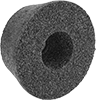
A large grinding surface, combined with a thick layer of rough abrasive removes more material than other wheels. They are also known as Type 11 wheels, flared-cup wheels, snagging wheels, and cup stones.
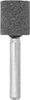
Made of aluminum oxide, these bits are well suited for use on most metals and materials that are not heat sensitive.
Similar to diamond, boron nitride is harder than aluminum oxide and lasts longer. Bits are also known as jig grinding pins and mandrels.
The small 3/32" diameter shank and small head makes these bits good for precise and intricate jobs.
Bits stay cool during grinding so they won’t mar or discolor stainless steel.
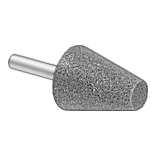
Longer lasting than grinding bits, these abrasive cones remove heavy amounts of material and leave a rough surface texture. They have a threaded insert that attaches to the spindle on a straight grinder. Use in corners and inside castings.
Attach cutoff wheels, grinding wheels, and other abrasive wheels to hand-held drills and die grinders.
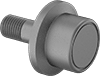
These rollers are rated to handle radial and thrust (top and side) loads simultaneously.
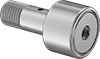
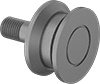
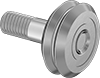
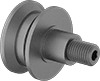
These threaded track rollers are made of materials that prevent corrosion in wet environments.
Made of 440C stainless steel, these shaft-mount track rollers resist corrosion in damp environments.
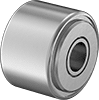
Support and guide loads on angle rails in food, pharmaceutical, and other sanitary environments. Also known as yoke-style cam followers, these track rollers offer more mounting flexibility than threaded alternatives and are typically mounted on shafts and clevis rod ends.
Also known as yoke-style cam followers, these rollers have more mounting flexibility than threaded track rollers. They're typically mounted onto a shaft or clevis rod end.
Thread the stud directly into a component or secure with a nut for through-hole mounting.
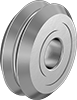
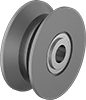
Guide loads along angle rail tracks in food and pharmaceutical plants or other sanitary environments.
Also known as eccentric track rollers, the shoulder adjusts up or down to align to your track, enabling uniform alignment among rollers in a system.
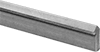
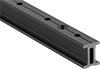
Use these rails with any track rollers that have a 90° V-groove.
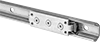
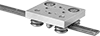
These track roller carriages and guide rails are stainless steel for use in wet, corrosive environments.
High-temperature PTFE-thickened grease enables these carriages to operate in temperatures up to 500° F, higher than any other carriage that we offer.
Made of stainless steel, these track rollers and guide rails are more corrosion resistant than steel rollers and rails.
Compared to plastic gears, metal gears are better for high-load, high-speed, and heavy duty applications.
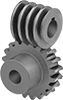
Worm gears use screw threads to reduce shaft speed by ratios of 10:1 and greater while transmitting motion at a right angle.
Often used with V-groove wheels or track roller carriages, these off-center bushings create precise mounting clearance.
Move belts forward and backward or stop and start them in precise positions, especially in areas where rust is a concern.
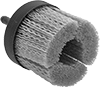
Use on delicate surfaces.
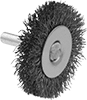
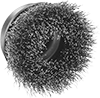
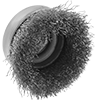
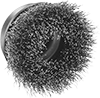
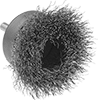
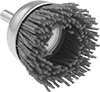
Remove light-to-medium rust and stains and small burs with these flexible-bristle brushes.
Made of phosphorus bronze that is Factory Mutual approved, these brushes inhibit sparking and are nonmagnetic and corrosion resistant.
The abrasive lasts longer than that of standard brushes.
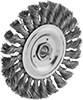
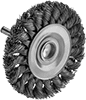
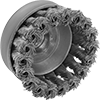
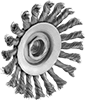
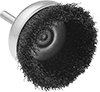
Rigid, twisted bristles handle tasks such as edge rounding and removing weld slag, heavy surface contamination, and large burs.
Bristles are partially twisted in alternating directions, which prevents them from separating.
The bristles are twisted all the way to the end so they’re more rigid and clean fastest.
Use on contours and angles or for reaching into cracks and corners.
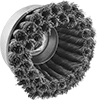
Rigid, partially twisted bristles handle tasks such as edge rounding and removing weld slag, heavy surface contamination, and large burs. Also known as knot-wire brushes.
A special fastener on the back of these brushes allows you to easily swap one brush for another.
The rigid, front-facing bristles are partially twisted for added cleaning power when removing debris from flat surfaces.
The bristles are partially twisted in alternating directions, which prevents them from separating.
Made of phosphorus bronze that is Factory Mutual approved, the bristles on these brushes inhibit sparking and are nonmagnetic and corrosion resistant.
Two rows of bristles cover more surface area.
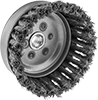
Clean around edges, corners, and contours with these dish-shaped brushes.
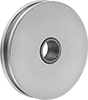
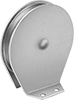
Also known as sheaves, use these pulleys to assist with horizontal pulling or to guide a rope.
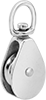
Hang these pulleys from hooks, screws, and bolts to assist with horizontal pulling or to guide a rope.
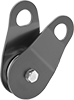
Also known as snatch blocks, these open so it’s easier to feed the rope through the housing—a free rope end is not needed.
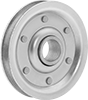
Use the bore to mount these pulleys on a shaft. These pulleys are also known as sheaves.
Mount these pulleys to a flat surface.
Run these high-density aluminum oxide wheels at higher speeds than standard cutoff wheels to make quick cuts in aluminum, iron, stainless steel, and steel.
Two layers of fiberglass mesh reinforcement give these wheels at least three times the life of standard cutoff wheels when cutting metal such as aluminum, iron, stainless steel, and steel.
These high-density ceramic oxide wheels have two layers of fiberglass mesh reinforcement and last up to twice as long as long-life cutoff wheels when cutting aluminum, iron, stainless steel, and steel.
For quick cuts in stainless steel, run these high-density zirconia alumina wheels at a higher rpm than standard cutoff wheels.
Also known as Type 27, raised-hub, and depressed-center cutoff wheels, these wheels outperform Type 1 wheels when making flush cuts in aluminum, iron, stainless steel, and steel.
Switch between cutting and deburring aluminum, iron, stainless steel, and steel without the need to change your wheel.
Made of premium grade abrasives, these wheels are strong and thick for making notches in aluminum, iron, stainless steel, and steel.
Also known as Type 27, raised-hub, and depressed-center cutoff wheels, these wheels outperform Type 1 wheels when making flush cuts.
Make fast, burr-free cuts in stainless steel with these ceramic and zirconia alumina wheels.
Prevent corrosion and discoloration on stainless steel—these wheels contain less than 0.1% iron, chloride, and sulfur contaminants.
Made of premium grade of abrasives, these wheels are strong and thick for making notches in stainless steel.
An extra-fine layer of fiberglass mesh reinforcement allows these wheels to make smoother cuts than standard bench-grinder cutoff wheels when cutting metal such as aluminum, iron, stainless steel, and steel.
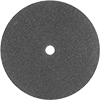
Use these wheels to cut through metal such as aluminum, iron, stainless steel, and steel.
A ceramic alumina abrasive cuts through stainless steel.
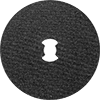
These wheels are designed to cut stainless steel. They are reinforced with a layer fiberglass mesh.
Two layers of fiberglass mesh reinforcement give these fast-cutting, zirconia alumina wheels at least three times the life of standard cutoff wheels when aluminum, iron, stainless steel, and steel.
These non-reinforced aluminum oxide wheels create the nearly polished finish required for testing metal.
Designed to cut sheet metal.
These wheels are thinner than standard bench-top cutoff saw wheels, so they cut through aluminum, iron, stainless steel, and steel more quickly.
Make fast, burr-free cuts in stainless steel with these premium aluminum oxide wheels.
Make cuts in most metal, including aluminum, iron, stainless steel, and steel.
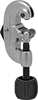
Made of materials that are FM approved, these cutters satisfy OSHA requirements that specify nonsparking tools for locations where flammable vapors and combustible residues are present.
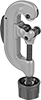
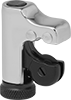
A small swing radius lets you cut tubing in tight spaces.
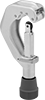
An enclosed ratchet feed opens quickly to accept tubing and instantly slides to cutting position.
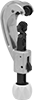
This cutter has two sets of guide wheels that ride in the corrugations for stability so you get clean, precise cuts.
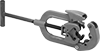
Cut pipe with just 90°-110° of handle swing and 4" of clearance.
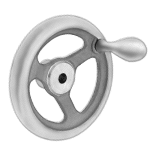
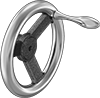
Create custom threads or drill a hole in the side of the hub to secure with a set screw. The spoked design allows a better grip around the rim than solid hand wheels to manually adjust valves, presses, and machine components.
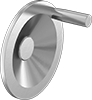
Mill specific holes or keyways in the hub to meet your specifications or weld in place. These hand wheels are solid, so they won't catch hands or material while manually adjusting valves, presses, and machine components.
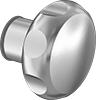
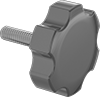
Long shafts can thread through these knobs for mounting versatility. The knobs provide a secure grip to position, tighten, and hold fixtures, equipment, and machinery.
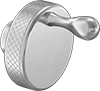
A handle makes these knobs easy to turn. Mill specific holes or keyways in the hub to meet your specifications, or weld in place. These knobs provide a secure grip to position, tighten, and hold fixtures, equipment, and machinery.
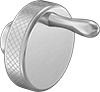
A handle makes these knobs easy to turn. Tap custom threads or secure with a set screw to provide a firm grip to position, tighten, and hold fixtures, equipment, and machinery.
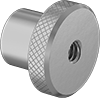
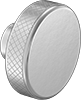
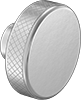
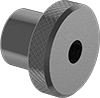
Tap custom threads or secure with a set screw to provide a firm grip to position, tighten, and hold fixtures, equipment, and machinery.
Mill specific holes or keyways in the hub to meet your specifications, or weld in place. These knobs provide a secure grip to position, tighten, and hold fixtures, equipment, and machinery.
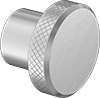
Suitable for food-processing areas, these one-piece knobs have no joints to collect dirt or debris. They provide a secure grip to position, tighten, and hold fixtures, equipment, and machinery. Mount them into a threaded hole.
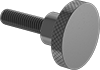
Mount these knobs into a threaded hole. They provide a secure grip to position, tighten, and hold fixtures, equipment, and machinery.
Knobs have left-hand threads; they're used in applications where counterclockwise motion can loosen common right-hand threads. Mount them into a threaded hole to position, tighten, and hold fixtures, equipment, and machinery.
Create custom threads or secure with a set screw to provide a firm grip to position, tighten, and hold fixtures, equipment, and machinery. Long shafts can pass through these knobs for mounting versatility.
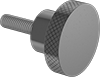
Install these knobs on a threaded stud. They provide a secure grip to position, tighten, and hold fixtures, equipment, and machinery.
Designed for sanitary environments, these knobs are commonly used in pharmaceutical and food-processing facilities. Install them on threaded studs to position, tighten, and hold equipment.
Replace damaged wheels or use multiple wheels to build a custom conveyor.
The corrosion-resistant stainless steel construction makes these pulleys suitable for washdown applications.
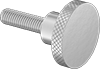
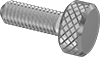
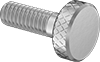
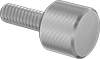
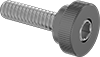
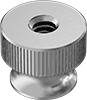
These metric thumb screws are made of chemical-resistant 18-8 stainless steel. They have a thin, knurled head for use in low-clearance applications.
Made from 18-8 stainless steel, these thumb screws are chemical resistant. They have a thin, knurled head for use in low-clearance applications.
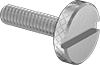
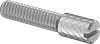
These slotted thumb screws have a thin, knurled head for use in low-clearance applications. Made of 18-8 stainless steel, they are chemical resistant.
Stainless steel thumb screws have excellent corrosion resistance in most environments.
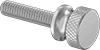
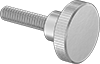
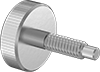
Made from 18-8 stainless steel, these thumb screws are chemical resistant. They have a raised head that makes them easy to grip.
These metric thumb screws are made of chemical-resistant 18-8 stainless steel. They have a raised head that makes them easy to grip.
Use these slim thumb screws in tight spaces.
These slotted thumb screws are slim to fit in tight spaces.
With a slim profile, these metric thumb screws fit in tight spaces.
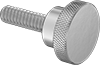
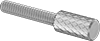
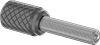
A knurled head allows for slip-resistant controlled adjustment.
These metric thumb screws have a knurled head for a slip-resistant controlled adjustment.
A large head allows you to grip these screws with your entire hand for greater torque while tightening than standard knurled plastic-head thumb screws.
These metric thumb screws have a large head that allows you to grip them with your entire hand for greater torque while tightening than standard knurled plastic-head thumb screws.
Tighten these thumb screws by hand or with a hex key for more torque.
Fine threads give you precise control.
Made from 18-8 stainless steel, these thumb screws are chemical resistant. Also known as dog- and pilot-point thumb screws, insert the point into a drilled hole or slot to hold items in place.
These metric thumb screws are made of chemical-resistant 18-8 stainless steel. Also known as dog- and pilot-point thumb screws, insert the point into a drilled hole or slot to hold items in place.
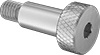
Install and remove these shoulder screws by hand or with a hex key.
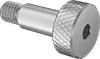
Install and remove these metric shoulder screws by hand or with a hex key.
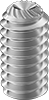
These metric 18-8 stainless steel set screws are chemical resistant. They have serrations on the cup edge that grip the material surface to resist loosening.
Made from 18-8 stainless steel, these set screws are chemical resistant. They have serrations on the cup edge that grip the material surface to resist loosening.
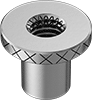
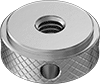
Made from 18-8 stainless steel, these metric thumb nuts have good chemical resistance and may be mildly magnetic.
These thumb nuts have good chemical resistance and may be mildly magnetic.
More corrosion resistant than 18-8 stainless steel thumb nuts, these have excellent resistance to chemicals and salt water.
These thumb nuts have good chemical resistance. The flange distributes pressure over a large area to reduce stress on your part.
Stainless steel thumb nuts have excellent corrosion resistance in most environments.
These metric thumb nuts have good chemical resistance. The flange distributes pressure over a large area to reduce stress on your part.
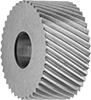
Pair these knurls with a knurling tool to create patterns on a workpiece for an improved grip.
Also known as axial-feed knurls, these have a convex face, which produces a cleaner pattern and lasts longer than standard knurls.
Install these knurls in a hand knurling tool to create grooved patterns on steel and stainless steel without using a lathe.
Knurl steel and stainless steel without a lathe.
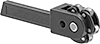
Attach these tools to a manual lathe.
Work faster by using two knurls at the same time.
These tools are specially designed to perform heavy duty knurling applications using a CNC lathe.
Create a knurled pattern on the end of a workpiece.
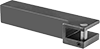
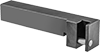
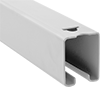
Combine track, mounting brackets, and hangers to create a system for hanging doors.
Built to withstand corrosive marine environments, track is anodized aluminum and hangers are 316 stainless steel.
Keep sliding doors and panels from damaging walls and door frames.