


Shape Shape |
|---|
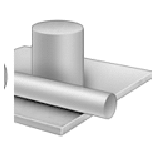
 | Sheet and Bar |
 | Triangular Bar |

Material Material |
|---|
|
For Joining For Joining |
|---|
|
|
DFARS (Defense Acquisition Regulations Supplement) DFARS (Defense AcquisitionRegulations Supplement)  |
|---|
REACH (Registration, Evaluation, Authorization and Restriction of Chemicals) REACH (Registration,Evaluation, Authorization and Restriction of Chemicals) |
|---|
|
RoHS (Restriction of Hazardous Substances) RoHS (Restriction ofHazardous Substances) |
|---|
|
Tin
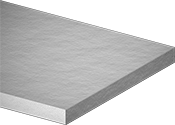
With 99.9% tin content, this material is considered commercially pure. It's commonly used to make gaskets and filters.
 For technical drawings and 3-D models, click on a part number.
6" × 6" | 12" × 12" | 12" × 24" | 24" × 24" | ||||||
|---|---|---|---|---|---|---|---|---|---|
| Thick. | Thick. Tolerance | Each | Each | Each | Each | ||||
| 1/32" | -0.007" to 0.007" | 00000000 | 000000 | 00000000 | 0000000 | 00000000 | 0000000 | 00000000 | 0000000 |
| 1/16" | -0.008" to 0.008" | 00000000 | 000000 | 00000000 | 000000 | 00000000 | 000000 | 00000000 | 00000000 |
| 1/8" | -0.012" to 0.012" | 00000000 | 000000 | 00000000 | 000000 | 00000000 | 00000000 | 00000000 | 00000000 |
Lead-Free Bar Solder for Electronics and Electrical Applications
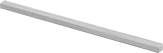
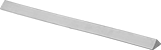
This solder is commonly used in solder melting pots. It is electrically conductive. Without a flux core, it allows you to choose the flux that works best for your application.
Material Composition | ||||||||||||
|---|---|---|---|---|---|---|---|---|---|---|---|---|
| Tin | Silver | Antimony | Copper | Lead | Melting Temperature, ° F | Shape | Lg. | Wd. | Ht. | Wt., lbs. | Each | |
For Joining Brass, Bronze, Copper | ||||||||||||
| 97% | 0.2% | 0.8% | 2% | 0% | 465° | Rectangular Bar | 14" | 1/2" | 1/2" | 1 | 00000000 | 000000 |
For Joining Brass, Bronze, Copper, Nickel Alloys, Stainless Steel, Steel | ||||||||||||
| 96% | 4% | __ | __ | 0% | 450° | Triangular Bar | 12" | 1" | 1/2" | 1 | 00000000 | 00000 |
| 96.5% | 3% | __ | 0.5% | 0% | 430° | Triangular Bar | 12" | 1" | 1/2" | 1 | 00000000 | 00000 |
| 97% | __ | __ | 3% | 0% | 365° | Triangular Bar | 12" | 1" | 1/2" | 1 | 00000000 | 00000 |
| 99.3% | __ | __ | 0.7% | 0% | 440° | Triangular Bar | 12" | 1" | 1/2" | 1 | 00000000 | 00000 |
Lead-Free Bar Solder for Food Service Equipment
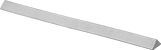
This solder is commonly used in solder melting pots. It's composed of pure tin, so it is safe for use with food service equipment.
Material Composition | ||||||||||
|---|---|---|---|---|---|---|---|---|---|---|
| Tin | Lead | Melting Temperature, °F | Solder Type | Lg. | Wd. | Ht. | Wt., lbs. | Specifications Met | Each | |
For Joining Brass, Bronze, Copper, Stainless Steel, Steel | ||||||||||
| 100% | 0% | 450° | Flux Required | 11 1/2" | 1" | 1/2" | 1 | NSF/ANSI 372 | 0000000 | 000000 |
Lead-Free Bar Solder for High-Temperature Applications
This solder is commonly used in solder melting pots. It keeps its strength in applications where vibration and frequent and extreme temperature changes occur, such as in water lines and refrigeration equipment. It does not have a flux core, so you can choose the flux that works best for your application.
Material Composition | |||||||||
|---|---|---|---|---|---|---|---|---|---|
| Tin | Antimony | Lead | Melting Temperature, ° F | Lg. | Wd. | Ht. | Wt., lbs. | Each | |
For Joining Brass, Bronze, Copper, Nickel Alloys, Stainless Steel, Steel | |||||||||
| 95% | 5% | 0% | 460° | 12" | 1" | 1/2" | 1 | 0000000 | 000000 |
Casting Metals
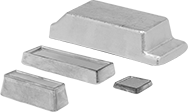
Melt and pour these alloys into molds to create metal parts and prototypes.
Tin-base babbitt is used to cast bearings for high-speed, high-wear applications and can withstand heavy, sustained loads. It has a higher melting temperature than lead-base babbitt.
Material Composition | Approximate | |||||||||
|---|---|---|---|---|---|---|---|---|---|---|
| Melting Temperature, °F | Tin | Antimony | Copper | Thick. | Wd. | Lg. | Wt., lbs. | Shape | Each | |
| 669° | 89% | 7% | 4% | 1 1/2" | 2" | 5 1/2" | 4 1/2 | Sheet and Bar | 0000000 | 0000000 |
Additives and Fillers for Paints, Coatings, and Lubricants

When mixed into coatings, resins, polymers, and metals, these fillers enhance strength, conductivity, lubricity, and other physical properties.
Container | |||||||||
|---|---|---|---|---|---|---|---|---|---|
| Material | Concentration | Net Weight | Type | Material | Form | Particle Size | CAS Number | Each | |
| Tin | 99.9% | 1 lbs. | Bottle | Plastic | Powder | 44 microns | 7440-31-5 | 0000000 | 0000000 |