

Filter by
Product Family

System of Measurement
Maximum Temperature


Performance
Backing Type

Texture

Breaking Strength
DFARS Specialty Metals
Minimum Temperature
Environment
Form

Component

Webbing Type
Kevlar Fabric
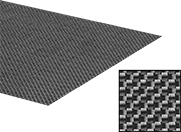 |
Plain Weave |
50" × 36" | ||||||||
|---|---|---|---|---|---|---|---|---|
Material | Color | Thk. | Fiber Tensile Stiffness, msi | For Use Outdoors | Each | |||
Plain Weave | ||||||||
| Kevlar Fabric | Yellow | 0.01" | 33 to 36 | No | 8468K45 | 000000 | ||
Aramid/Fiberglass Fabric
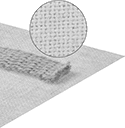 |
Wd. | Thk. | Fabric Wt., oz/yd² | Max. Temp., ° F | Color | Choose a Length, ft. | Per Ft. | ||
|---|---|---|---|---|---|---|---|---|
| 1/2" | 1/16" | 25 | 600 | Yellow | 100 | 8822K71 | 00000 | |
| 1" | 1/16" | 25 | 600 | Yellow | 50, 100 | 8822K72 | 0000 | |
| 2" | 1/16" | 25 | 600 | Yellow | 25, 50, 100 | 8822K73 | 0000 | |
| 2" | 1/8" | 50 | 600 | Yellow | 25, 50, 100 | 8822K74 | 0000 | |
| 3" | 1/16" | 25 | 600 | Yellow | 100 | 8822K75 | 0000 | |
| 3" | 1/8" | 50 | 600 | Yellow | 10, 25, 50, 100 | 8822K76 | 0000 | |
| 40" | 0.0570" | 17 | 600 | Yellow | 1, 2, 3, 6, 15, 30 | 8821K5 | 00000 | |
| 40" | 0.1100" | 30 | 600 | Yellow | 1, 2, 3, 6, 15, 30 | 8821K6 | 00000 | |
| 60" | 0.0300" | 8 | 600 | Yellow | 1, 2, 3, 6, 15, 30 | 8821K7 | 00000 |
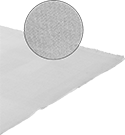
Cut-Resistant Kevlar Fabric Sheets
Cut-Resistant Kevlar Webbing
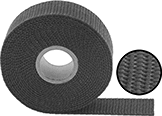 |
Tie down sheet metal, dies, and other items with sharp edges. Made from Kevlar, this webbing is strong, heat resistant, and difficult to cut—it’s tough enough to use in parachute harnesses. For neat ends that won’t unravel, cut this webbing with an ultrasonic knife. You can also use snips or a hot knife, but you’ll need to fold and sew the ends or add a finishing tip (sold separately) to prevent fraying.
Note: Breaking strength is the force at which new webbing will break. Choose webbing with a high enough breaking strength for the working load limit and safety factor required by your application.
Warning: Never use for lifting applications.
Standard Length
Wd. | Breaking Strength, lbf | Thk. | Max. Temp., ° F | Color | Flammability Rating | Choose a Length, ft. | Per Ft. | ||
|---|---|---|---|---|---|---|---|---|---|
| 3/4" | 3,000 | 1/16" | 500 | Black | NFPA 1970, NFPA 1977, NFPA 2112 | 5, 10, 25, 50, 100 | 8739T11 | 00000 | |
| 1" | 4,000 | 1/16" | 500 | Black | NFPA 1970, NFPA 1977, NFPA 2112 | 5, 10, 25, 50, 100 | 8739T12 | 0000 | |
| 1 1/2" | 5,500 | 1/16" | 500 | Black | NFPA 1970, NFPA 1977, NFPA 2112 | 5, 10, 25, 50, 100 | 8739T13 | 00000 | |
| 2" | 7,000 | 1/16" | 500 | Black | NFPA 1970, NFPA 1977, NFPA 2112 | 5, 10, 25, 50, 100 | 8739T937 | 00000 |
Short Length
Wd. | Lg., ft. | Breaking Strength, lbf | Thk. | Max. Temp., ° F | Color | Flammability Rating | Pkg. Qty. | Pkg. | ||
|---|---|---|---|---|---|---|---|---|---|---|
| 1" | 1 | 4,000 | 1/16" | 500 | Black | NFPA 1970, NFPA 1977, NFPA 2112 | 10 | 8739T121 | 000000 | |
| 1" | 2 | 4,000 | 1/16" | 500 | Black | NFPA 1970, NFPA 1977, NFPA 2112 | 5 | 8739T122 | 00000 | |
| 1" | 3 | 4,000 | 1/16" | 500 | Black | NFPA 1970, NFPA 1977, NFPA 2112 | 5 | 8739T123 | 00000 | |
| 1" | 4 | 4,000 | 1/16" | 500 | Black | NFPA 1970, NFPA 1977, NFPA 2112 | 2 | 8739T124 | 00000 |
 |
For Max. Webbing Wd. | Style | Pkg. Qty. | Pkg. | ||
|---|---|---|---|---|---|
| 1" | A | 5 | 9576T48 | 00000 |
Nomex Fabric Sheets

Stainless Steel Hook and Loop
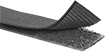 |
Woven from flexible stainless steel yarn, this hook and loop withstands temperatures up to 800° F. Weld, sew, or glue it to a surface. Strength will diminish with repeated use.
Flame-Resistant Nomex Webbing
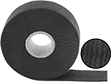 |
Often used to make tethers for firefighters, this Nomex webbing withstands direct flames and heat up to 500° F. It’s also used to secure workpieces during welding. For neat ends that won’t unravel, cut this webbing with an ultrasonic knife. You can also use snips or a hot knife, but you’ll need to fold and sew the ends or add a finishing tip (sold separately) to prevent fraying.
Note: Breaking strength is the force at which new webbing will break. Choose webbing with a high enough breaking strength for the working load limit and safety factor required by your application.
Warning: Never use for lifting applications.
Standard Length
Wd. | Breaking Strength, lbf | Thk. | Max. Temp., ° F | Color | Flammability Rating | Choose a Length, ft. | Per Ft. | ||
|---|---|---|---|---|---|---|---|---|---|
| 3/4" | 600 | 1/16" | 500 | Black | NFPA 1970, NFPA 1977, NFPA 2112 | 5, 10, 25, 50, 100 | 8737T91 | 00000 | |
| 1" | 850 | 1/16" | 500 | Black | NFPA 1970, NFPA 1977, NFPA 2112 | 5, 10, 25, 50, 100 | 8737T92 | 0000 | |
| 1 1/2" | 1,200 | 1/16" | 500 | Black | NFPA 1970, NFPA 1977, NFPA 2112 | 5, 10, 25, 50, 100 | 8737T61 | 0000 | |
| 2" | 1,700 | 1/16" | 500 | Black | NFPA 1970, NFPA 1977, NFPA 2112 | 5, 10, 25, 50, 100 | 8737T93 | 00000 |
Short Length
Wd. | Lg., ft. | Breaking Strength, lbf | Max. Temp., ° F | Thk. | Color | Flammability Rating | Pkg. Qty. | Pkg. | ||
|---|---|---|---|---|---|---|---|---|---|---|
| 1" | 1 | 850 | 500 | 1/16" | Black | NFPA 1970, NFPA 1977, NFPA 2112 | 10 | 8737T12 | 000000 | |
| 1" | 2 | 850 | 500 | 1/16" | Black | NFPA 1970, NFPA 1977, NFPA 2112 | 5 | 8737T13 | 00000 | |
| 1" | 3 | 850 | 500 | 1/16" | Black | NFPA 1970, NFPA 1977, NFPA 2112 | 5 | 8737T14 | 00000 | |
| 1" | 4 | 850 | 500 | 1/16" | Black | NFPA 1970, NFPA 1977, NFPA 2112 | 2 | 8737T15 | 00000 |
|
For Max. Webbing Wd. | Style | Pkg. Qty. | Pkg. | ||
|---|---|---|---|---|---|
| 1" | A | 5 | 9576T48 | 00000 |
