


Filter by
System of Measurement


Fastener Head Type

Material

Threading


Thread Size
Tip Type

Approximate Threads per Inch
Specifications Met

Anchor Type


Sold As
REACH
Export Control Classification Number (ECCN)
DFARS Specialty Metals
Thread Type

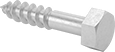
Steel Hex Head Wood Screws
 |
Lg. | Head Ht. | Approx. Threads per In. | Threading | Tapping Method | Specs. Met | Pkg. Qty. | Pkg. | |||
|---|---|---|---|---|---|---|---|---|---|---|
Black-Oxide Steel | ||||||||||
3/4" | ||||||||||
| 2 1/2" | 0.5" | 4 1/2 | Partially Threaded | Thread Forming | ASME B18.2.1 | 1 | 95452A163 | 000000 | ||
| 3" | 0.5" | 4 1/2 | Partially Threaded | Thread Forming | ASME B18.2.1 | 1 | 95452A164 | 0000 | ||
| 3 1/2" | 0.5" | 4 1/2 | Partially Threaded | Thread Forming | ASME B18.2.1 | 1 | 95452A165 | 00000 | ||
| 4" | 0.5" | 4 1/2 | Partially Threaded | Thread Forming | ASME B18.2.1 | 1 | 95452A166 | 00000 | ||
| 5" | 0.5" | 4 1/2 | Partially Threaded | Thread Forming | ASME B18.2.1 | 1 | 95452A168 | 00000 | ||
| 6" | 0.5" | 4 1/2 | Partially Threaded | Thread Forming | ASME B18.2.1 | 1 | 95452A169 | 00000 | ||
| 8" | 0.5" | 4 1/2 | Partially Threaded | Thread Forming | ASME B18.2.1 | 1 | 95452A170 | 00000 | ||
Zinc-Plated Steel | ||||||||||
3/4" | ||||||||||
| 3" | 0.5" | 4 1/2 | Partially Threaded | Thread Forming | ASME B18.2.1 | 5 | 91478A840 | 00000 | ||
| 4" | 0.5" | 4 1/2 | Partially Threaded | Thread Forming | ASME B18.2.1 | 5 | 91478A842 | 00000 | ||
| 5" | 0.5" | 4 1/2 | Partially Threaded | Thread Forming | ASME B18.2.1 | 5 | 91478A843 | 00000 | ||
| 6" | 0.5" | 4 1/2 | Partially Threaded | Thread Forming | ASME B18.2.1 | 1 | 91478A844 | 0000 | ||
Hot-Dipped Galvanized Steel | ||||||||||
3/4" | ||||||||||
| 4" | 0.5" | 4 1/2 | Partially Threaded | Thread Forming | ASME B18.2.1, ASTM A307, SAE J429 | 1 | 94048A404 | 0000 | ||
| 5" | 0.5" | 4 1/2 | Partially Threaded | Thread Forming | ASME B18.2.1, ASTM A307, SAE J429 | 1 | 94048A407 | 0000 | ||
| 6" | 0.5" | 4 1/2 | Partially Threaded | Thread Forming | ASME B18.2.1, ASTM A307, SAE J429 | 1 | 94048A410 | 0000 | ||
| 7" | 0.5" | 4 1/2 | Partially Threaded | Thread Forming | ASME B18.2.1, ASTM A307, SAE J429 | 1 | 94048A420 | 0000 | ||
| 8" | 0.5" | 4 1/2 | Partially Threaded | Thread Forming | ASME B18.2.1, ASTM A307, SAE J429 | 1 | 94048A430 | 00000 | ||
| 10" | 0.5" | 4 1/2 | Partially Threaded | Thread Forming | ASME B18.2.1, ASTM A307, SAE J429 | 1 | 94048A440 | 00000 | ||
| 12" | 0.5" | 4 1/2 | Partially Threaded | Thread Forming | ASME B18.2.1, ASTM A307, SAE J429 | 1 | 94048A450 | 00000 | ||
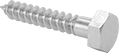
Stainless Steel Hex Head Wood Screws
 |
Lg. | Head Ht. | Approx. Threads per In. | Threading | Tapping Method | Specs. Met | Pkg. Qty. | Pkg. | |||
|---|---|---|---|---|---|---|---|---|---|---|
18-8 Stainless Steel | ||||||||||
3/4" | ||||||||||
| 3" | 0.5" | 4 1/2 | Partially Threaded | Thread Forming | ASME B18.2.1 | 1 | 92351A896 | 000000 | ||
| 4" | 0.5" | 4 1/2 | Partially Threaded | Thread Forming | ASME B18.2.1 | 1 | 92351A903 | 00000 | ||
| 5" | 0.5" | 4 1/2 | Partially Threaded | Thread Forming | ASME B18.2.1 | 1 | 92351A911 | 00000 | ||
| 6" | 0.5" | 4 1/2 | Partially Threaded | Thread Forming | ASME B18.2.1 | 1 | 92351A919 | 00000 | ||
| 7" | 0.5" | 4 1/2 | Partially Threaded | Thread Forming | ASME B18.2.1 | 1 | 92351A927 | 00000 | ||
| 8" | 0.5" | 4 1/2 | Partially Threaded | Thread Forming | ASME B18.2.1 | 1 | 92351A935 | 00000 | ||
| 10" | 0.5" | 4 1/2 | Partially Threaded | Thread Forming | ASME B18.2.1 | 1 | 92351A943 | 00000 | ||
| 12" | 0.5" | 4 1/2 | Partially Threaded | Thread Forming | ASME B18.2.1 | 1 | 92351A951 | 00000 | ||
316 Stainless Steel | ||||||||||
3/4" | ||||||||||
| 4" | 0.5" | 4 1/2 | Partially Threaded | Thread Forming | ASME B18.2.1 | 1 | 90123A634 | 00000 | ||
| 5" | 0.5" | 4 1/2 | Partially Threaded | Thread Forming | ASME B18.2.1 | 1 | 90123A642 | 00000 | ||
| 6" | 0.5" | 4 1/2 | Partially Threaded | Thread Forming | ASME B18.2.1 | 1 | 90123A650 | 00000 | ||
| 8" | 0.5" | 4 1/2 | Partially Threaded | Thread Forming | ASME B18.2.1 | 1 | 90123A665 | 00000 | ||
| 12" | 0.5" | 4 1/2 | Partially Threaded | Thread Forming | ASME B18.2.1 | 1 | 90123A681 | 00000 | ||
Anchors for Block and Brick
 |
Ultimate Strength, lbf | |||||||||||
|---|---|---|---|---|---|---|---|---|---|---|---|
Thread Size | Lg. | Drill Bit Size | Min. Installation Dp. | Material | Pull-Out | Shear | Conditions Tested In | Pkg. Qty. | Pkg. | ||
| 3/4"-10 | 3 15/16" | 1 1/4" | 3 1/2" | Zinc | 8,000 | 13,200 | 4,000 psi Concrete | 1 | 97031A046 | 00000 | |
Lag Anchors for Block and Brick
 |
Pair with large-diameter wood screws, often called lag screws, to secure heavy wood structures like beams and joists to block, brick, and concrete. As you tighten your screw, these anchors expand while their lobes grip the hole’s walls for a strong hold.
To install, tap the anchor into a drilled hole until it’s flush or slightly below the surface. Then, position your structure, insert a lag screw, and tighten. You can remove your lag screw to disassemble or adjust the structure. However, frequently removing the screw will weaken the strength. The anchor itself cannot be removed.
Ultimate Strength, lbf | |||||||||||
|---|---|---|---|---|---|---|---|---|---|---|---|
For Screw Size | Lg. | Drill Bit Size | Min. Installation Dp. | Material | Pull-Out | Shear | Conditions Tested In | Pkg. Qty. | Pkg. | ||
| 3/4" | 3 1/2" | 1" | 3 1/2" | Zinc | 2,800 | 2,400 | 4,000 psi Concrete | 4 | 97039A036 | 000000 | |
High-Strength Anchors for Block and Brick
 |
Ultimate Strength, lbf | |||||||||||
|---|---|---|---|---|---|---|---|---|---|---|---|
Thread Size | Lg. | Drill Bit Size | Min. Installation Dp. | Material | Pull-Out | Shear | Conditions Tested In | Pkg. Qty. | Pkg. | ||
| 3/4"-10 | 3 1/8" | 1 1/4" | 3 1/8" | Zinc | 9,600 | 15,200 | 3,000 psi Concrete | 1 | 92915A160 | 000000 | |
