


Filter by


Flexibility


REACH

DFARS Specialty Metals
Export Control Classification Number (ECCN)
RoHS
Foam Casting Compounds
 | 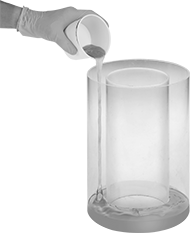 |
Compound expands to fill every hole and cavity. |
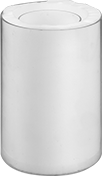
Create lightweight molds with these two-part compounds. They expand as foam after they’re poured to fill every cavity. The denser the foam, the less it will expand. Before casting, apply petroleum jelly (not included) to prevent sticking, stretching, and tearing. It won't cause the foam to collapse as it cures.
Flexible—Flexible compounds cure into soft, open-cell foam, which absorbs water, air, and gases. They are often used to cast gaskets, cushions, and other bendable objects.
Rigid—Rigid compounds form stiff, closed-cell foam, which prevents water and air from flowing through the part. Machinable, they’re dense enough to create prototype modeling blocks, so you can test setups without wearing down tools.
Foam Expansion | Density, lb/ft³ | Time to Harden, min. | Time to Cure, min. | Time to Demold, min. | Cure Temp., ° F | Max. Temp., ° F | Shrinkage | Color | Mixing Req. | Wt., lb. | Each | |||
|---|---|---|---|---|---|---|---|---|---|---|---|---|---|---|
Polyurethane Foam | ||||||||||||||
 White | ||||||||||||||
Flexible—Not Machinable | ||||||||||||||
| 4X | 12 | 3 | 25 | 25 | 80 | 125 | Not Rated | White | Yes | 3 | 8866N206 | 000000 | ||
| 4X | 12 | 3 | 25 | 25 | 80 | 125 | Not Rated | White | Yes | 12 | 8866N26 | 000000 | ||
| 8X | 8 | 3 | 25 | 25 | 80 | 125 | Not Rated | White | Yes | 3 | 8866N205 | 00000 | ||
| 8X | 8 | 3 | 25 | 25 | 80 | 125 | Not Rated | White | Yes | 12 | 8866N25 | 000000 | ||
| 15X | 4 | 3 | 25 | 25 | 80 | 125 | Not Rated | White | Yes | 3 | 8866N204 | 00000 | ||
| 15X | 4 | 3 | 25 | 25 | 80 | 125 | Not Rated | White | Yes | 12 | 8866N24 | 000000 | ||
 Beige | ||||||||||||||
Rigid—Machinable | ||||||||||||||
| 2X | 20 | 3 | 15 | 15 | 75 | 85 | Not Rated | Beige | Yes | 16 | 8866N23 | 000000 | ||
| 7X | 12 | 3 | 15 | 15 | 75 | 85 | Not Rated | Beige | Yes | 4 | 8866N202 | 00000 | ||
| 7X | 12 | 3 | 15 | 15 | 75 | 85 | Not Rated | Beige | Yes | 16 | 8866N22 | 000000 | ||
| 19X | 4 | 3 | 15 | 15 | 75 | 85 | Not Rated | Beige | Yes | 4 | 8866N201 | 00000 | ||
| 19X | 4 | 3 | 15 | 15 | 75 | 85 | Not Rated | Beige | Yes | 16 | 8866N21 | 000000 | ||
Impression Foam
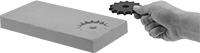 |
Stiff yet moldable, this foam takes the shape of any object that's pressed into it. In addition to making molds, it’s also used for packaging to keep uniquely shaped items in place. It comes in a package of two sheets.
Smooth Texture
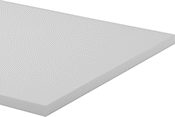 |
Closed Cell—Restrict water, air, and gases from being absorbed.
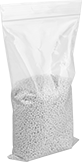
Foaming Agents for Plastic Molding Machines
 |
Activation Temp., ° F | Melting Temp., ° F | Min. Gas Evolution | Color | Container Type | Food Industry Std. | Each | |||
|---|---|---|---|---|---|---|---|---|---|
Microfine Cell | |||||||||
| 325 | 250 | 30 cm³/g | White | Cardboard Box | FDA Compliant 21 CFR 174.5 | 5469N13 | 0000000 | ||
| 325 | 250 | 65 cm³/g | White | Cardboard Box | FDA Compliant 21 CFR 174.5 | 5469N12 | 000000 | ||
| 400 | 350 | 30 cm³/g | Off-White | Cardboard Box | FDA Compliant 21 CFR 174.5 | 5469N14 | 000000 | ||
Fine Cell | |||||||||
| 310 | 310 | 95 cm³/g | White | Cardboard Box | FDA Compliant 21 CFR 174.5 | 5469N11 | 000000 | ||
