We will reply to your message within two hours.
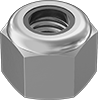
Includes inch thread sizes. These Grade 8 steel locknuts are 25% stronger than our medium-strength steel nylon-insert locknuts.
A nylon insert keeps metric bolt threads from coming loose due to vibration, wear, and temperature swings. About 25% stronger than medium-strength steel locknuts, these nuts are made of high-strength, Class 10 steel.
Closely spaced metric threads prevent loosening from vibration. These Class 10 steel locknuts are 25% stronger than our medium-strength steel nylon-insert locknuts.
Made from Grade 5 steel, these inch-sized locknuts are suitable for fastening most machinery and equipment.
Made from medium-strength steel with a nylon insert, these Class 8 metric locknuts are strong enough to use on most machinery and equipment that’s prone to vibration and temperature changes.
Get a grip on metric bolts exposed to vibration, wear, and changes in temperature. These metric locknuts have a nylon insert that holds onto bolts without damaging their threads.
Made from low-strength steel, these locknuts should be used for light duty fastening applications, such as securing.access panels.
Choose these locknuts for their adherence to strict military standards for material and construction. They’re low-strength steel, so they should be used for fastening panels and other light duty fastening applications.
These locknuts have good chemical resistance.
These metric locknuts have good chemical resistance.
Choose these locknuts for their adherence to strict military standards for material and construction.
More corrosion resistant than 18-8 stainless steel locknuts, these locknuts have excellent resistance to chemicals and salt water.
More corrosion resistant than 18-8 stainless steel locknuts, these metric locknuts have excellent resistance to chemicals and salt water.
One-third the weight of steel, aluminum locknuts resist corrosion in wet environments.
Brass locknuts are corrosion resistant in wet environments and electrically conductive.
Titanium locknuts have a high strength-to-weight ratio and are resistant to acids and salt water.
These locknuts are about half the height of standard nylon-insert locknuts. Use them in light duty low clearance applications or jam one against a hex nut to hold it in place.
With a shorter hex height than standard DIN 985 locknuts, these nylon-insert locknuts meet international ISO 10511 dimensional standards and are easy to install in tight spaces.
These Grade 8 locknuts are about 25% stronger than medium-strength steel thin locknuts.
Grade 5 locknuts are suitable for fastening most machinery and equipment when used in conjunction with a standard hex nut.
These locknuts have good chemical resistance and may be mildly magnetic.
More corrosion resistant than 18-8 stainless steel locknuts, these have excellent resistance to chemicals and salt water.
Comparable in strength to Grade 8 bolts, these locknuts are about three times stronger than low-strength steel extra-wide thin locknuts.
Use these locknuts for light duty fastening applications, such as securing access panels.
Known for their strength, these locknuts are zinc-plated to resist corrosion in wet environments.
Grade F nuts are comparable in strength to Grade 5 bolts.
Grade G nuts are comparable in strength to Grade 8 bolts.
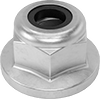
These nylon flange locknuts form threads as they're tightened to resist vibration.
Made from nylon 6/6, these nuts resist oil, grease, and solvents (except mineral acids).
These metric nuts resist oil, grease, and solvents (except mineral acids).
Glass-filled nylon nuts are stronger than nylon 6/6 nuts. They resist oil, grease, and solvents (except mineral acids).
Plastic nuts are chemical resistant, nonconductive, and lightweight.
These nylon 6/6 cap nuts are chemical resistant, nonconductive, and lightweight.
These metric nylon 6/6 cap nuts are chemical resistant, nonconductive, and lightweight.
A nylon insert on these metric nuts prevents vibration from loosening them, and a domed head protects the threads at the end of the bolt from damage and debris.
The nylon cap covers and grips the threads to resist loosening.
A nylon insert grips threads to resist loosening.
These nylon 6/6 wing nuts are chemical resistant, nonconductive, and lightweight.
Made from nylon 6/6, these metric wing nuts are chemical resistant, nonconductive, and lightweight.
These nylon thumb nuts are chemical resistant, nonconductive, and lightweight.
Plastic coupling nuts are chemical resistant, nonconductive, and lightweight.
These nylon nuts are chemical resistant, nonconductive, and lightweight.
These press-fit nuts have a nylon insert that grips threads to resist loosening.
Thread the male connection into a tapped hole and snap the other end into a panel for a secure hold that can be released for repairs and upgrades.
Stick these supports to surfaces where you don't want to drill a hole. The snap-in end can be released for repairs and upgrades.
Secure the self-tapping female connection with a screw; the other end snaps snugly into a panel, yet can be released for repairs and upgrades.
Designed for multi-level printed circuit board applications, these self-aligning, through-hole supports have a chamfered female end for stacking. The other end snaps and locks in place for a permanent connection.
Both ends snap and lock in place for a permanent connection.
Wings add tension to strengthen the hold in a hole. The other end is releasable for repairs and upgrades.
The flat top supports boards without drilling a hole while wings on the other end add tension for a secure hold in a hole.
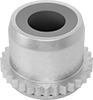
With a nylon insert that grips your threaded shaft or spindle without damaging its threads, these locknuts—also called shaft nuts—hold bearings, bushings, gears, and pulleys prone to vibration tightly in place.
Secure threaded plastic conduit fittings to a knockout in an outlet box or enclosure.
Slide these clips on DIN rails—often used in equipment cabinet racks—to route and organize cables. Since these clips don’t require adhesive or screws, you can move them anywhere along the rail.
To build a custom knob or thumb screw, pair one of these knobs with a hex or socket head screw. They provide a secure grip to position, tighten, and hold fixtures, equipment, and machinery.
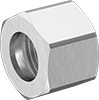
Use these nuts with plastic compression fittings to create a seal on plastic tubing. They have a built-in sleeve (ferrule), so the sleeve is positioned correctly for installation.
Use these nuts with plastic compression fittings to create a seal on plastic tubing. They're moisture-resistant acetal, so they won't absorb water and soften, even in high-humidity environments.
Use these nuts with high-temperature compression fittings for food and beverage to create a seal on plastic tubing.
Use these nuts and sleeves with compression fittings for food and beverage to create a seal on plastic tubing.
Made of corrosion-resistant plastic, these fittings won’t deteriorate when used in oil applications. They have high strength and impact resistance.
Press down on the clamp to connect wires and pull it up to disconnect.
Push stripped wires into connectors for a reliable connection that's faster to install than twisting or crimping.
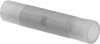
A plastic cover fully insulates these splices and is clear so you can visually confirm the connection.
Suitable for use in tight spaces, these connectors have a narrow profile that takes up less space than standard wire splicing connectors.
Grip the wings on these connectors to increase leverage when tightening.
A plastic cover fully insulates these splices.
Visually confirm your connection through the inspection window in the insulation of these splices.
Crimp the barrel twice on each end for an extra-tight grip in high-vibration applications. A plastic cover fully insulates these splices.
When heat is applied, adhesive-lined insulation shrinks and bonds to wires, creating a moisture- and corrosion-resistant seal.
These splices are filled with a sealant that creates a barrier to completely keep out moisture when splices are crimped.
Filled with grease, these splices resist moisture and corrosion.
Pierce the insulation of wire without stripping it to make quick connections that are also sealed to keep out water.
Connect wire without stripping—these splices pierce insulation.
When heat is applied, adhesive-lined insulation shrinks and bonds to the wires, creating a watertight seal.
Push stripped wire into each end of these splices to make a connection.
Insert wires and twist on the threaded end caps. The caps lock wires into place, making these splices a good choice for high-vibration applications.
Sealed threads make these splices weather resistant.
Join wires and cables in some of the dirtiest and wettest locations—from paper mills to marine environments—without special tools.
Taps connect to wires with male quick-disconnect terminals.
Filled with gel, these wire taps seal out moisture.
Tap a main wire or add a finished terminal to the end of a wire.
Use a single splice to connect more than two wires.
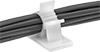
Mount to a surface to secure and route cable.
Add push-in cable holder to this adapter to mount cable to DIN rail.
Keep individual wires separate by laying them between the coils on these holders.
These mounts create space between a bundle and surface.
Bend cable around these holders and let tension keep the bundle in place. They are often used on wire harness boards.
Compared to metal loop clamps, plastic loop clamps reduce wear on soft materials, such as tubing and cable. Clamps are nonconductive and noncorrosive.