


Filter by
For Flange Hole Diameter
Aligner Connection Method
Export Control Classification Number (ECCN)

DFARS Specialty Metals
RoHS
Level Orientation
Pipe Flange Aligner Pins with Horizontal Level
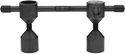
Pipe Flange Aligner Pins
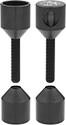 |
Insert a pair of these nut-and-bolt pins into adjacent flange holes and tighten to align flanges before connecting two pipes. One pin in each pair has a level for vertical alignment. Use a separate level to align the flange horizontally. Also known as two-hole pins.
4 1/2" Lg. Extension—Pins with a 4 ½” length extension let you increase the length of your pins to align thicker flanges.
Two Couplings—Use the included couplings to connect the extension to your pins.


Pipe Flange Aligners with Protractor
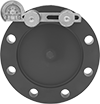 |
For Flange Hole Dia. | Angle Measured Range | Graduations (Angle Increments) | For Distance Between Bolt Holes | Each | |||
|---|---|---|---|---|---|---|---|
Aluminum | |||||||
| 3/16" to 1 3/4" | 0° to 90° | 2.5° (2°) | 2" to 5 1/2" | 2342A11 | 0000000 | ||
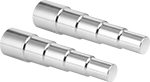
Stepped Pipe Flange Aligner Pins
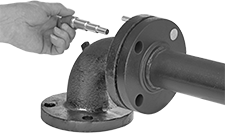
Magnetic Pipe Flange Aligners with Level
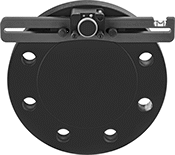 |  |
Ensure an even seal around your flange—these tools align and level flanges in a single step. The strong magnets make sure your bolt holes are perfectly inline horizontally and that your flange isn’t tilted. If your flange is made of stainless steel or another nonmagnetic material, secure these aligners using the included threaded cones.
For Flange Hole Dia. | For Max. Flange Hole Ctr.-to-Ctr. Distance | Level Lg. | Aligner Connection Method | Includes | Cone Material | Magnet Material | Container Type | Each | |||
|---|---|---|---|---|---|---|---|---|---|---|---|
Aluminum Body | |||||||||||
| 1/2" to 2" | 9 1/2" | 10 1/2" | Magnetic | Threaded Cones | Steel | Neodymium | Carrying Case | 7049N11 | 0000000 | ||
Magnetic Pipe Flange Aligner Pins
 |
Swiftly and accurately align pipe flange bolt holes without the hassle of threads. These pins have strong magnets that snap together. Insert them into adjacent bolt holes to help make sure flanges are parallel before connecting pipes. Also known as two-hole pins.
For 2 3/4" Flange Thickness—Pins for 2 3/4" thick flanges can be used with pipe flange aligner extensions (sold separately) to lengthen their reach for flanges up to 3 1/2″ thick.
Pipe Flange Aligners | Pipe Flange Aligner Extensions | |||||||||
|---|---|---|---|---|---|---|---|---|---|---|
For Flange | ||||||||||
Hole Dia. | Thk. | Aligner Connection Method | Magnet Material | Pair | Lg. | Each | ||||
Steel | ||||||||||
| 5/16" to 7/8" | 7/8" | Magnetic | Neodymium | 7065N11 | 000000 | — | ——— | 0 | ||
| 1/2" to 1 7/16" | 1 3/8" | Magnetic | Neodymium | 7065N12 | 000000 | — | ——— | 0 | ||
| 3/4" to 1 15/16" | 2 3/4" | Magnetic | Neodymium | 7065N13 | 000000 | 1 3/4" | 7065N14 | 000000 | ||
