


Autotuning Temperature Controller
with Analog Signal Heating Output, 1/4 DIN, 3 Outputs
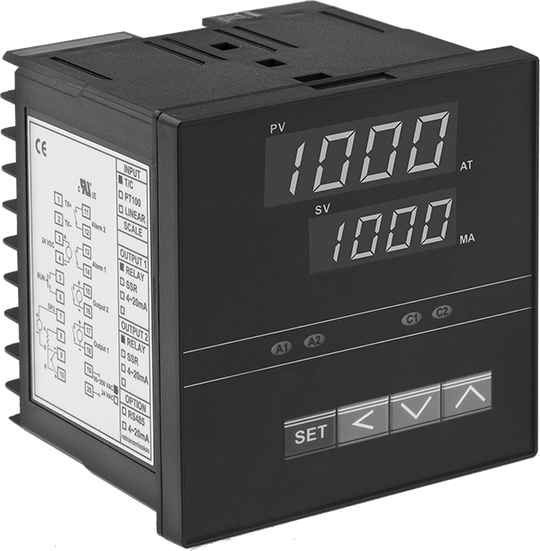
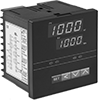
Controller Output Type | Analog Signal |
For DIN Panel Cutout Size | 1/4 |
For Panel Cutout | |
Height | 3 5/8" |
Width | 3 5/8" |
For Thermocouple Type | B, E, J, K, N, R, S, T |
Total Number of Outputs | 3 |
Output Type | Heating/Cooling—1 4 mA to 20 mA Analog Signal |
Mechanical Relay | |
Switch Designation | SPST-NO |
Maximum Switching Current @ Voltage | 5 amp @ 110V AC |
For Probe Type | Thermocouple, RTD |
Reset Type | Automatic |
Input Voltage Range | 90V AC to 264V AC |
Height | 3 3/4" |
Width | 3 3/4" |
Depth | 3 1/2" |
Actuation Point Adjustability | Adjustable |
Adjustment Method | Keypad |
Certification | C-UL Recognized Component, CE Marked, UL Recognized Component |
Control Type | Proportional-Integral-Derivative |
Digit Height | 7/16", 9/16" |
Display Type | LED |
Electrical Connection Type | Hardwire |
Electrical Phase | Single |
For RTD Probe Resistance | 100 ohm |
Frequency | 60 Hz |
Housing Material | Plastic |
Measurement Unit | Celsius, Fahrenheit |
Mounting Location | Panel |
Number of Actuation Points | 1 |
Output Voltage - 3 | 110V AC |
RTD Probe Connection | Wire Leads |
Switch Starting Position - 3 | 1 Off |
Temperature Accuracy | |
RTD Probe | ±0.36° F |
Type J Probe | ±2° F |
Type K Probe | ±2° F |
Type T Probe | ±1.8° F |
Temperature Range | |
RTD Probe | -325° F to 1,650° F |
Type J Probe | -55° F to 1,830° F |
Type K Probe | -55° F to 2,495° F |
Type T Probe | -450° F to 750° F |
Maximum Operating Temperature | 122° F |
Temperature Resolution | 0.001° F |
Thermocouple Probe Connection | Wire Leads |
Wire Connection | Screw Terminal |
Country of Origin | Taiwan |
DFARS Compliance | Specialty Metals COTS-Exempt |
Export Control Classification Number (ECCN) | EAR99 |
REACH Compliance | REACH (EC 1907/2006) (01/21/2025, 247 SVHC) Compliant |
RoHS Compliance | RoHS 3 (2015/863/EU) Compliant |
Schedule B Number | 853710.9060 |
U.S.–Mexico–Canada Agreement (USMCA) Qualifying | No |
Additional Specifications |
Ideal in systems with rapid, unpredictable, or complex temperature changes, these controllers turn heating equipment on and off using a proportional-integral-derivative (PID) control algorithm to make fine adjustments, giving you the most precise and stable temperature control. They work similarly to proportional controllers but gather more variables to calculate the most effective way to return to the target temperature and avoid overshooting. They also have fuzzy logic to learn your system's behavior and compensate as needed. Use the autotuning function to have the controller cycle and identify the ideal PID variables for your system. You can also manually select the PID variables. These controllers read temperature with a highly sensitive thermocouple or RTD probe (both not included) in critical process applications. Since they reset automatically, they switch off and on again as the temperature fluctuates. All fit into instrument panels with DIN cutouts. Use the keypad to adjust the actuation point, reset point, other settings.
All meet American, Canadian, and European safety standards.
For the Manufacturer User Manual, click on a part number and select Product Detail.
Analog Signal Output—Analog signal outputs are typically used with SRC (silicon controlled rectifier) power controllers (not included) for some of the highest precision control.
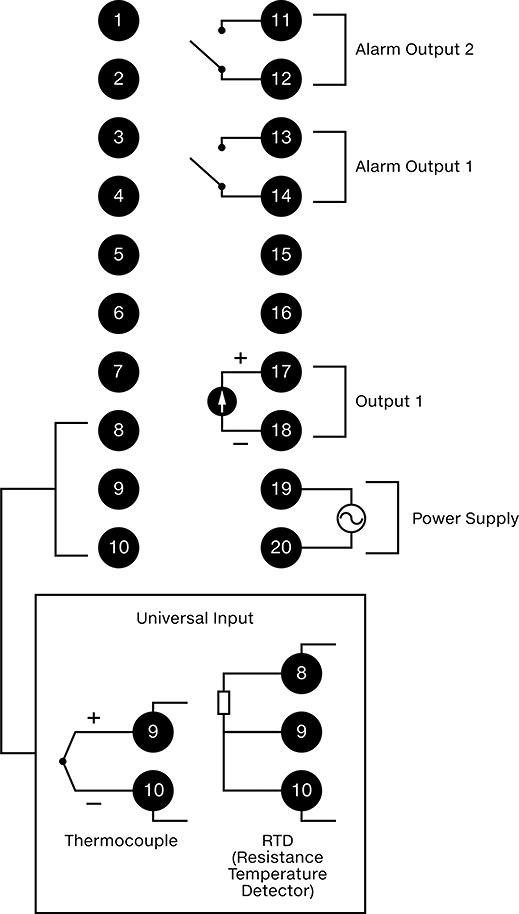
For Alarming—Alarm outputs can also be configured to actuate simple devices.