


Filter by
Diameter

Ball Material
Housing Material
Mount Type


Weight Capacity
Tolerance Rating
Maximum Temperature
Shape

Hardness Rating
Hardness


REACH

U.S.–Mexico–Canada Agreement (USMCA) Qualifying
Minimum Temperature
DFARS Specialty Metals
RoHS
Stud-Mount Ball Transfers
 |
Style L |
Install these ball transfers in a threaded hole or use a nut to secure.
Weight capacity is given for the ball up orientation. Using these ball transfers in a ball down or angled orientation could reduce the weight capacity stated.
Stainless Steel Ball—Stainless steel balls offer the most corrosion resistance.
Angled Working Orientation—Ball transfers with an angled working orientation can be used to form support stands.
Style | Ball Dia. | Wt. Cap., lb. | Ht. | Dia. | Working Orientation | Thread Size | Stud Lg. | Each | |||
|---|---|---|---|---|---|---|---|---|---|---|---|
Stainless Steel Ball | |||||||||||
Aluminum Housing | |||||||||||
| L | 5/16" | 55 | 1/2" | 19/32" | Ball Up, Ball Down, Angled | M4 | 5/16" | 2440T33 | 0000000 | ||
Clean Room Stud-Mount Ball Transfers
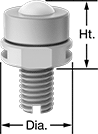 |
Unlike most ball transfers, which have metal balls, these have a plastic outer ball that rolls on stainless steel inner balls, so there's no metal-on-metal contact that could create and release particles into your clean room. They've also been ultrasonically cleaned and then individually bagged to prevent dust contamination. These ball transfers were originally developed for the electronics manufacturing industry, where aligning glass layers in monitors and screens must be done without introducing dust. Use them to create conveyors, transfer tables, and material staging areas in your clean room.
PEEK Ball—PEEK ball transfers withstand more wear and are more chemical resistant than acetal ball transfers, so they handle more demanding applications.
Vespel® Polyimide Ball—Vespel® polyimide ball transfers are nonconductive, which means they prevent stray electrical charges from passing between your material and equipment. They're best for moving glass and other material with a polished surface because they're smoother than acetal and PEEK ball transfers and won't scratch surfaces.
Temp., ° F | ||||||||||||||
|---|---|---|---|---|---|---|---|---|---|---|---|---|---|---|
Ball Dia. | Wt. Cap., lb. | Ht. | Dia. | Working Orientation | Housing Color | Thread Size | Stud Lg. | Min. | Max. | Clean Room Std. | Each | |||
PEEK Ball | ||||||||||||||
PEEK/Stainless Steel Housing | ||||||||||||||
| 3/8" | 2 1/2 | 9/16" | 19/32" | Ball Up | Beige | M8 × 1.25 mm | 15/32" | 0 | 260 | Fed. Std. Class 1,000 | 3348N12 | 000000 | ||
Vespel® Polyimide Ball | ||||||||||||||
Vespel® Polyimide/Stainless Steel Housing | ||||||||||||||
| 3/8" | 1 | 9/16" | 19/32" | Ball Up | Brown | M8 × 1.25 mm | 15/32" | 0 | 200 | Fed. Std. Class 1,000 | 3348N13 | 000000 | ||
Steel Balls
 |
Wear-Resistant 52100 Alloy Steel—High carbon and chromium content makes this 52100 alloy steel extremely hard and resistant to wear. It’s also known as chrome steel. Often used as bearings, these balls are hardened for increased abrasion and impact resistance.
%20--%3e%3cg%3e%3cg%20id='Layer_1'%3e%3cpath%20class='cls-1'%20d='M68,27.2c-14.6,0-26.4,11.7-26.4,26.3,0,7,2.8,13.7,7.7,18.7v44.8l18.8-16.1,18.7,16.1v-44.9c10.3-10.3,10.3-27,0-37.3-5-4.9-11.7-7.7-18.7-7.7h0ZM81.3,105l-13.2-11.4-13.2,11.4v-28.7c8.2,4.8,18.3,4.8,26.5,0v28.7ZM76.2,70.8c-5.2,2.5-11.2,2.5-16.4,0-9.5-4.5-13.5-15.9-9-25.4,4.5-9.5,15.9-13.5,25.4-9,9.5,4.5,13.5,15.9,9,25.4-1.9,4-5.1,7.1-9,9Z'/%3e%3cpath%20class='cls-2'%20d='M5.8,95.5c-1.2,0-2.1-1-2.1-2.1,0,0,0,0,0,0V29.4h20.9c2.1,0,3.8-1.7,3.8-3.8V3.7c.2,0,.4,0,.5,0h37.5c1.2,0,2.1,1,2.1,2.1v18.6c1.2,0,2.5.1,3.7.3V5.8C72.2,2.6,69.6,0,66.4,0H28.9c-1.5,0-3,.6-4.1,1.7h-.1c0,.1-23,23.2-23,23.2-1.1,1.1-1.7,2.6-1.7,4.1v64.3c0,3.2,2.6,5.8,5.8,5.8h41.7v-3.7H5.8ZM24.7,7.1v18.7H6L24.7,7.1Z'/%3e%3c/g%3e%3c/g%3e%3c/svg%3e)
Certificates with a traceable lot number are available for these products. Download certificates from ORDER HISTORY after your order ships.
Dia. | Dia. Tolerance | Heat Treatment | Yield Strength, psi | Hardness | Appearance | Pkg. Qty. | Pkg. | |||
|---|---|---|---|---|---|---|---|---|---|---|
Wear-Resistant 52100 Alloy Steel | ||||||||||
| 19/32" | -0.0001" to 0.0001" | Hardened | 295,000 | Rockwell C60 (Extra Hard) | Mirror Like | 25 | 9528K36 | 000000 | ||
